

Original research article

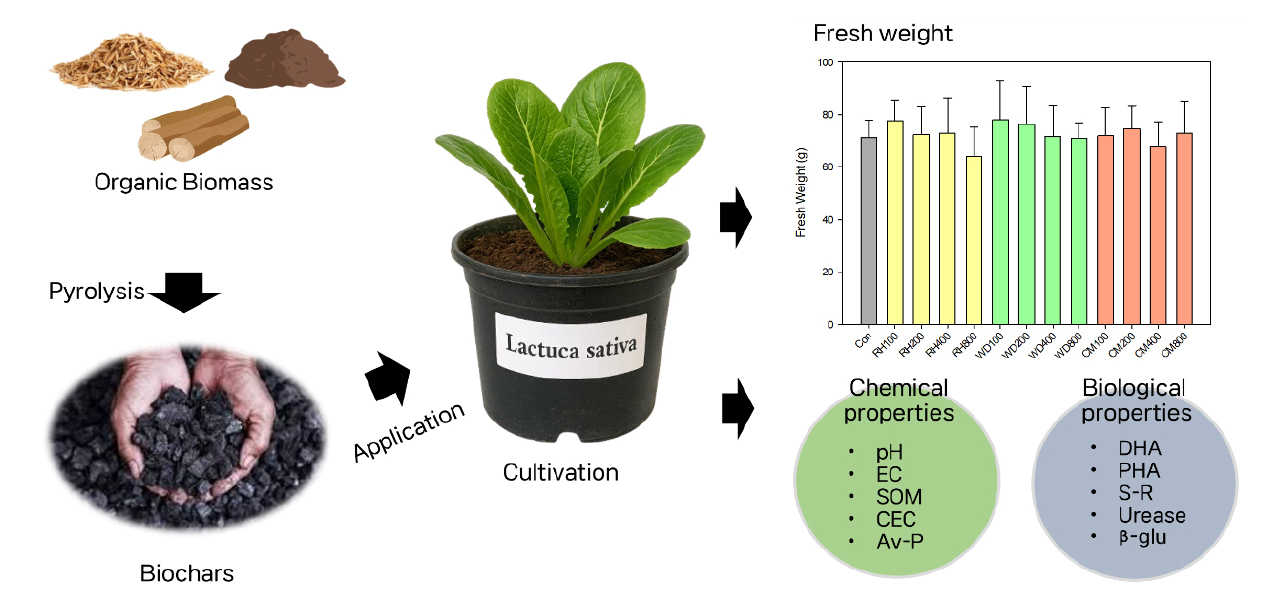
This study evaluated the effects of biochars derived from different feedstocks on soil properties and the growth of lettuce (Lactuca sativa). Biochars produced from rice husk (RH), wood chips (WD), and cow manure (CM) were applied to soil at rates of 100, 200, 400, and 800 kg 10 a-1. Across the biochar treatments, soil organic matter and cation exchange capacity generally increased compared with the control. In particular, the CM biochar produced the most pronounced increases in available phosphorus and pH, but it also elevated electrical conductivity (EC), indicating a potential risk of growth inhibition at higher application rates. In contrast, the RH biochar tended to slightly reduce EC as the application rate increased. The WD biochar showed the greatest growth response at the lowest application rate (100 kg 10 a-1), where the mean fresh weight of lettuce reached 80.4 g per plant. Regarding soil biological activity, soil respiration and urease activity increased under WD and CM treatments, whereas dehydrogenase and phosphatase activities generally decreased. These patterns may reflect nutrient imbalances or mild physiological stress in the soil environment. Overall, biochar application improved soil chemical and biological properties and promoted lettuce growth, but the effects differed depending on biochar feedstock and application rate. Therefore, appropriate soil management that considers biochar characteristics and application rates is required to improve soil quality and promote crop growth.
Adhikari S, Moon E, Paz-Ferreiro J, Timms W. 2024. Comparative analysis of biochar carbon stability methods and implications for carbon credits. Sci. Total Environ. 914:169607. https://doi.org/10.1016/j.scitotenv.2023.169607
10.1016/j.scitotenv.2023.169607Baek NR, Husna IP, Park SW, Shin ES, Lee SI, Choi WJ. 2024. Too much biochar is not better than nothing. Korean J. Soil Sci. Fert. 57:2 38-244. https://doi.org/10.7745/KJSSF.2024.57.3.238
10.7745/KJSSF.2024.57.3.238Baiamonte G, Crescimanno G, Parrino F, De Pasquale C. 2019. Effect of biochar on the physical and structural properties of a sandy soil. Catena. 175:294-303. https://doi.org/10.1016/j.catena.2018.12.019
10.1016/j.catena.2018.12.019Bakshi S, Banik C, Laird, DA. 2020. Estimating the organic oxygen content of biochar. Sci Rep. 10:13082. https://doi.org/10.1038/s41598-020-69798-y
10.1038/s41598-020-69798-y32753602PMC7403298Barnett G. 1994. Phosphorus forms in animal manure. Bioresour. Technol. 49:139-147. https://doi.org/10.1016/0960-8524(94)90077-9
10.1016/0960-8524(94)90077-9Batista EM, Shultz J, Matos TT, Fornari MR, Ferreira TM, Szpoganicz B, de Freitas RA, Mangrich AS. 2018. Effect of surface and porosity of biochar on water holding capacity aiming indirectly at preservation of the Amazon biome. Sci. Rep. 8:10677. https://doi.org/10.1038/s41598-018-28794-z
10.1038/s41598-018-28794-z30013110PMC6048162Bekchanova M, Kuppens T, Cuypers A, Jozefczak M, Malina R, 2024. Biochar’s effect on the soil carbon cycle: a rapid review and meta-analysis. Biochar. 6:88. https://doi.org/10.1007/s42773-024-00381-8
10.1007/s42773-024-00381-8Bevacqua E, Schleussner C-F, Zscheischler J. 2025. A year above 1.5°C signals that Earth is most probably within the 20-year period that will reach the Paris Agreement limit. Nat. Clim. Change 1-4. https://doi.org/10.5194/egusphere-egu25-2849
10.5194/egusphere-egu25-2849Bilgili, Mehmet, Tumse S, Nar S. 2024. Comprehensive overview on the present state and evolution of global warming, climate change, greenhouse gasses and renewable energy. Arab. J. Sci. Eng. 49:14503-14531. https://doi.org/10.1007/s13369-024-09390-y
10.1007/s13369-024-09390-yCabugao KG, Yaffar D, Stenson N, Childs J, Phillips J, Mayes MA, Yang X, Weston DJ, Norby RJ. 2021. Bringing function to structure: root-soil interactions shaping phosphatase activity throughout a soil profile in Puerto Rico. Ecol. Evol. 11:1150-1164. https://doi.org/10.1002/ece3.7036
10.1002/ece3.703633598120PMC7863403Casida L. 1977. Microbial metabolic activity in soil as measured by dehydrogenase determinations. Appl. Environ. Microbiol. 34:630-636. https://doi.org/10.1128/aem.34.6.630-636.1977
10.1128/aem.34.6.630-636.1977339829PMC242722Chen J, Yu J, Li Z, Zhou J, Zhan L. 2023. Ameliorating effects of biochar, sheep manure and chicken manure on acidified purple soil. Agronomy. 13:1142. https://doi.org/10.3390/agronomy13041142
10.3390/agronomy13041142Ding Y, Liu Y, Liu S, Li Z, Tan X, Huang X, Zeng G, Zhou L, Zheng B. 2016. Biochar to improve soil fertility. A review. Agron. Sustain. Dev. 36:36. https://doi.org/10.1007/s13593-016-0372-z
10.1007/s13593-016-0372-zDvořáčková H, Dvořáček J, Záhora J, Šimečková J. 2022. Biochar alone did not increase microbial activity in soils from a temperate climate that had long-term acidity stress. Agriculture 12:941.
10.3390/agriculture12070941Eivazi F, Tabatabai M. 1988. Glucosidases and galactosidases in soils. Soil Biol. Biochem. 20:601-606. https://doi.org/10.1016/0038-0717(88)90141-1
10.1016/0038-0717(88)90141-1Erans M, Sanz-Pérez ES, Hanak DP, Clulow Z, Reiner DM, Mutch GA. 2022. Direct air capture: process technology, techno-economic and socio-political challenges. Energy Environ. Sci. 15:1360-1405. https://doi.org/10.1039/D1EE03523A
10.1039/D1EE03523AFidel RB, Laird DA, Thompson ML, Lawrinenko M. 2017. Characterization and quantification of biochar alkalinity. Chemosphere. 167:367-373. https://doi.org/10.1016/j.chemosphere.2016.09.151
10.1016/j.chemosphere.2016.09.151Gao S, DeLuca TH, Cleveland CC. 2019. Biochar additions alter phosphorus and nitrogen availability in agricultural ecosystems: A meta-analysis. Sci. Total Environ. 654:463-472. https://doi.org/10.1016/j.scitotenv.2018.11.124
10.1016/j.scitotenv.2018.11.124Gatiboni LC, Kaminski J, Rheinheimer DdS, Brunetto G. 2008. Fósforo da biomassa microbiana e atividade de fosfatases ácidas durante a diminuição do fósforo disponível no solo. Pesqui. Agropecu. Bras. 43:1085-1091. https://doi.org/10.1590/S0100-204X2008000800019
10.1590/S0100-204X2008000800019Glaser B, Lehr V, 2019. Biochar effects on phosphorus availability in agricultural soils: a meta-analysis. Sci Rep 9: 9338. https://doi.org/10.1038/s41598-019-45693-z
10.1038/s41598-019-45693-z31249335PMC6597700Han KH, Yun SI, Choi D-H, Lee SI. 2024. Net CO2 removal of rice husk biochar as soil amendment depending on energy reuse in the production stage. Korean J. Soil Sci. Fert. 57:130-139. doi:10.7745/KJSSF.2024.57.2.130
10.7745/KJSSF.2024.57.2.130Hanson E, Nwakile C, Hammed VO. 2024. Carbon Capture, Utilization, and Storage (CCUS) Technologies: Evaluating the Effectiveness of Advanced CCUS Solutions for Reducing CO2 Emissions Results Surf. Interfaces.100381. https://doi.org/10.1016/j.rsurfi.2024.100381
10.1016/j.rsurfi.2024.100381Haynes R. 1982. Effects of liming on phosphate availability in acid soils: a critical review. Plant soil. 68:289-308. https://doi.org/10.1007/BF02197935
10.1007/BF02197935Kabir E, Kim K-H, Kwon EE. 2023. Biochar as a tool for the improvement of soil and environment. Front. Environ. Sci. 11:1324533. https://doi.org/10.3389/fenvs.2023.1324533
10.3389/fenvs.2023.1324533Kaiser BN, GRidley KL, Ngaire Brady J, Phillips T, Tyerman SD. 2005. The role of molybdenum in agricultural plant production Ann. Bot. 96:745-754. https://doi.org/10.1093/aob/mci226
10.1093/aob/mci22616033776PMC4247040Kandeler E, Gerber H. 1988. Short-term assay of soil urease activity using colorimetric determination of ammonium. Biol. Fertil. Soils 6:68-72. https://doi.org/10.1007/BF00257924
10.1007/BF00257924Knight A, Cheng Z, Grewal S, Islam K, Kleinhenz M, Grewal P. 2013. Soil health as a predictor of lettuce productivity and quality: a case study of urban vacant lots. Urban Ecosyst. 16:637-656. https://doi.org/10.1007/s11252-013-0288-1
10.1007/s11252-013-0288-1Lee JW, Kidder M, Evans BR, Paik S, Buchanan Iii A, Garten CT, Brown RC. 2010. Characterization of biochars produced from cornstovers for soil amendment. Environ. Sci. Technol. 44:7970-7974. https://doi.org/10.1021/es101337x
10.1021/es101337xLehmann J, Gaunt J, Rondon M. 2006. Bio-char sequestration in terrestrial ecosystems-a review. Mitig. Adapt. Strateg. Glob. Change. 11:403-427. https://doi.org/10.1007/s11027-005-9006-5
10.1007/s11027-005-9006-5Li G, Liu Q, Li H, Zhang F. 2019. Comparison of analytical procedures for measuring phosphorus content of animal manures in China. Agric. Sci. Eng. 6:431-440. https://doi.org/10.15302/J-FASE-2019279
10.15302/J-FASE-2019279Lin Y, Cai Q, Chen B, Garg A. 2024. A review of the negative effects of biochar on soil in green infrastructure with consideration of soil properties. Indian Geotech. J. 1-15. https://doi.org/10.1007/s40098-024-00875-z
10.1007/s40098-024-00875-zMacdonald CA, Anderson IC, Khachane A, Singh BP, Barton CV, Duursma RA, Ellsworth DS, Singh BK. 2021. Plant productivity is a key driver of soil respiration response to climate change in a nutrient-limited soil. Basic Appl. Ecol. 50:155-168. https://doi.org/10.1016/j.baae.2020.12.005
10.1016/j.baae.2020.12.005Margalef O, Sardans J, Fernández-Martínez M, Molowny-Horas R, Janssens I, Ciais P, Goll D, Richter A, Obersteiner M, Asensio D. 2017. Global patterns of phosphatase activity in natural soils. Sci Rep 7:1337. https://doi. org/10.1038/s41598-017-01418-8.
10.1038/s41598-017-01418-828465504PMC5431046NIAST (National Institute of Agricultural Science and Technology). 2000. Methods of soil and plant analysis. NIAST, RDA, Suwon, Korea.
Phuong NTK, Khoi CM, Ritz K, Linh TB, Minh DD, Duc TA, Sinh NV, Linh TT, Toyota K. 2020. Influence of rice husk biochar and compost amendments on salt contents and hydraulic properties of soil and rice yield in salt-affected fields. Agronomy. 10:1101. https://doi.org/10.3390/agronomy10081101
10.3390/agronomy10081101Premalatha R, Poorna Bindu J, Nivetha E, Malarvizhi P, Manorama K, Parameswari E, Davamani V. 2023. A review on biochar’s effect on soil properties and crop growth. Front. Energy Res. 11:1092637. https://doi.org/10.3389/fenrg.2023.1092637
10.3389/fenrg.2023.1092637Qiu B, Tao X, Wang H, Li W, Ding X, Chu H. 2021. Biochar as a low-cost adsorbent for aqueous heavy metal removal: A review. J. Anal. Appl. Pyrolysis. 155:105081. https://doi.org/10.1016/j.jaap.2021.105081
10.1016/j.jaap.2021.105081Quilliam RS, Glanville HC, Wade SC, Jones DL. 2013. Life in the ‘charosphere’-Does biochar in agricultural soil provide a significant habitat for microorganisms? Soil Biol. Biochem. 65:287-293. https://doi.org/10.1016/j.soilbio.2013.06.004
10.1016/j.soilbio.2013.06.004RDA. 2012. Agricultural science technology research & survey analysis standard. Rural Development Administration, Suwon, Korea.
Sanei H, Rudra A, Przyswitt ZMM, Kousted S, Sindlev MB, Zheng X, Nielsen SB, Petersen HI. 2024. Assessing biochar’s permanence: An inertinite benchmark. Int. J. Coal Geol. 281:104409. https://doi.org/10.1016/j.coal.2023.104409
10.1016/j.coal.2023.104409Schmidt HP, Kammann C, Hagemann N, Leifeld J, Bucheli TD, Sánchez Monedero MA, Cayuela ML. 2021. Biochar in agriculture A systematic review of 26 global meta‐analyses. GCB Bioenergy 13:1708-1730.
10.1111/gcbb.12889Sinsabaugh RL, Lauber CL, Weintraub MN, Ahmed B, Allison SD, Crenshaw C, Contosta AR, Cusack D, Frey S, Gallo ME. 2008. Stoichiometry of soil enzyme activity at global scale. Ecol. Lett. 11:1252-1264. https://doi.org/10.1111/j.1461-0248.2008.01245.x
10.1111/j.1461-0248.2008.01245.xTabatabai MA, Bremner JM. 1969. Use of p-nitrophenyl phosphate for assay of soil phosphatase activity. Soil Biol. Biochem. 1:301-307. https://doi.org/10.1016/0038-0717(69)90012-1
10.1016/0038-0717(69)90012-1Toková L, Igaz D, Horák J, Aydin E. 2020. Effect of biochar application and re-application on soil bulk density, porosity, saturated hydraulic conductivity, water content and soil water availability in a silty loam Haplic Luvisol. Agronomy. 10:1005. https://doi.org/10.3390/agronomy10071005
10.3390/agronomy10071005Weaver RW, Angle S, Bottomley P, Bezdicek D, Smith S, Tabatabai A, Wollum A. 1994. Methods of soil analysis, Part 2. Microbiological and biochemical properties. Soil Science Society of America, WI, USA.
10.2136/sssabookser5.2Weber K, Quicker P. 2018. Properties of biochar. Fuel. 217:240-261. https://doi.org/10.1016/j.fuel.2017.12.054
10.1016/j.fuel.2017.12.054- Publisher :Korean Society of Soil Science and Fertilizer
- Publisher(Ko) :한국토양비료학회
- Journal Title :Korean Journal of Soil Science and Fertilizer
- Journal Title(Ko) :한국토양비료학회 학회지
- Volume : 59
- No :1
- Pages :89-100
- Received Date : 2025-11-04
- Revised Date : 2025-12-11
- Accepted Date : 2025-12-12
- DOI :https://doi.org/10.7745/KJSSF.2026.59.1.089
 Korean Journal of Soil Science and Fertilizer