

Original research article

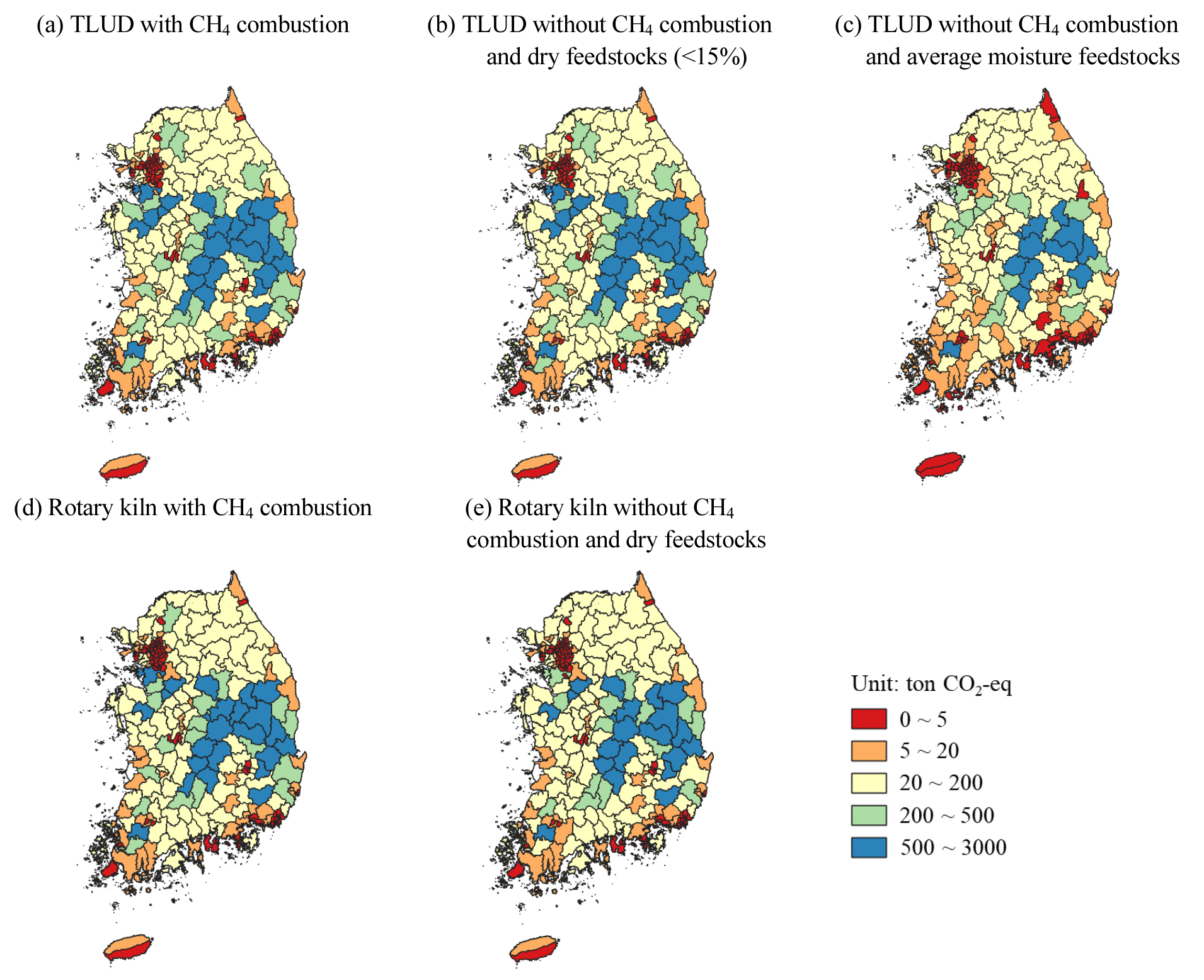
This study evaluated the net carbon dioxide (CO2) removal (NCR) potential of a local circular system utilizing orchard-pruning residues for biochar production. The life-cycle system comprised six stages: residue collection and natural drying, chipping, transport of chipped residues, local biochar production, biochar transport, and biochar application to orchards. The analysis focused on the biochar production stage, comparing pyrolysis types (TLUD and rotary kiln) and methane (CH4) emission factors (combustion and feedstock moisture). The amount of orchard-pruning residues was estimated for each city and county based on fruit orchard area in 2022, fruit production, and biomass conversion factors. To determine the optimal temperature, pruning residues from apple, pear, and grape orchards were pyrolyzed at 400, 500, and 600°C. Based on the molar H/Corg ratio (a carbon stability indicator) and biochar yield, 500°C was identified as optimal. At this temperature, long-term (>100 years) CO2 sequestration was estimated to range from 0.66 to 0.72 t CO2-eq t-1- dry feedstock. NCR was calculated by subtracting life-cycle greenhouse-gas (GHG) emissions, derived from literature values, from the CO2 sequestration potential via biochar. National NCR of local biochar circular systems, assuming 10% utilization of potential orchard-pruning residues (apple, pear, grape) was estimated as follows: TLUD with CH4 combustion 43 kt CO2-eq > TLUD without CH4 combustion using dry feedstock (<15% moisture) 41 kt CO2-eq > rotary kiln with CH4 combustion 38 kt CO2-eq > rotary kiln without CH4 combustion 34 kt CO2-eq > TLUD without CH4 combustion using average-moisture feedstock 19 kt CO2-eq. The findings suggest that effective NCR in orchard-pruning biochar local cycles requires sufficient feedstock drying and pyrolysis systems equipped with CH4-oxidizing afterburners, particularly stationary rotary kilns or well-operated TLUD units. However, when natural drying cannot reduce feedstock moisture below 15%, forced drying may introduce additional GHG emissions from energy consumption, thereby reducing the overall NCR efficiency.
An NH, Lee SM, Cho JR, Lee CR. 2019. Estimation of agricultural by-products and investigation on nutrient contents for alternatives of imported oil-cakes. J. Korea Org. Resour. Recycl. Assoc. 27:71-81. https://doi.org/10.17137/korrae.2019.27.4.71
10.17137/korrae.2019.27.4.71Carvalho J, Nascimento L, Soares M, Valério N, Ribeiro A, Faria L, Silva A, Pacheco N, Araújo J, Vilarinho C. 2022. Life cycle assessment (LCA) of biochar production from a circular economy perspective. Processes 10:2684. https://doi.org/10.3390/pr10122684
10.3390/pr10122684Cornelissen G, Pandit NR, Taylor P, Pandit BH, Sparrevik M, Schmidt HP. 2016. Emissions and char quality of flame-curtain “Kon Tiki” Kilns for Farmer-Scale charcoal/biochar production. PloS one 11:e0154617. http://dx.doi.org/10.1371/journal.pone.0154617.
10.1371/journal.pone.015461727191397PMC4871524Cornelissen G, Sørmo E, de la Rosa RKA. Ladd B. 2023. Flame curtain kilns produce biochar from dry biomass with minimal methane emissions. Sci. Total Environ. 903:166547. https://doi.org/10.1016/j.scitotenv.2023.166547
10.1016/j.scitotenv.2023.166547EBC. 2023. European Biochar Certificate - Guidelines for a Sustainable Production of Biochar. Carbon Standards International (CSI), Frick, Switzerland. (http://european-biochar.org). Version 10.3 from 5th Apr 2023.
EBC. 2024. Global Artisan C-sink - Guidelines for Carbon Sink Certification for artisan biochar production. Version 2.1E of 25th March 2024. Ithaka Institute, Arbaz, Switzerland (http://www.carbon-standards.com).
Egri D, Pârvulescu OC, Ion VA, Răducanu CE, Calcan SI, Bădulescu L, Madjar R, Orbeci C, Dobre T, Moț A, Iliescu LM. 2022. Vine pruning-derived biochar for agronomic benefits. Agronomy 12:2730. https://doi.org/10.3390/agronomy12112730
10.3390/agronomy12112730Fawzy S, Osman AI, Mehta N, Moran D, Al-Muhtaseb AAH, Rooney DW. 2022. Atmospheric carbon removal via industrial biochar systems: a techno-economic-environmental study. J. Clean. Prod. 371:133660. https://doi.org/10.1016/j.jclepro.2022.133660
10.1016/j.jclepro.2022.133660Han KH, Yun SI, Choi DH, Lee SI. 2024. Net CO2 removal of rice husk biochar as soil amendment depending on energy reuse in the production stage. Korean J. Soil Sci. Fert. 57:130-139. https://doi.org/10.7745/KJSSF.2024.57.2.130
10.7745/KJSSF.2024.57.2.130Han KH, Yun SI, Kwak JH, Lee SI. 2023. A Review on International Carbon Credit Certification Methodologies for Biochar as a Soil Amendment. Korean J. Soil Sci. Fert. 56:572-594. https://doi.org/10.7745/KJSSF.2023.56.4.572
10.7745/KJSSF.2023.56.4.572Han KH, Lee SB, Oh YR, Song ES, Yun SI, Kwak JH. 2025. CO2 sequestration potential over 100 years of cattle manure biochar in soil as affected by different feedstocks and pyrolysis temperatures. Korean J. Soil Sci. Fert. 58:405-415. https://doi.org/10.7745/KJSSF.2025.58.3.405
10.7745/KJSSF.2025.58.3.405IPCC (Intergovernmental Panel on Climate Change). 2019. Appendix 4 Method for Estimating the Change in Mineral Soil Organic Carbon Stocks from Biochar Amendments. https://www.ipcc-nggip.iges.or.jp/public/2019rf/pdf/4_Volume4/19R_V4_Ch02_Ap4_Biochar.pdf.
Kern S, Halwachs M, Kampichler G, Pfeifer C, Pröll T, Hofbauer H. 2012. Rotary kiln pyrolysis of straw and fermentation residues in a 3 MW pilot plant–Influence of pyrolysis temperature on pyrolysis product performance. J. Anal. Appl. Pyrolysis 97:1-10. https://doi.org/10.1016/j.jaap.2012.05.006
10.1016/j.jaap.2012.05.006Mafra (Ministry of Agriculture, food, and rural affair). 2021. 2050 Agricultural and Food Carbon Neutrality Promotion Strategy. https://www.mafra.go.kr/home/5109/subview.do?enc=Zm5jdDF8QEB8JTJGYmJzJTJGaG9tZSUyRjc5MiUyRjU2Mzg1OSUyRmFydGNsVmlldy5kbyUzRg%3D%3D.
Matuštík J, Hnátková T, Kočí V. 2020. Life cycle assessment of biochar-to-soil systems: A review. J. Clean. Prod. 259:120998. https://doi.org/10.1016/j.jclepro.2020.120998
10.1016/j.jclepro.2020.120998Nematian M, Keske C, Ng'ombe JN. 2021. A techno-economic analysis of biochar production and the bioeconomy for orchard biomass. Waste Manag. 135:467-477. https://doi.org/10.1016/j.wasman.2021.09.014
10.1016/j.wasman.2021.09.014Nunes LJ, Rodrigues AM, Matias JC, Ferraz AI, Rodrigues AC. 2021. Production of biochar from vine pruning: Waste recovery in the wine industry. Agriculture 11:489. https://doi.org/10.3390/agriculture11060489
10.3390/agriculture11060489Oo AZ, Sudo S, Win KT, Shibata A, Gonai T. 2018. Influence of pruning waste biochar and oyster shell on N2O and CO2 emissions from Japanese pear orchard soil. Heliyon, 4:e00568. https://doi.org/10.1016/j.heliyon.2018.e00568
10.1016/j.heliyon.2018.e0056829560477PMC5857720Rathinapriya P, Lee IB, Yi PH, Jeong ST. 2025. Effect of biochar and organic amendments on improving soil quality and apple orchard productivity: a 2-year field study. Korean J. Soil Sci. Fert. 58:159-176. https://doi.org/10.7745/KJSSF.2025.58.2.159
10.7745/KJSSF.2025.58.2.159RDA (Rural Development and Administration). 2024. Establishment of Fertilizer legal standards for biochar. https://korea.kr/briefing/pressReleaseView.do?newsId=156623405#goList.
Sahoo K, Upadhyay A, Runge T, Bergman R, Puettmann M, Bilek E. 2021. Life-cycle assessment and techno-economic analysis of biochar produced from forest residues using portable systems Int J Life Cycle Assess 26 189-213. https://doi.org/10.1007/s11367-020-01830-9
10.1007/s11367-020-01830-9Spinelli R, Marchi E. 2021. Trends and perspectives in the design of mobile wood chippers. Croat. j. for. eng. 42:25-38. https://doi.org/10.5552/crojfe.2021.787
10.5552/crojfe.2021.787UNFCCC. 2012. Methodological tool: Project and leakage emissions from road transportation of freight. https://cdm.unfccc.int/methodologies/PAmethodologies/tools/am-tool-12-v1.1.0.pdf.
van Schoor AU, Stander AJ, Petersen A, Teke GM, Stafford W, Görgens JF. 2025. Life cycle assessment and economic analysis of carbon sequestration through biochar produced from invasive alien plants. Biomass Bioenergy 203:108299. https://doi.org/10.1016/j.biombioe.2025.108299
10.1016/j.biombioe.2025.108299Verra. 2025. VM0044: Methodology for biochar utilization in soil and non-soil applications (Version 1.2). https://verra.org/methodologies/vm0044-methodology-for-biochar-utilization-in-soil-and-non-soil-applications/
Zhu X, Labianca C, He M, Luo Z, Wu C, You S, Tsang DCW. 2022. Life-cycle assessment of pyrolysis processes for sustainable production of biochar from agro-residues. Bioresour. Technol. 360:127601. https://doi.org/10.1016/j.biortech.2022.127601
10.1016/j.biortech.2022.127601- Publisher :Korean Society of Soil Science and Fertilizer
- Publisher(Ko) :한국토양비료학회
- Journal Title :Korean Journal of Soil Science and Fertilizer
- Journal Title(Ko) :한국토양비료학회 학회지
- Volume : 59
- No :1
- Pages :77-88
- Received Date : 2025-11-04
- Revised Date : 2025-11-18
- Accepted Date : 2025-11-19
- DOI :https://doi.org/10.7745/KJSSF.2026.59.1.077
 Korean Journal of Soil Science and Fertilizer