
Original research article

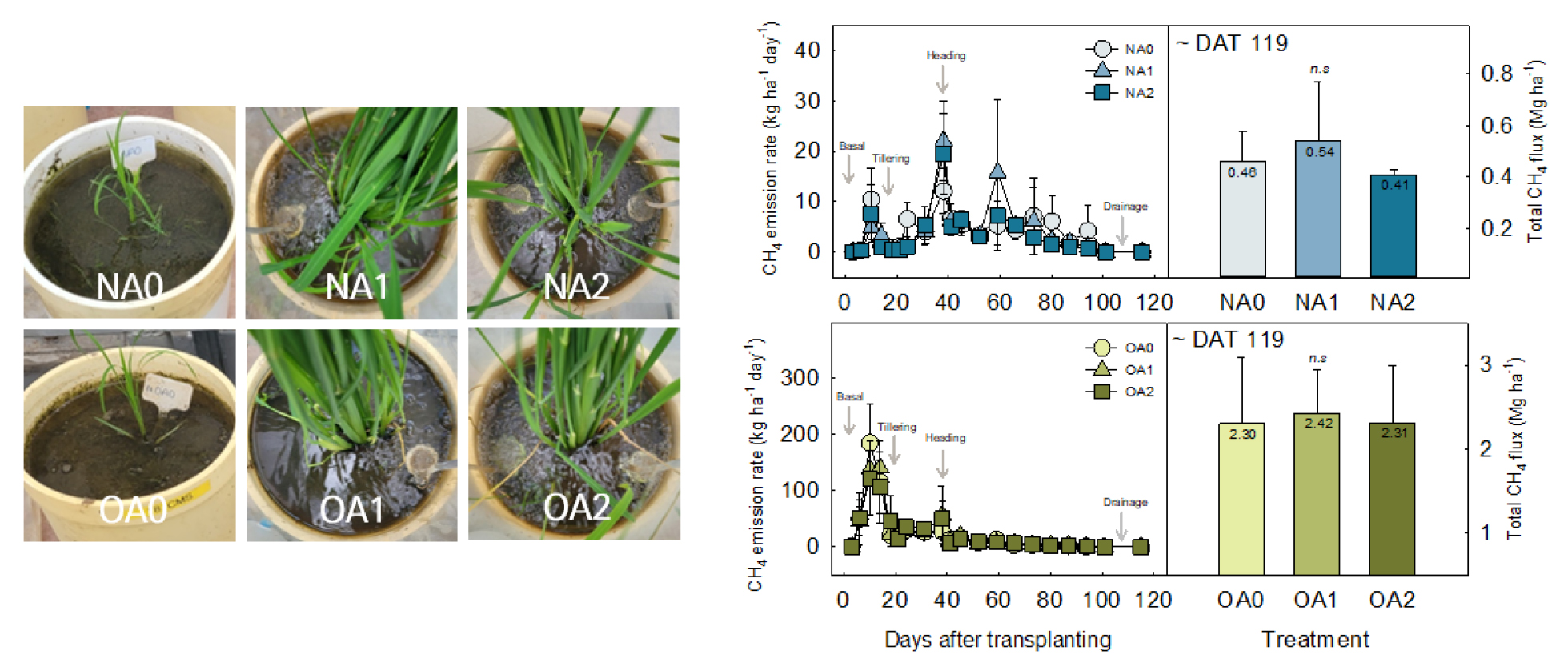
Rice paddies are a major source of methane (CH4) emissions, necessitating the development of novel mitigation strategies during cultivation. Surface water aeration (SWA) can increase oxygenation in flooded water, potentially reducing CH4 emissions in paddy systems. However, its efficacy remains unclear. In this pot experiment, different levels of aeration - specifically, none (control, without air supply), low (air supply via a single line) and high (air supply via double lines) - were applied using an air supply device. These treatments were evaluated in the presence (OM) or absence (NOM) of rice straw as an organic amendment to investigate their effects on CH4 emissions and rice productivity. Dissolved CH4 and oxygen concentrations in surface water were periodically monitored to decipher the factors influencing CH4 dynamics. Regardless of organic matter incorporation, SWA partially reduced CH4 emissions, particularly during the initial period (ca. 3 - 4 weeks), resulting in 22 - 32% and 5 - 7% reductions compared to the control under NOM and OM treatments, respectively. However, SWA did not significantly reduce cumulative CH4 emissions over the entire cultivation period, likely due to enhanced organic matter decomposition stimulated by increased aeration. Interestingly, dissolved CH4 concentrations were significantly reduced by aeration in both the OM and NOM treatments, which could be attributed to increased ebullition from the surface water. Furthermore, SWA deteriorated rice productivity. In conclusion, SWA showed negligible effects on overall CH4 mitigation while reducing rice productivity. This study suggests that SWA is not a feasible strategy for CH4 mitigation, highlighting the need for alternative approaches that can optimize oxygen levels within the soil profile without hindering plant growth.
An JH, Lee YM, Song JK, Kim SY. 2024. Effects of bacillus velezensis strain GH1-13 seed-soaking inoculation on rice productivity and greenhouse gas (CH4 and N2O) emissions in a paddy soil during cultivation: A pot experiment. KJSSF. 57:63-72. https://doi.org/10.7745/KJSSF.2024.57.1.063
10.7745/KJSSF.2024.57.1.063Bengough AG, Bransby MF, Hans J, McKenna SJ, Roberts TJ, Valentine TA. 2006. Root responses to soil physical conditions; growth dynamics from field to cell. J. Exp. Bot. 57:437-447. https://doi.org/10.1093/jxb/erj003
10.1093/jxb/erj003Cho SR, Verma PP, Das S, Kim GW, Lim JY, Kim PJ, 2022. A new approach to suppress methane emissions from rice cropping systems using ethephon. Sci. Total Environ. 804:150159. https://doi.org/10.1016/j.scitotenv.2021.150159
10.1016/j.scitotenv.2021.150159Choi SW, Lee JH, Lee YM, Kim PJ, Cho JS, Cheong YH, Rim YS, Kim SY. 2020. The effects of ethephon application on suppressing methane emission and stimulating rice productivity in a rice paddy soil: A pot experiment. KJSSF 53:489-501. https://doi.org/10.7745/KJSSF.2020.53.4.489
10.7745/KJSSF.2020.53.4.489Conrad R. 2007. Microbial ecology of methanogens and methanotrophs. Adv. Agron. 96:1-63. https://doi.org/10.1016/S0065-2113(07)96005-8
10.1016/S0065-2113(07)96005-8Gwon HS, Choi EJ, Lee SI, Lee HS, Lee JM, Kang SS. 2022. Research review of methane emissions from Korean rice paddies. J. Clim. Chang. Res. 13:117-134. https://doi.org/10.15531/KSCCR.2022.13.1.117
10.15531/KSCCR.2022.13.1.117Huang YC, Hseu ZY. 2021. Silicon availability in relation to soil properties in Inceptisols on uncultivated lands and paddy fields in Taiwan. Geoderma Reg. 26:e00406. https://doi.org/10.1016/j.geodrs.2021.e00406
10.1016/j.geodrs.2021.e00406IPCC. 2006. 2006 IPCC Guidelines for National Greenhouse Gas Inventories, Volume 1 – Annex 8A.2 Reporting Tables. Intergovernmental Panel on Climate Change.
Kim SY, Jeong ST, Ho A, Hong CO, Lee CH, Kim PJ. 2018. Cattle manure composting: Shifts in the methanogenic community structure, chemical composition, and consequences on methane production potential in a rice paddy. Appl. Soil Ecol. 124:344-350. https://doi.org/10.1016/j.apsoil.2017.12.002
10.1016/j.apsoil.2017.12.002Kim SY, Lee, CH., Gutierrez J., Kim, PJ. 2013. Contribution of winter cover crop amendments on global warming potential in rice paddy soil during cultivation. Plant Soil 366:273-286. https://doi.org/10.1007/s11104-012-1403-4.
10.1007/s11104-012-1403-4Kim SY, Pramanik P, Gutierrez J, Hwang HY, Kim PJ. 2014. Comparison of methane emission characteristics in air-dried and composted cattle manure amended paddy soil during rice cultivation. Agric. Ecosyst. Environ. 197:60-67. https://doi.org/10.1016/j.agee.2014.07.013
10.1016/j.agee.2014.07.013Lapham LL, Hobbs EA, Testa JM, Heyes A, Forsyth MK, Hodgkins C, Szewczyk C, Harris LA. 2022. The effects of engineered aeration on atmospheric methane flux from a chesapeake bay tidal tributary. Front. Environ. Sci. 10. https://doi.org/10.3389/fenvs.2022.866152
10.3389/fenvs.2022.866152Jean LM, Pierre R. 2001. Production, oxidation, emission and consumption of methane by soils: a review. Eur. J. Soil Biol. 37:25-50.
10.1016/S1164-5563(01)01067-6Lee HS, Hwang WH, Jeong JH, Yang SY, Jeong NJ, Lee CK, Choi MG. 2021. Physiological causes of transplantation shock on rice growth inhibition and delayed heading. Sci. Rep. 11:16818. https://doi.org/10.1038/s41598-021-96009-z
10.1038/s41598-021-96009-z34413345PMC8376942Lee JH, Lee JY, Kang YG, Kim JH, Oh TK. 2023a. Evaluating methane emissions from rice paddies: A study on the cultivar and transplanting date. Sci. Total Environ. 902:166174. https://doi.org/10.1016/j.scitotenv.2023.166174
10.1016/j.scitotenv.2023.166174Lee JM, Jeong HC, Lee HS, Park HR, Kim GS, Lee SI. 2023b. Effects of water management practices on methane emissions and rice yields in East Asian paddy fields: A regional-scale meta-analysis. KJSSF 56:313-324. https://doi.org/10.7745/KJSSF.2023.56.4.313
10.7745/KJSSF.2023.56.4.313Lynch J. 1995. Root architecture and plant productivity. Plant Physiol. 109:7-13. https://doi.org/10.1104/pp.109.1.7
10.1104/pp.109.1.712228579PMC157559MAFRA, 2025. National Greenhouse Gas Inventory Report of Korea (2024 submission). Ministry of Agriculture, Food and Rural Affairs.
Qian H, Chen J, Zhu X, Wang L, Liu Y, Zhang J, Deng A, Song Z, Ding Y, Jiang Y. 2022. Intermittent flooding lowers the impact of elevated atmospheric CO2 on CH4 emissions from rice paddies. Agric. Ecosyst. Environ. 329:107872. https://doi.org/10.1016/j.agee.2022.107872
10.1016/j.agee.2022.107872Qian H, Zhu X, Huang S, Linquist B, Kuzyakov Y, Wassmann R, Minamikawa K, Martinez-Eixarch M, Yan X, Zhou F. 2023. Greenhouse gas emissions and mitigation in rice agriculture. Nat. Rev. Earth Environ. 4:716-732. https://doi.org/10.1038/s43017-023-00482-1
10.1038/s43017-023-00482-1RDA (Rural Development Administration). 2012. Standard methods for agricultural science research and analysis. Suwon, Korea.
RDA (Rural Development Administration). 2022. Fertilizer Recommendation for Crops (5th revision). RDA, Jeonju, Korea.
Rolston DE. 1986. Gas flux. In: Klute A, ed. Methods of soil analysis. Part 1. Soil Science Society of America. p. 1103-1119. https://doi.org/10.2136/sssabookser5.1.2ed.c47
10.2136/sssabookser5.1.2ed.c47Rongzhong Y, William RH. 2017. Influence of rice straw on priming of soil C for dissolved organic C and CH4 production. Plant Soil. 417:231-241. https://doi.org/10.1007/s11104-017-3254-5
10.1007/s11104-017-3254-5Singh S, Singh J, Kashyap A. 1999. Methane flux from irrigated rice fields in relation to crop growth and N-fertilization. Soil Biol. Biochem. 31:1219-1228. https://doi.org/10.1016/S0038-0717(99)00027-9
10.1016/S0038-0717(99)00027-9Song HJ, Lee JH, Hwang HY, Jeong ST, Canatoy RC, Turner BL, Mishra U, Park SY, Kim PJ. 2025. Dilemma of organic matter input to mitigate climate impact of rice paddies. Soil Biol. Biochem. 109873. https://doi.org/10.1016/j.soilbio.2025.109873
10.1016/j.soilbio.2025.109873Senthilraja K, Venkatesan S, Udhaya Nandhini D, Dhasarathan M, Prabha B, Boomiraj K, Mohan Kumar S, Bhuvaneswari K, Raveendran M, Geethalakshmi V. 2023. Mitigating methane emission from the rice ecosystem through organic amendments. Agriculture 13:1037. https://doi.org/10.3390/agriculture13051037
10.3390/agriculture13051037Tang J, Li C, Tan W, Cao C, Zhang W, Zhang L, Hu Q, Xiong H, Luo J, Song W, et al. 2023. Introducing soil air injection device to reduce carbon footprint of rice production system in China. J. Clean. Prod. 406:137068. https://doi.org/10.1016/j.jclepro.2023.137068
10.1016/j.jclepro.2023.137068Wu X, Wang W, Xie K, Yin C, Hou H, Xie X. 2019. Combined effects of straw and water management on CH4 emissions from rice fields. J. Environ. Manage. 231:1257-1262. https://doi.org/10.1016/j.jenvman.2018.11.011
10.1016/j.jenvman.2018.11.011Yokogawa, 2022. Compensation Tables: Dissolved Oxygen Measurement. Yokokawa Process Analyzers, Amersfoort, Netherlands.
Yuan ZF, Zhou Y, Chen Z, Tang X, Wang Y, Kappler A, Xu J. 2023. Reduce methane emission from rice paddies by man-made aerenchymatous tissues. Carbon Res. 2. https://doi.org/10.1007/s44246-023-00049-1
10.1007/s44246-023-00049-1- Publisher :Korean Society of Soil Science and Fertilizer
- Publisher(Ko) :한국토양비료학회
- Journal Title :Korean Journal of Soil Science and Fertilizer
- Journal Title(Ko) :한국토양비료학회 학회지
- Volume : 59
- No :2
- Pages :184-197
- Received Date : 2026-03-11
- Revised Date : 2026-04-09
- Accepted Date : 2026-04-14
- DOI :https://doi.org/10.7745/KJSSF.2026.59.2.184
 Korean Journal of Soil Science and Fertilizer