

Original research article

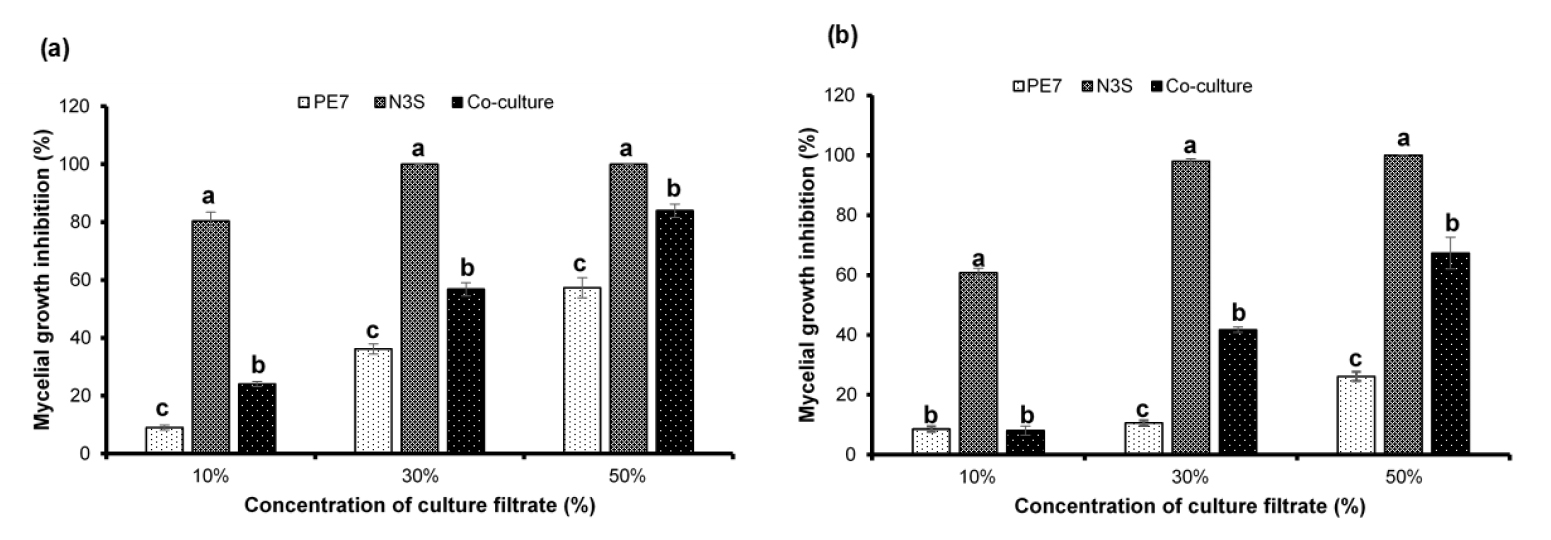
Bacterial antagonists have gained great attention for their dual roles in plant growth promotion and disease control to reduce extensive use of agrochemicals in sustainable agriculture. This study demonstrates the mutualistic growth of Bacillus subtilis PE7 and Bacillus amyloliquefaciens N3S in a co-culture system and their production of agro-active substances including indole-3-acetic acid (IAA) and antifungal metabolites compared with their corresponding monocultures. Although a cooperative growth of two Bacillus strains was observed, IAA production in the co-culture was lower than those in the monocultures. The culture filtrates (CFs) of strain N3S monoculture showed the highest inhibitory action on mycelial growth of Sclerotinia sclerotiorum. In addition, the antifungal activity of the CFs of the co-culture was stronger than that of strain PE7 monoculture. Treatment of S. sclerotiorum with the CFs of the monocultures and co-culture induced the severe distortions in the hyphal morphology. The cooperative growth as well as metabolite production of two Bacillus species in the co-culture highlights the potential of bacterial consortium for the development of effective biofertilizer and biofungicide in green agriculture.
Altaf MM, Ahmad I, Khan MSA, Grohmann E. 2017. Bacillus biofilms and their role in plant health. Biofilms in Plant and Soil Health, pp. 55-67. In Ahmad I, Husain FM (Eds.). Jhon Wiley & Sons, Chennai, India. https://doi.org/10.1002/9781119246329.ch4
10.1002/9781119246329.ch4Anwar MS, Paliwal A, Firdous N, Verma A, Kumar A, Pande V. 2019. Co-culture development and bioformulation efficacy of psychrotrophic PGPRs to promote growth and development of pea (Pisum sativum) plant. J. Gen. Appl. Microbiol. 65:88-95. https://doi.org/10.2323/jgam.2018.05.007
10.2323/jgam.2018.05.007Ayaz M, Li CH, Ali Q, Zhao W, Chi YK, Shafiq M, Ali F, Yu XY, Yu Q, Zhao JT, Yu JW, Qi RD, Huang WK. 2023. Bacterial and fungal biocontrol agents for plant disease protection: Journey from lab to field, current status, challenges, and global perspectives. Molecules 28:6735. https://doi.org/10.3390/molecules28186735
10.3390/molecules2818673537764510PMC10537577Bagheri N, Ahmadzadeh M, Mariotte P, Jouzani GS. 2022. Behavior and interactions of the plant growth-promoting bacteria Azospirillumoryzae NBT506 and Bacillus velezensis UTB96 in a co-culture system. World J. Microbiol. Biotechnol. 38:101. https://doi.org/10.1007/s11274-022-03283-8
10.1007/s11274-022-03283-835486223PMC9054896Bais HP, Fall R, Vivanco JM. 2004. Biocontrol of Bacillus subtilis against infection of Arabidopsis roots by Pseudomonas syringae is facilitated by biofilm formation and surfactin production. Plant Physiol. 134:307-319. https://doi.org/10.1104/pp.103.028712
10.1104/pp.103.02871214684838PMC316310de Oliveira-Paiva CA, Bini D, de Sousa SM, Ribeiro VP, dos Santos FC, de Paula Lana UG, de Souza FF, Gomes EA, Marriel IE. 2024. Inoculation with Bacillus megaterium CNPMS B119 and Bacillus subtilis CNPMS B2084 improve P-acquisition and maize yield in Brazil. Front. Microbiol. 15:1426166. https://doi.org/10.3389/fmicb.2024.1426166
10.3389/fmicb.2024.142616638989019PMC11233657Elumalai P, Gao X, Parthipan P, Luo J, Cui J. 2025. Agrochemical pollution: a serious threat to environmental health. Curr. Opin. Environ. Sci. Health 43:100597. https://doi.org/10.1016/j.coesh.2025.100597
10.1016/j.coesh.2025.100597Etesami H, Jeong BR, Glick BR. 2023. Potential use of Bacillus spp. as an effective biostimulant against abiotic stresses in crops—A review. Curr. Res. Biotechnol. 5:100128. https://doi.org/10.1016/j.crbiot.2023.100128
10.1016/j.crbiot.2023.100128Fan H, Zhang Z, Li Y, Zhang X, Duan Y, Wang Q. 2017. Biocontrol of bacterial fruit blotch by Bacillus subtilis 9407 via surfactin-mediated antibacterial activity and colonization. Front. Microbiol. 8:1973. https://doi.org/10.3389/fmicb.2017.01973
10.3389/fmicb.2017.0197329075242PMC5641556Fessia A, Barra P, Barros G, Nesci A. 2022. Could Bacillus biofilms enhance the effectivity of biocontrol strategies in the phyllosphere?. J. Appl. Microbiol. 133:2148-2166. https://doi.org/10.1111/jam.15596
10.1111/jam.15596Gavilanes FZ, Andrade DS, Zucareli C, Horácio EH, Yunes JS, Barbosa AP, Alves LAR, Cruzatty LG, Maddela NR, Guimarães MdeF. 2020. Co-inoculation of Anabaena cylindrica with Azospirillum brasilense increases grain yield of maize hybrids. Rhizosphere 15:100224. https://doi.org/10.1016/j.rhisph.2020.100224
10.1016/j.rhisph.2020.100224Gong AD, Li HP, Yuan QS, Song XS, Yao W, He WJ, Zhang JB, Liao YC. 2015. Antagonistic mechanism of iturin A and plipastatin A from Bacillus amyloliquefaciens S76-3 from wheat spikes against Fusarium graminearum. PloS One 10:e0116871. https://doi.org/10.1371/journal.pone.0116871
10.1371/journal.pone.011687125689464PMC4331432Hamed AA, Ghareeb MA, Kelany AK, Abdelraof M, Kabary HA, Soliman NR, Elawady ME. 2024. Induction of antimicrobial, antioxidant metabolites production by co-cultivation of two red-sea-sponge-associated Aspergillus sp. CO2 and Bacillus sp. COBZ21. BMC Biotechnol. 24:3. https://doi.org/10.1186/s12896-024-00830-z
10.1186/s12896-024-00830-z38233817PMC10795289Han SE, Cho JY, Kim KY, Maung CEH. 2023a. Role of an antagonistic bacterium, Bacillus subtilis PE7, in growth promotion of netted melon (Cucumis melo L. var. reticulatus Naud.). Can. J. Microbiol. 70:40-51. https://doi.org/10.1139/cjm-2023-0083
10.1139/cjm-2023-0083Han SE, Kim KS, Maung CEH, Kim KY. 2023b. Growth enhancement of tomato by a plant growth promoting bacterium, Bacillus subtilis PE7. Korean J. Soil. Sci. Fert. 56:398-406. https://doi.org/10.7745/KJSSF.2023.56.4.398
10.7745/KJSSF.2023.56.4.398Han SE, Kim KY, Maung CEH. 2024. Bacillus subtilis PE7-mediated alleviation of phosphate starvation and growth promotion of netted melon (Cucumis melo L. var. reticulatus Naud.). Microorganisms 12:2384. https://doi.org/10.3390/microorganisms12122384
10.3390/microorganisms1212238439770587PMC11678189Herrmann LW, Letti LAJ, Penha RdeO, Soccol VT, Rodrigues C, Soccol CR. 2024. Bacillus genus industrial applications and innovation: First steps towards a circular bioeconomy. Biotechnol. Adv. 70:108300. https:// doi.org/10.1016/j.biotechadv.2023.108300
10.1016/j.biotechadv.2023.108300Jabborova D, Davranov K, Jabbarov Z, Bhowmik SN, Ercisli S, Danish S, Singh S, Desouky SE, Elazzazy AM, Nasif O, Datta R. 2022. Dual inoculation of plant growth-promoting Bacillus endophyticus and Funneliformis mosseae improves plant growth and soil properties in ginger. ACS Omega 7:34779-34788. https://doi.org/10.1021/acsomega.2c02353
10.1021/acsomega.2c0235336211029PMC9535732Jeong SK, Han SE, Srinivasan PV, Jeong WJ, Maung CEH, Kim KY. 2024. Agro active potential of Bacillus subtilis PE7 against Didymella bryoniae (Auersw.), the causal agent of gummy stem blight of Cucumis melo. Microorganisms 12:1691. https://doi.org/10.3390/microorganisms12081691
10.3390/microorganisms1208169139203532PMC11357386Kim JH, Lee N, Hwang S, Kim W, Lee Y, Cho S, Palsson BO, Cho BK. 2021. Discovery of novel secondary metabolites encoded in actinomycete genomes through coculture. J. Ind. Microbiol. Biotechnol. 48:kuaa001. https://doi.org/10.1093/jimb/kuaa001
10.1093/jimb/kuaa00133825906PMC9113425Lee S, Kim H, Kim S, Kwak K, Ko S. 2025. Isolation and characterization of plant growth-promoting rhizobacteria from soil. Korean J. Soil Sci. Fert. 58:27-37. https://doi.org/10.7745/KJSSF.2025.58.1.027
10.7745/KJSSF.2025.58.1.027Li T, Tang J, Karuppiah V, Li Y, Xu N, Chen J. 2020. Co-culture of Trichoderma atroviride SG3403 and Bacillus subtilis 22 improves the production of antifungal secondary metabolites. Biol. Control 140:104122. https://doi.org/10.1016/j.biocontrol.2019.104122
10.1016/j.biocontrol.2019.104122Liu H, Hao D, Li Y, Wang X, Chen J. 2022. Approaches for the establishment of optimized co-culture system of multiple Trichoderma strains for culture metabolites highly effective in cucumber growth promotion. Front. Microbiol. 13:1020077. https://doi.org/10.3389/fmicb.2022.1020077
10.3389/fmicb.2022.102007736238592PMC9551241Markelova N, Chumak A. 2025. Antimicrobial activity of Bacillus cyclic lipopeptides and their role in the host adaptive response to changes in environmental conditions. Int. J. Mol. Sci. 26:336. https://doi.org/10.3390/ijms26010336
10.3390/ijms2601033639796193PMC11720072Nemutanzhela ME, Roets Y, Gardiner N, Lalloo R. 2014. The use and benefits of Bacillus based biological agents in aquaculture. p. 33. In Hernandez-Vergara MP, Perez-Rostro CI (Eds.) Sustainable aquaculture techniques. Intech, Rijeka, Croatia. https://doi.org/10.5772/57198
10.5772/57198Ongena M, Jacques P. 2008. Bacillus lipopeptides: versatile weapons for plant disease biocontrol. Trends Microbiol. 16:115-125. https://doi.org/10.1016/j.tim.2007.12.009
10.1016/j.tim.2007.12.009Peng XY, Wu JT, Shao CL, Li ZY, Chen M, Wang CY. 2021. Co-culture: stimulate the metabolic potential and explore the molecular diversity of natural products from microorganisms. Mar. Life Sci. Technol. 3:363-374. https://doi.org/10.1007/s42995-020-00077-5
10.1007/s42995-020-00077-537073292PMC10077301Prasad B, Sharma D, Kumar P, Dubey RC. 2023. Biocontrol potential of Bacillus spp. for resilient and sustainable agricultural systems. Physiol. Mol. Plant Pathol. 128:102173. https://doi.org/10.1016/j.pmpp.2023.102173
10.1016/j.pmpp.2023.102173Ramlucken U, Ramchuran SO, Moonsamy G, van Rensburg CJ, Thantsha MS, R Lalloo. 2021. Production and stability of a multi-strain Bacillus based probiotic product for commercial use in poultry. Biotechnol. Rep. 29:e00575. https://doi.org/10.1016/j.btre.2020.e00575
10.1016/j.btre.2020.e0057533659192PMC7890156Ratzke C, Gore J. 2018. Modifying and reacting to the environmental pH can drive bacterial interactions. PLoS Biol. 16:e2004248. https://doi.org/10.1371/journal.pbio.2004248
10.1371/journal.pbio.200424829538378PMC5868856Selegato DM, Castro-Gamboa I. 2023. Enhancing chemical and biological diversity by co-cultivation. Front. Microbiol. 14:1117559. https://doi.org/10.3389/fmicb.2023.1117559
10.3389/fmicb.2023.111755936819067PMC9928954Shafi J, Tian H, Ji M. 2017. Bacillus species as versatile weapons for plant pathogens: a review. Biotechnol. Biotechnol. Equip. 31:446-459. https://doi.org/10.1080/13102818.2017.1286950
10.1080/13102818.2017.1286950Stamenković-Stojanović S, Karabegović I, Beškoski V, Nikolić N, Lazić M. 2019. Bacillus based microbial formulations: Optimization of the production process. Hem. Ind. 73:169-182. https://doi.org/10.2298/HEMIND190214014S
10.2298/HEMIND190214014SSun Y, Shi X, Xing Y, Ren XX, Zhang DY, Li X, Xiu ZL, Dong YS. 2022. Co-culture of Aspergillus sydowii and Bacillus subtilis induces the production of antibacterial metabolites. Fungal Biol. 126:320-332. https://doi.org/10.1016/j.funbio.2022.01.002
10.1016/j.funbio.2022.01.002Tsotetsi T, Nephali L, Malebe M, Tugizimana F. 2022. Bacillus for plant growth promotion and stress resilience: what have we learned?. Plants 11:2482. https://doi.org/10.3390/plants11192482
10.3390/plants1119248236235347PMC9571655Xiao J, Guo X, Qiao X, Zhang X, Chen X, Zhang D. 2021. Activity of fengycin and iturin A isolated from Bacillus subtilis Z-14 on Gaeumannomyces graminis var. tritici and soil microbial diversity. Front. Microbiol. 12:682437. https://doi.org/10.3389/fmicb.2021.682437
10.3389/fmicb.2021.68243734220767PMC8250863Yu L, Ding W, Wang Q, Ma Z, Xu X, Zhao X, Chen Z. 2017. Induction of cryptic bioactive 2, 5-diketopiperazines in fungus Penicillium sp. DT-F29 by microbial co-culture. Tetrahedron 73:907-914. https://doi.org/10.1016/j.tet.2016.12.077
10.1016/j.tet.2016.12.077Zhang D, Qiang R, Zhou Z, Pan Y, Yu S, Yuan W, Cheng J, Wang J, Zhao D, Zhu J, Yang Z. 2022. Biocontrol and action mechanism of Bacillus subtilis lipopeptides’ fengycins against Alternaria solani in potato as assessed by a transcriptome analysis. Front. Microbiol. 13:861113. https://doi.org/10.3389/fmicb.2022.861113
10.3389/fmicb.2022.86111335633712PMC9130778Zhang L, Sun C. 2018. Fengycins, cyclic lipopeptides from marine Bacillus subtilis strains, kill the plant-pathogenic fungus Magnaporthe grisea by inducing reactive oxygen species production and chromatin condensation. Appl. Environ. Microbiol. 84:e00445-00418. https://doi.org/10.1128/AEM.00445-18
10.1128/AEM.00445-1829980550PMC6122000Zhou H, Dong K, Du Q, Wei Q, Wu J, Deng J, Wang F. 2024. Biofilm-forming of Bacillus tequilensis DZY 6715 enhanced suppression the Camellia oleifera anthracnose caused by Colletotrichum fructicola and its mechanism. Sci. Hortic. 338:113676. https://doi.org/10.1016/j.scienta.2024.113676
10.1016/j.scienta.2024.113676- Publisher :Korean Society of Soil Science and Fertilizer
- Publisher(Ko) :한국토양비료학회
- Journal Title :Korean Journal of Soil Science and Fertilizer
- Journal Title(Ko) :한국토양비료학회 학회지
- Volume : 58
- No :3
- Pages :271-283
- Received Date : 2025-04-15
- Revised Date : 2025-06-30
- Accepted Date : 2025-07-07
- DOI :https://doi.org/10.7745/KJSSF.2025.58.3.271
 Korean Journal of Soil Science and Fertilizer