

Introduction
Materials and Methods
Experimental conditions
Field split-plot design
N and fertilizer treatments
Soil properties
Irrigation treatments
Effects of N on phenotypic traits of onion
Yield evaluation
Statistical analysis
Result and Discussion
Variation in solar radiation during onion cultivation
Effects of irrigation regime in onion cultivation
N supply schedule during onion cultivation
Soil water matric potential dynamics
Soil inorganic N dynamics
Growth responses of onion to N and controlled irrigation management
N fertigation and irrigation on onion yield
Conclusions
Introduction
Onion (Allium cepa L.) is one of the most widely cultivated vegetable crops worldwide and an essential component of East Asian diets. In South Korea, onion production exceeds 1.3 million tons annually across more than 18,000 ha of cultivated land, making it one of the country’s major horticultural crops and an important source of farmer income and food supply (KOSTAT, 2023). However, sustaining stable onion productivity has become increasingly challenging due to climate variability, irregular rainfall distribution, and inefficient nutrient and irrigation management practices. Onion is particularly sensitive to fluctuations in soil moisture and nutrient availability because of its shallow and limited root system. Therefore, the development of eco-friendly fertilizer materials and nutrient management strategies with improved nutrient availability has become an important approach for sustainable crop production (Park et al., 2026). Optimizing nitrogen fertilization together with efficient irrigation management is therefore essential to improve onion cultivation. Adequate and timely supply of nitrogen (N), phosphorus (P), and potassium (K) is essential for vegetative growth, bulb enlargement, and yield formation (Li et al., 2025). Among these nutrients, N plays a major role in leaf development, photosynthetic activity, and bulb productivity. However, excessive or poorly synchronized N application can reduce nitrogen use efficiency and increase nutrient losses through leaching, denitrification, and volatilization, thereby contributing to environmental contamination and soil degradation (Martínez-Dalmau et al., 2021; Rathinapriya et al., 2025). Similarly, improper irrigation management can reduce water use efficiency, promote nutrient loss, and increase the incidence of physiological disorders and diseases in onion cultivation (Sansan et al., 2024).
Drip irrigation systems have been widely adopted to improve root-zone moisture distribution and nutrient delivery in vegetable crops, including onion (Piri and Naserin, 2020). Nevertheless, many previous studies have relied on fixed irrigation schedules or generalized evapotranspiration estimates without considering dynamic environmental conditions such as solar radiation, rainfall, and real-time soil moisture status. Furthermore, most onion studies have evaluated N fertilization and irrigation independently, with limited information available on their combined effects under field conditions, particularly in East Asian agro-climatic environments (Rani et al., 2020; Kim et al., 2024). Although some studies have examined interactions between irrigation and N management, these approaches were generally based on static irrigation regimes and lacked environmentally responsive control systems (Banik et al., 2024).
Recent advances in precision agriculture have enabled the integration of environmental sensing, automated irrigation control, and fertigation systems for improving resource use efficiency. Approaches incorporating solar radiation, rainfall, soil moisture, and soil electrical conductivity (EC) data can support dynamic irrigation scheduling and more efficient nutrient management under changing environmental conditions (Vyavahare et al., 2023; Li et al., 2025). Such systems may help maintain favorable soil water conditions, reduce excessive irrigation, and improve synchronization between crop water demand and nutrient availability.
Therefore, this study aimed to evaluate the combined effects of different N fertilization levels and solar radiation based digital irrigation management on soil water status, soil inorganic N dynamics, plant growth, and bulb yield of onion under open-field conditions. Unlike conventional fixed irrigation systems, this study highlighted integrated solar radiation, rainfall feedback, and soil moisture sensing to dynamically regulate root-zone water conditions during onion cultivation. Furthermore, this study identified nitrogen and irrigation combinations that optimize onion productivity while improving resource use efficiency under variable climatic conditions.
Materials and Methods
Experimental conditions
The field experiment was conducted at the Allium Vegetable Research Center, National Institute of Horticultural and Herbal Science (NIHHS), Muan-gun, Jeollanam-do, South Korea (34.96° N, 126.45° E), during the 2023 - 2024 growing season. Onion seedlings (Allium cepa L., cv. Katamaru) were raised for approximately 45 days in a nursery before transplanting. Raised beds were prepared, and four drip irrigation lines were installed per bed. Beds were covered with vinyl mulch to conserve soil moisture and suppress weeds. Seedlings were transplanted in rows with 10 plants per row. Growth and physiological measurements were conducted at six developmental stages (March 12, March 22, April 11, April 18, May 20, and May 28, 2024) to capture key growth transitions under varying N and irrigation treatments. All plots were managed uniformly with respect to weed control, pest management, and other agronomic practices through-out the experimental period.
Field split-plot design
The experiment was arranged in a split-plot design with two replications. N fertilization levels (0N, 1/3N, 2/3N, and 1N) were assigned to the main plots, while irrigation levels (25%, 50%, 75%, and 100% of crop water requirement) were assigned to the subplots. Within each replication, main plots were arranged in a randomized layout, and each main plot was subdivided into four subplots with irrigation treatments randomly allocated. A total of 32 experimental units were established. As illustrated in Supplementary Figure 1, main plots were arranged as vertical strips, and subplots were systematically distributed within each main plot. Each subplot corresponded to an 8.5 m × 1 m planting unit within the × 84.5 m field area. Buffer zones (1 m spacing) were maintained between adjacent plots to prevent lateral movement of water and nutrients. Soil electrical conductivity and moisture sensors were installed at representative locations in each treatment to monitor soil conditions.

N and fertilizer treatments
Four N fertilization levels were established: 0N (0 kg N 10a-1), 1/3N (80 kg N 10a-1), 2/3N (160 kg N 10a-1), and 1N (240 kg N 10a-1), representing 0%, 33%, 67%, and 100% of the standard recommended rate, respectively. Phosphorus and potassium were uniformly applied across all treatments at rates of P2O5 77 kg 10a-1 and K2O 154 kg 10a-1. Phosphorus was incorporated into the soil prior to transplanting. Potassium was applied as 35% basal fertilizer before planting and 65% as top dressing in two equal splits during late February and late March. N was supplied via drip fertigation using a pressure-compensated drip irrigation system (HWASAN Engineering, South Korea) equipped with drip lines spaced at 0.2 m emitter intervals along crop rows. This configuration ensured uniform nutrient distribution and minimized N losses through leaching or volatilization.
Soil properties
The experimental soil was classified as loam. Soil samples were collected from the 0 - 20 cm depth prior to treatment establishment. Samples were air-dried, ground, and passed through a 2 mm sieve before analysis. Soil chemical properties, including pH, organic matter (OM), available P2O5, and exchangeable cations (K, Ca, and Mg), were determined according to the standard analytical procedures of the National Institute of Agricultural Science and Technology (NIAST, 2000), Rural Development Administration, South Korea (Table 1).
Table 1
Chemical properties of the experimental soil in the onion field prior to treatment application.
|
pH (1:5) |
Organic matter (g kg-1) |
Av. P2O5 (mg kg-1) | Exch. cations (cmolc kg-1) | ||
| K | Ca | Mg | |||
| 7.4 | 26 | 718 | 1.2 | 8.1 | 2.1 |
Irrigation treatments
Irrigation treatments consisted of four levels: 25%, 50%, 75%, and 100% of calculated onion water requirement. Water requirement was estimated based on solar radiation accumulation measured using a pyranometer (Apogee Instruments, USA). Rainfall was recorded using an ECRN-100 tipping bucket rain gauge (METER Group Inc., USA). Environmental data were recorded at 15-minute intervals using a ZL6 data logger (METER Group Inc., USA), with real-time data access and storage via the ZENTRA Cloud platform (www.zentracloud.com. Meter, USA), and calculated using the formula:
Irrigation was applied using a drip irrigation system, and all treatments received water at consistent intervals based on their assigned level. Soil water matric potential was monitored to ensure accurate control and avoid moisture stress across treatments.
Effects of N on phenotypic traits of onion
Phenotypic traits such as plant height, pseudo-stem height, pseudo-stem diameter, and number of leaves were recorded at six key stages during onion growth: March 12, March 22, April 11, April 18, May 20, and May 28, 2024. These observations were made from plants subjected to four irrigation levels such as 25%, 50%, 75%, and 100% of the calculated crop water requirement and four N fertilization levels. Plant height was measured from the soil surface to the tip of the tallest leaf using a measuring scale. Pseudo-stem height was recorded as the vertical distance from the base to the point where leaves began to diverge. Pseudo-stem diameter was measured using a digital caliper at the midpoint of the pseudo-stem. The number of leaves per plant was manually counted. Plant biomass and bulb weight were measured at later growth stages to assess biomass accumulation and yield components. Selected plants were carefully uprooted and removed adhered soil particles, whole plant fresh weight was recorded using an electronic balance. Bulb weight was measured separately after detaching the aboveground parts. At each sampling date, three randomly selected plants per plot were measured, and mean values were calculated to represent each treatment combination (n = 12 per treatment). These data were used to evaluate the main and interaction effects of N and irrigation on vegetative growth under field conditions.
Yield evaluation
Onion yield was measured after harvesting, marketable bulbs were cleaned, weighed using a digital scale, and the total yield per plot was calculated and converted to kg 10a-1 for standardized comparison.
Statistical analysis
Statistical analysis was performed using SAS software (Enterprise Guide 7.1, SAS Institute Inc., USA). The experiment was arranged in a split-plot design, with N fertilization levels assigned to main plots and irrigation levels to subplots. Data were analyzed using two-way analysis of variance (ANOVA) appropriate for a split-plot design to evaluate the main effects of N fertigation, irrigation, and their interaction (N × I). Significance was evaluated using Duncan’s Multiple Range Test (DMRT) at a 5% probability level (p < 0.05).
Result and Discussion
Variation in solar radiation during onion cultivation
Daily accumulated solar radiation varied throughout the onion cultivation period, increasing progressively from March to May (Fig. 1). The average daily solar radiation was 14.3 MJ m-2 in March, 16.0 MJ m-2 in April, and 21.1 MJ m-2 in May, indicating a gradual increase in atmospheric energy demand as the crop developed. The highest radiation levels were observed during the bulb enlargement stage in May, when daily values frequently exceeded 25 MJ m-2 day-1. As solar radiation is a major driver of evapotranspiration and crop water demand, the observed seasonal increase provided the basis for calculating irrigation requirements using the solar radiation-based irrigation control system. Similar trends have been reported in onion cultivation under temperate environments (Piri and Naserin, 2020; Vyavahare et al., 2023). The results demonstrate that real-time solar radiation can be effectively utilized to adjust irrigation according to crop water demand, thereby supporting stable soil moisture conditions and improving water-use efficiency under variable climatic conditions (Gowtham et al., 2025; Cheng et al., 2026).
Effects of irrigation regime in onion cultivation
Irrigation supply varied according to the assigned treatment levels, ranging from 15.8 mm in the 25% irrigation treatment to 65.2 mm in the 100% treatment (Table 2). However, seasonal rainfall contributed an additional 242.9 mm during the cultivation period, resulting in total water inputs of 258.7 - 308.1 mm across treatments. Crop coefficient (Kc) values increased from 0.5 after winter dormancy to 1.0 during the bulb enlargement stage (early April to late May) before declining to 0.8 toward harvest, indicating greater crop water demand during active growth and bulb development. Similar Kc patterns have been reported for onion cultivated under temperate conditions (Pereira et al., 2021; Wakchaure et al., 2023). Despite differences in irrigation supply, the substantial rainfall received during the growing season likely compensated for reduced irrigation inputs and minimized moisture stress among treatments. Consequently, irrigation level had limited influence on onion growth and yield. The solar radiation-based irrigation system adjusted water application according to crop demand, helping to maintain adequate soil moisture while avoiding excessive irrigation. These findings suggest that environmentally responsive irrigation scheduling can support efficient water management and stable onion production under open-field conditions.
Table 2
Irrigation, rainfall and crop coefficient of onion cultivation period.
N supply schedule during onion cultivation
Nitrogen was supplied through split fertigation at key growth stages, resulting in cumulative N application rates of 24.0, 16.0, 8.0, and 0 kg 10a-1 for the 1N, 2/3N, 1/3N, and 0N treatments, respectively (Table 3). The largest proportion of N was applied during the early growth period (October - November), followed by additional applications in March and April to support vegetative growth and bulb initiation. This fertigation strategy was designed to synchronize N supply with crop demand and maintain nutrient availability throughout the growing season. Similar split-N application approaches have been reported to improve nitrogen use efficiency and reduce nutrient losses in onion production systems (Piri and Naserin, 2020; Valenzuela, 2024). The gradual reduction in N application toward the later growth stages also helped avoid excessive N accumulation during bulb development and maturation.
Table 3
N fertilizer supply rate and fertigation supply time during onion cultivation.
Soil water matric potential dynamics
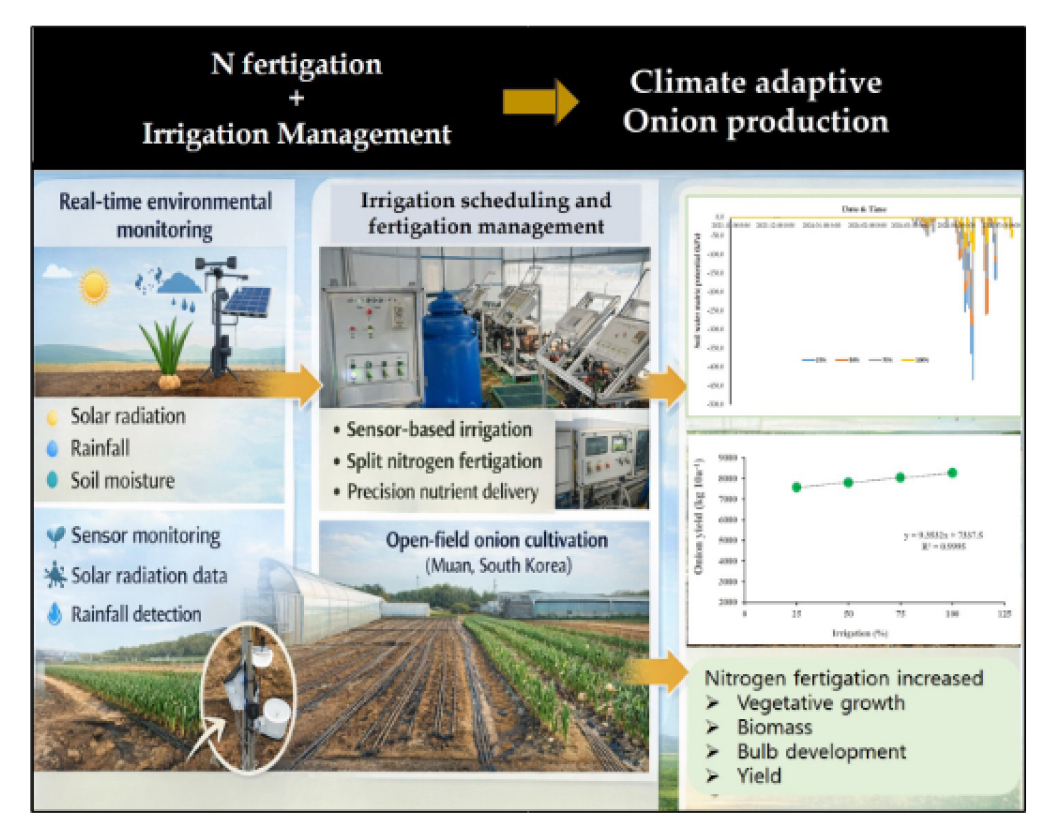
Soil water matric potential varied throughout the cultivation period and was influenced by both irrigation level and rainfall events (Fig. 2). During the early growth stages, soil water status remained relatively stable across treatments. However, greater fluctuations were observed from mid-April onward as atmospheric demand increased. The 100% irrigation treatment generally maintained comparatively higher (less negative) matric potential values, whereas reduced irrigation levels (75%, 50%, and 25%) exhibited progressively lower values. The 25% irrigation treatment showed the greatest variability, with frequent declines below -200 kPa and extreme reductions approaching -400 to -450 kPa, indicating severe soil moisture deficit conditions. Intermediate treatments (50% and 75%) also experienced notable fluctuations, though less extreme than the 25% treatment.
Despite these fluctuations, soil moisture in higher irrigation treatments remained relatively stable, confirming that irrigation scheduling based on daily accumulated solar radiation and rainfall feedback effectively buffered soil water status. Similar findings have been reported in recent studies showing that sensor-based or radiation-driven irrigation improves moisture stability and reduces water stress in shallow-rooted crops such as onion (Vyavahare et al., 2023; Derbie et al., 2024). These results suggest that moisture management can maintain favorable soil water conditions even under fluctuating climatic conditions.

Soil inorganic N dynamics
Soil inorganic N content (NO3-N + NH4+-N) varied with N fertilization rate and sampling time (Fig. 3). At the initial stage, all treatments showed similar inorganic N levels (22.8 mg kg-1), reflecting uniform baseline soil conditions. Following N application, clear differences emerged among treatments, with increasing N rates resulting in higher soil inorganic N concentrations. The 1N treatment consistently exhibited the highest values, peaking at 38.8 mg kg-1 at the early sampling stage, followed by 2/3N, 1/3N, and 0N treatments. Across the growing period, soil inorganic N levels in fertilized treatments showed a gradual decline from early to late stages. In the 1N treatment, decreased from 38.8 to 25.5 mg kg-1, while the 2/3N treatment declined from 32.9 to 22.4 mg kg-1. This reduction likely reflects progressive plant uptake during active vegetative growth and bulb development rather than accumulation of residual N in the soil. In contrast, the 0N treatment maintained relatively low and stable values throughout the cultivation period, indicating limited N availability. Overall, soil inorganic N dynamics were strongly governed by N fertilization rate, while temporal changes suggest efficient utilization of applied N by the crop. These findings are consistent with previous studies reporting that split fertigation enhances N availability during early growth stages and supports gradual uptake during later developmental phases (Valenzuela, 2024; Rathinapriya et al., 2025).

Growth responses of onion to N and controlled irrigation management
Nitrogen fertigation significantly improved onion growth throughout the cultivation period, whereas irrigation level had limited effects on most growth parameters (Tables 4, 5, 6). Plant height, pseudo-stem height, pseudo-stem diameter, leaf number, plant biomass, and bulb weight generally increased with increasing N application rate. At the final growth stage, plant height increased from 43.7 - 46.7 cm in the 0N treatment to 62.0 - 67.2 cm in the 1N treatment. Similarly, pseudo-stem height increased from 16.7 - 19.3 cm to 21.5 - 26.0 cm, while pseudo-stem diameter increased from 15.1 - 17.4 mm to 19.6 - 21.7 mm (Table 4). Leaf production also responded positively to N fertigation, with the highest leaf number (8.8 leaves) recorded in the 1N-50% and 2/3N-75% treatments, whereas the lowest values were consistently observed in the unfertilized control (0N) (Table 5).
The positive effects of N fertigation were even more pronounced for biomass accumulation and bulb development (Table 6). Final plant weight increased from 146.0 - 167.3 g under the 0N treatment to 370.5 - 390.3 g under the 1N treatment. Likewise, bulb weight increased from 87.2 - 104.0 g in the control to 247.3 - 265.7 g under full N application, representing approximately a 2.5-fold increase. Intermediate N treatments (1/3N and 2/3N) showed proportional increases in both plant and bulb biomass, indicating a clear dose-dependent response to N supply.
Two-way ANOVA further confirmed that N fertigation significantly affected most vegetative growth and bulb characteristics throughout the growing period (P < 0.05), whereas irrigation effects were generally non-significant (Tables 4, 5, 6). Although significant N × irrigation interactions were detected for a few growth parameters at specific sampling dates, these interactions were not consistently observed across the growing season or in final bulb yield. The limited irrigation response was likely attributable to adequate rainfall combined with the solar radiation-based irrigation system, which maintained favorable soil moisture conditions throughout cultivation. Similar findings have been reported in winter-grown onion and garlic, where maintaining stable root-zone moisture and temperature through black polyethylene mulching reduced water stress and created favorable conditions for crop establishment and growth (Kim et al., 2026). Under these non-limiting moisture conditions, N availability became the primary factor governing onion growth and bulb development. Similar responses have been reported in onion and other vegetable crops, where optimized N fertilization enhanced vegetative growth and yield when adequate soil moisture was maintained (Gupta et al., 2023; Lakhiar et al., 2024; Valenzuela, 2024). Overall, these findings indicate that N fertigation was the principal driver of onion growth and bulb production, while digital irrigation management effectively maintained favorable root-zone moisture conditions across irrigation treatments.
Table 4
Effects of N fertigation and irrigation on phenotypic traits of onion.
Values followed by different lowercase letters indicate significant differences among treatment combinations according to Duncan’s multiple range test (DMRT) at P < 0.05. Two-way ANOVA was performed to evaluate the main effects of nitrogen fertigation (N), irrigation (I), and their interaction (N × I). Nitrogen fertigation significantly influenced most growth parameters, whereas irrigation and the N × I interaction showed limited or stage-specific effects depending on the sampling date.
Table 5
Effects of different irrigation and N fertilization rates on leaf development of onion.
Values followed by different lowercase letters indicate significant differences among treatment combinations according to Duncan’s multiple range test (DMRT) at P < 0.05. Two-way ANOVA was performed to evaluate the main effects of nitrogen fertigation (N), irrigation (I), and their interaction (N × I). Nitrogen fertigation significantly influenced most growth parameters, whereas irrigation and the N × I interaction showed limited or stage-specific effects depending on the sampling date.
Table 6
Effects of different irrigation and N fertilization on plant biomass and bulb development of onion.
Values followed by different lowercase letters indicate significant differences among treatment combinations according to Duncan’s multiple range test (DMRT) at P < 0.05. Two-way ANOVA was performed to evaluate the main effects of nitrogen fertigation (N), irrigation (I), and their interaction (N × I). Nitrogen fertigation significantly influenced most growth parameters, whereas irrigation and the N × I interaction showed limited or stage-specific effects depending on the sampling date.
N fertigation and irrigation on onion yield
Onion yield increased significantly with increasing N fertilization, whereas irrigation level had no significant effect on yield (Fig. 4). The lowest yield was recorded in the 0N - 25% irrigation treatment (2,573 kg 10a-1), while the highest yield was obtained in the 1N - 100% treatment (8,272 kg 10a-1), representing more than a threefold increase. Yield increased progressively from 0N to 1/3N, 2/3N, and 1N across all irrigation treatments, indicating a strong N-dependent response. Under the 1N treatment, yields ranged from 7,575 to 8,272 kg 10a-1, whereas under the 2/3N treatment yields ranged from 7,061 to 7,686 kg 10a-1, suggesting that N supply was the primary factor determining bulb productivity.

Within each N level, irrigation treatments resulted in only small yield differences. Regression analysis showed a positive relationship between irrigation level and yield within each N treatment (R2 = 0.84 - 0.99); however, these increases were not statistically significant. The absence of a significant irrigation effect is likely attributable to sufficient seasonal rainfall and solar radiation-based irrigation management, which maintained adequate soil moisture throughout the growing period. Consequently, N availability became the dominant factor regulating bulb production. Similar findings have been reported in onion production systems where adequate soil moisture allowed crop response to be driven primarily by N fertilization rather than irrigation level (Teixeira et al., 2014; Lee and Sung, 2023). These results indicate that optimizing N fertigation is more important than increasing irrigation volume for maximizing onion yield under well-managed moisture conditions.
Conclusions
This study demonstrated that N fertigation was the primary factor regulating soil inorganic N availability, vegetative growth, bulb development, and yield of onion under open-field conditions. Increasing N application significantly enhanced plant growth, biomass accumulation, bulb weight, and final yield, while the gradual decline in soil inorganic N during crop development indicated efficient nutrient uptake and utilization. In contrast, irrigation level had limited effects on growth and yield parameters, whereas N × irrigation interactions were generally limited and did not influence final bulb yield. A key finding of this study was that the solar radiation- based digital irrigation system successfully maintained favorable soil moisture conditions throughout the growing season, even under reduced irrigation inputs. Under these non-limiting soil moisture conditions, nitrogen availability became the principal factor governing onion growth and productivity, with the highest growth and yield achieved under the 1N treatment. Overall, these findings demonstrate that integrating N fertigation with irrigation management can improve nutrient-use efficiency, optimize water management, and support sustainable onion production under variable climatic conditions.