


Introduction
Limited implications of experimental results
Data status
The need for a Korean database on crop-soil responses to microplastic toxicity
Conclusions
Introduction
Plastics are synthetic organic polymers produced through the polymerization of monomers obtained from oil or natural gas. In the 1950s, plastics began to emerge as ubiquitous materials across diverse domains of human activity (Barnes et al., 2009). Primary plastic production increased from approximately 2 Mt in 1950 to 380 Mt in 2015, yielding 8,300 Mt in total (Geyer et al., 2017). Driven largely by industrial activities, global annual plastic production, use, and waste generation are projected to increase by nearly 70% by 2040 compared with 2020 levels, when production reached 435 Mt (OECD, 2024). In agriculture, plastic-based materials have become essential inputs following the adoption of plastic films to protect crops and enhance yields. In 2019, agricultural value chains accounted for 12.5 Mt of plastic products in plant and animal production, including cultivation, fertilization, and plastic mulching, and 37.3 Mt in food packaging (FAO, 2021). Due to their resistance to mineralization, environmental plastics persist as micro-fragments (<5 mm), classified as secondary microplastics, which are generated through weathering processes such as oxidative degradation, photodegradation, thermal degradation, and hydrolysis. Consequently, plastic accumulation in agricultural soils, along with the extent of their ecological footprint, is projected to increase proportionally with continued inputs.
The principal sources of microplastics in agricultural environments include mulching films, compost, sewage sludge, waste water irrigation, and atmospheric deposition (Tian et al., 2022). These inputs can accelerate soil degradation and compound the environmental contamination already associated with agrochemicals. Microplastics are typically hydrophobic and have large surface areas, which facilitate the accumulation of organic pollutants (Anderson et al., 2016). In addition, various heavy metals and other toxic substances can physically adsorb onto plastic surfaces, facilitating their transport in the environment and altering their mobility and bioavailability. Environmental microplastics can enter plants through several uptake and translocation mechanisms, including foliar absorption, stem translocation, apoplastic and symplastic movement, and entry through cracks (Jamil et al., 2025). Such interactions may create cumulative pollution effects, disrupt soil and crop processes, and consequently affect biogeochemical cycling. Increasing evidence highlights soil contamination as an emerging threat to agricultural productivity and soil functions (de Souza Machado et al., 2019; Zhang et al., 2022; Chaudhary et al., 2025; Jamil et al., 2025). In some studies, microplastics in soils have been linked to reduced microbial diversity and inhibited crop growth, suggesting potential risks for crop yield (Zhang et al., 2022).
In this opinion paper, we emphasize the limited applicability of existing data in addressing the widespread presence of plastics in agricultural systems and their impacts on crops. We also examine the common structure of microplastic datasets in agricultural contexts and evaluate their potential utility for supporting soil modeling efforts. Finally, we propose a strategy to develop a new soil-crop-microplastic database by analyzing archived samples and linking this information to the existing soil database.
Limited implications of experimental results
One line of research has emphasized the accurate quantification of microplastics. Microplastics are characterized by polymer type, color, shape, and physicochemical properties (i.e., hydrophobicity, density, transparency, buoyancy) (Ko et al., 2024). Some progress has been made in addressing critical issues, including the standardization of sampling and measurement methods and the analysis of microplastics with diverse characteristics in soils (Fig. 1); however, these efforts remain insufficient. Another line of research has investigated the adsorption behavior of microplastics toward selected contaminants under controlled laboratory conditions, typically using specific polymer types. For example, recent meta-analysis showed that microplastics could increase the bioavailability of Cu, Pb, Cd, Fe, and Mn (An et al., 2023; Sun et al., 2024). These effects are largely attributed to the hydrophobicity and large specific surface area of microplastics, which influence the retention and release of agrochemicals and environmental toxicants in similar ways. Plant physiological, biochemical, and growth responses under microplastic stress have also been studied elsewhere (Jamil et al., 2025). Phytotoxicity was commonly highlighted, with a focus on alterations in gene expression, plant growth, reactive oxygen species, and antioxidant enzyme activities, as revealed by omics analyses. These results provide valuable mechanistic insights; however, their broader implications are limited by the boundary conditions inherent to aqueous solutions. Particularly in soil systems, few studies have effectively characterized plant responses in relation to the origin, distribution, and behavior of microplastics. Nonetheless, the practical relevance lies in the fact that the polymers studied are among the most widely used in agricultural applications. For Korean agricultural soils, although limited, incubation-based studies have examined the effects of microplastics on microbial and chemical properties (Palansooriya et al., 2023) as well as on plant growth (Lee et al., 2025). While these laboratory approaches provide valuable mechanistic and microscale insights, their relevance to real-world agricultural conditions remains limited. Therefore, we emphasize that the findings must be interpreted and applied appropriately, considering their intended context.
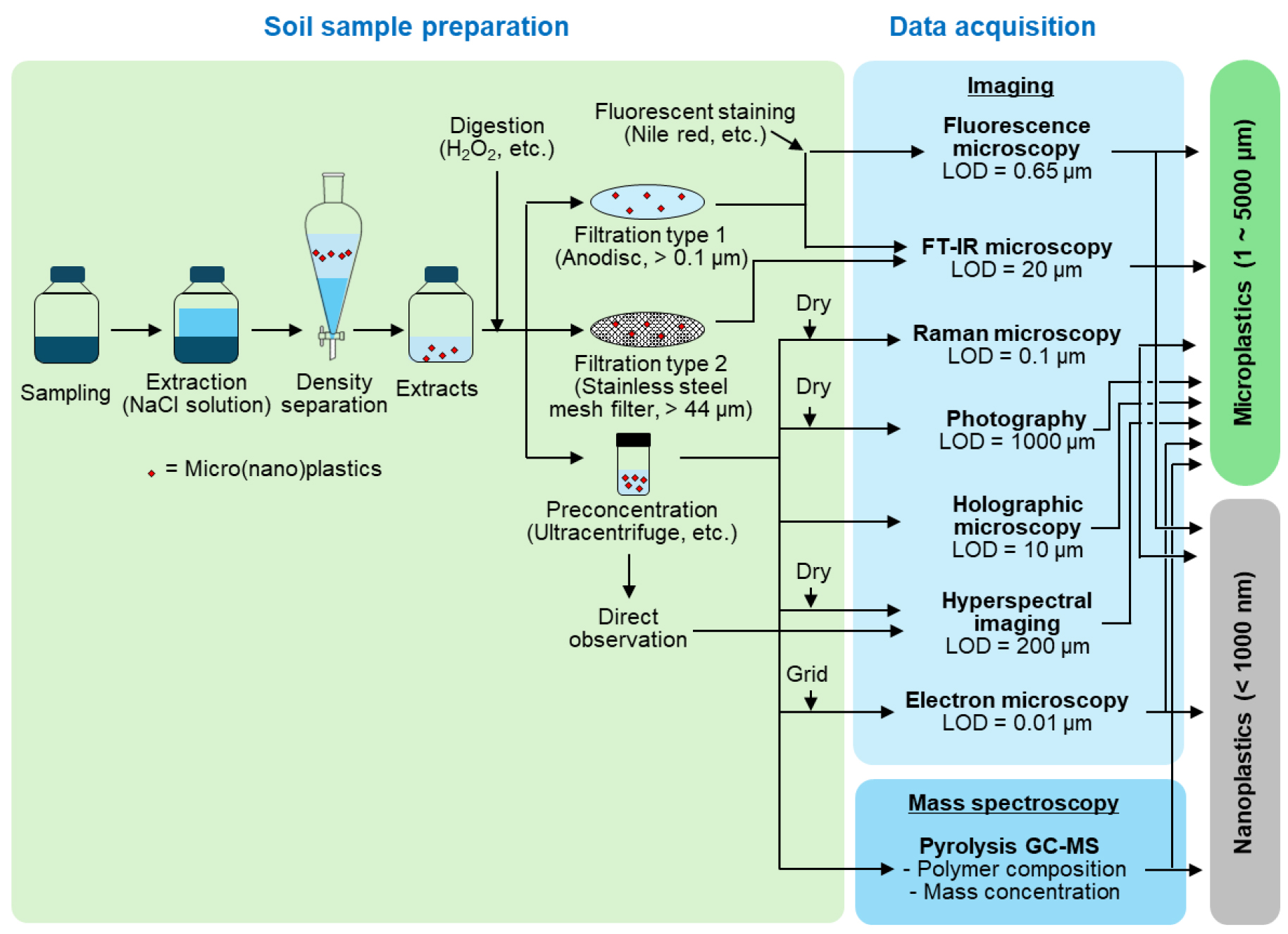
Fig. 1
Methods for analyzing micro(nano)plastics (MNPs) in soils, including sample preparation and data acquisition. Analytical instruments and their respective limits of detection (LOD) are shown according to micro(nano)plastic particle size. Modified from Ko et al. (2024).
Overall, this study identifies four research axes: (1) quantification and characterization, (2) adsorption and contaminant interactions, (3) plant physiological responses, and (4) soil microbial and chemical responses. All four axes require empirical validation. Table 1 presents an overview of these axes, emphasizing their boundary conditions, major limitations, and prospective directions to enhance field applicability.
Table 1
Summary of experimental approaches, boundary conditions, and research needs for microplastic studies in soils in Korean agricultural soils.
Data status
In Korean agriculture, organic waste compost is derived primarily from livestock waste and agricultural by-products. In 2023, the annual generation of animal waste was estimated at approximately 50.9 Mt (MAFRA, 2024). Of this amount, about 72.7% is converted into compost and 11.8% into liquid fertilizers, which are subsequently applied to agricultural land (MAFRA, 2024). This amount is considerable when compared with the quantity of chemical fertilizers applied, which totaled 388 thousand tons in 2023. The role of these by-product fertilizers in crop production is increasing relative to conventional fertilizers. However, data on the occurrence and status of microplastics potentially contained in these fertilizers are still limited. In addition, plastic mulching represents another major contributor to microplastic accumulation in soils. In 2023, approximately 52.0% of agricultural vinyl waste, totaling 290 thousand tons, originated from mulching practices (KEC, 2024). This agricultural vinyl primarily consisted of low-density polyethylene (LDPE), high-density polyethylene (HDPE), polyvinyl chloride (PVC), ethylene-vinyl acetate (EVA), and polypropylene (PP). However, only 161,193 Mt were reported as recycled during the same period. These statistics reflect either total plastic inputs or estimates of recycled material, without accounting for residual microplastic accumulation. Limited evidence is still available regarding microplastic residues in relation to differences in the use of mulching and vinyl films.
Lee et al. (2024) reviewed and analyzed 18 studies on microplastic contamination and associated risks in soil and groundwater, seven of which involved field surveys or experiments. Specifically, Choi et al. (2021) reported that agricultural soils in Yeoju, Korea (n = 9) contained an average of 664 particles kg-1. Among land-use types, PE and PP concentrations were highest in orchards (n = 4), followed by upland (n = 48), greenhouse (n = 8), and paddy fields (n = 8). Notably, fragments were the predominant shape, whereas films and fibers were comparatively less abundant. Kim et al. (2021) measured microplastic abundances in soils from 10 fields for each land use type, including mulched fields, paddy rice fields, and areas inside and outside greenhouses, reporting average abundances of 81, 160, 1,880, and 1,302 particles kg-1, respectively. At a more localized scale, Chia et al. (2023) found that the microplastic abundances in greenhouse and mulched soils in Haean ranged from 50 to 379 and 158 to 943 particles kg-1, respectively (n = 5). Similarly, in Namyangju, Korea, tilled soils, bare ground, and areas between greenhouses contained 241, 195, and 306 particles kg-1, respectively (n = 2) (Park and Kim, 2022). These studies reported microplastic abundances by polymer type, according to land use and soil management practices. Such field evidence is critical for understanding the scale and characteristics of microplastic contamination in agricultural environments. Based on these data, relative abundances and cumulative relative abundances can be calculated, providing additional insights into distribution patterns. The data also included the polymer types present in the soils, as well as particle size and shape mostly within the top 5 cm of soil, with PE, PP, and PVC being the most dominant. One of the key conclusions from this review study is the lack of data that capture both spatial and temporal variability. Under Korean conditions, the available data are not yet sufficiently developed to support carbon cycle or other biogeochemical models aimed at predicting crop yields.
The need for a Korean database on crop-soil responses to microplastic toxicity
For Korean soils, we propose the establishment of a quantitative database structured across four categories, with the primary objective of supporting crop-specific, national-scale monitoring and assessment (Table 2). The database categories comprise: (1) site information, (2) microplastic characteristics, (3) soil chemical properties, and (4) crop response variables. Site information includes land use type, geographic features, and details of management practices. Microplastic parameters should be classified by polymer type and further specified according to physical and chemical properties. Physical parameters comprise particle size, abundance (particles kg-1), and density, while chemical parameters include both production-related additives and sorbed elements, notably Cd, Cu, Pb, and Zn (Ebrahimi et al., 2022). The soil data are obtained from the “HeukToram” database, which provides comprehensive soil test results. The dataset includes eight key parameters: pH (1:5 H2O), available P2O5 (mg kg-1), available SiO2 (mg kg-1), organic matter (g kg-1), exchangeable magnesium (cmol(+) kg-1), potassium (cmol(+) kg-1), calcium (cmol(+) kg-1), and electrical conductivity (EC; dS m-1). The crop data are intended to assess plant responses and interactions with the soil chemical environment. Supplementary information may include detailed standardized methodologies for analyzing archived samples to ensure comparability.
Table 2
Proposed microplastic characteristics and crop response variables for integration into the RDA soil test database (0 – 15 cm) for soil and crop impact assessments.
| Variable | Content | Method (detection limits) | Units |
| Site info | |||
| Land use |
Agricultural context: rice paddy, upland field, greenhouse, mulched field (4), other | Field survey and classification | |
| Field location |
Geographic coordinates (latitude and longitude) |
Conversion of postal address to geographic coordinates; WGS-84 datum | degrees |
| Management | Tillage, fertilization, irrigation, liming | Field survey | |
| Crop response | |||
| Crop type1 |
Crop common name and assigned code (cultivar, if available) | Field record | |
| Yield | Total harvested crop biomass at maturity |
1 m2 quadrat sampling; 3 - 5 replicates; ≥20 heads or pods per sample |
kg ha-1 (or equivalent) |
| Elements |
Carbon, nitrogen, lignin in harvested biomass | 3 - 5 composite samples |
kg ha-1 (or equivalent) |
| Harvest index |
Ratio of harvested biomass to total aboveground biomass |
1 m2 quadrat sampling; 5 replicates; ≥20 plants per sample | |
| Microplastic characteristics | |||
| Polymer type2 |
Polyethylene (PE), polypropylene (PP), polyvinyl chloride (PVC), etc. |
Single archived sample per field; FTIR/Ramen microspectroscopy | |
| Shape2 |
Fragments, films, fibers, beads, foams, etc. |
Single archived sample per field; image analysis | |
| Size2 | Size ranges or mean particle size |
Single archived sample per field; image analysis (≥50 - 100 µm) | µm or mm |
| Abundance2 | Number of particles per unit soil mass |
Single archived sample per field; FTIR/Ramen microspectroscopy (~10 - 100 particles kg-1 soil) | particle kg-1 |
| Density2 |
Bulk or polymer-specific mass concentration |
Single archived sample per field; density analysis + Pyrolysis–GC/MS (0.1 - 1 mg kg-1 soil) |
mg kg-1 (or equivalent) |
| Contaminants |
Heavy metals adsorbed on microplastics (e.g., Cu, Pb, Cd, Fe, and Mn) |
Single archived sample per field; ICP-MS (0.001 - 0.1 µg g-1) |
µg g-1 (or equivalent) |
1The Open Data Portal (www.data.go.kr) provides standard crop codes for 64 crops, including cereals, pulses, potatoes, and oil crops.
2Refer to Ko et al. (2024) for details on microplastic analyses.
Evidence for this need is supported by studies demonstrating that microplastics can alter soil fertility and plant growth. A recent meta-analysis, for example, showed that microplastics can increase heavy metal bioavailability in acidic or sandy soils, as well as in soils with >20% organic matter (An et al., 2023). Consistently, Sun et al. (2024) reported enhanced bioavailability in representative agricultural soils, including those with organic matter contents exceeding 3%. Bioavailability is typically defined as the response ratio between treated and control soils, with elevated values indicating potential disruption of plant metabolism and consequent reductions in crop yield and quality. For monitoring purposes, however, bioavailability may alternatively be inferred from increasing microplastic abundance. In Korean agricultural soils, PE levels have been linked to shifts in bacterial community composition and several soil chemical properties, including pH, electrical conductivity, available phosphate, and total exchangeable cations (Palansooriya et al., 2023).
At sites with high microplastic abundance, studies have reported impaired seed germination and root development in food crops and vegetables. Microplastics generally hinder early growth and can limit overall development (Hasan and Jho, 2022). For assessing plant responses, biogeochemically meaningful variables include shoot and root biomass as well as crop-specific harvest yields, which can be directly integrated with soil microplastic data. Optionally, compost type and source should also be recorded, as compost, while classified as an organic fertilizer, is derived from heterogeneous organic waste streams and may itself serve as a microplastic input. This approach aligns with the original purpose of soil data collection in Korea, which was designed to inform organic matter management and fertilizer recommendations.
Collectively, these findings underscore the value of archived agricultural soil samples, typically collected at 0 - 20 cm depth and already characterized for chemical properties, as a resource for microplastic analyses that can be integrated with the existing RDA soil database (NAS, 2025). For each valid sample, metadata are available to identify land use type, the sampling location, the date of collection, and the corresponding timespan. To ensure representative coverage, rigorous sample selection must be discussed to capture spatial heterogeneity across different land uses and soil types. Furthermore, temporal considerations must be addressed to ensure that the selected samples accurately reflect current contamination trends and ongoing environmental pressures. Additionally, crop data are essential for linking the sampled field locations to crop yields and biomass statistics, as well as to farm management information.
The regulation and mitigation of agricultural microplastics represent a global environmental challenge, particularly given the uncertain combined impacts of plastic pollution and climate change (IPCC, 2022). Addressing this challenge requires standardized frameworks for the measurement, management, and regulation of microplastics in soils and crops. We argue that developing a dedicated database is essential not only for systematic monitoring but also for establishing mechanistic links between soil microplastic contamination and crop-level impacts, thereby providing a robust scientific basis for agricultural management.
Conclusions
While laboratory experiments and field surveys have provided valuable insights into the interactions among microplastics, soil, and plants, their applicability to real-world agricultural systems is still constrained. In Korea, data on microplastic occurrence, characteristics, and crop responses are currently fragmented and lack sufficient spatial and temporal resolution. Establishing a structured, quantitative database that integrates site information, microplastic properties, soil fertility indicators, and crop performance matrix is therefore critical. Such a resource would support national-scale monitoring, enable a more comprehensive understanding of microplastic impacts, and support evidence-based management strategies and policymaking. In our view, bridging the gap between controlled experiments and real-world applications is critical. This can be achieved by leveraging existing soil test databases and archived samples for integrated biogeochemical analyses linking soil and crop components to microplastic contamination. Developing a dedicated soil-crop-microplastic database would form a foundational tool for mitigating the environmental and agronomic risks associated with microplastic pollution, ultimately supporting sustainable crop production under increasing plastic pollution and climate pressures.