Biochar loss from rice paddies: A bottomless pit for carbon sequestration?
© 2026 The Korean Society of Soil Science and Fertilizer
ABSTRACT
Introduction
Biochar (BC), a stable and carbon (C) enriched material derived from the pyrolysis of biomass under oxygen-limited conditions, has a great potential to sequester atmospheric carbon dioxide (CO2) (Baek et al., 2024; Han et al., 2024, 2025; Pia et al., 2024). Several studies have demonstrated that application of BC increased soil organic C (SOC) (Liu et al., 2012, 2019, 2023; Chen et al., 2016, 2024; Lu et al., 2020; Zhang et al., 2020; Sriphirom et al., 2021; Yang et al., 2024). Theoretically, the increment of SOC following biochar application may be typically affected by feedstock, pyrolysis temperature, particle size, and application rate of biochar (Table 1 and references therein). For example, it is widely reported that the stability of lignocellulosic BC is higher than herbaceous BC; the former forms a more aromatic C structure-recalcitrant to microbial decomposition-due to its high lignin content (Tomczyk et al., 2020; Li et al., 2023). Higher pyrolysis temperature also favors SOC increment, as the recalcitrant C content of BC generally increases with temperature through the loss of labile C components (Leng and Huang, 2018; Li et al., 2023). Additionally, smaller BC particles may enhance SOC stabilization by providing a higher surface area for organo-mineral interactions (Zhang et al., 2015; Abbruzzini et al., 2017; Song et al., 2024). Finally, higher application of BC naturally leads to greater SOC content through the direct addition of larger C pools (Lee et al., 2023; Meng et al., 2024; Wen et al., 2025).
However, these postulations regarding the relationship between BC characteristics and SOC increments may not hold true in rice growing paddies if the applied BC is lost from the system. There is growing evidence of the potential loss of BC via physical disintegration and chemical mineralization under field conditions (Ameloot et al., 2013; Wang et al., 2013; Wang et al., 2016; Rasse et al., 2017; Ventura et al., 2019; Nan et al., 2023; Lyu and Zimmerman, 2025). Notably, Lyu and Zimmerman (2025) compared BC loss between laboratory and field conditions, reporting that while BC loss in laboratory conditions was negligible (0.4 - 3%), it increased up to 93.3% under field conditions. Therefore, understanding the mechanisms and pathways of BC is critical to enhance SOC by BC application. In this opinion paper, we delineate potential mechanisms of BC loss and propose future research directions to investigate these BC losses from rice paddies.
Table 1.
Theoretical mechanisms of factors affecting the magnitude of increases in soil organic carbon by biochar application.
Mechanisms and Pathways of Potential BC Loss in Rice Paddies
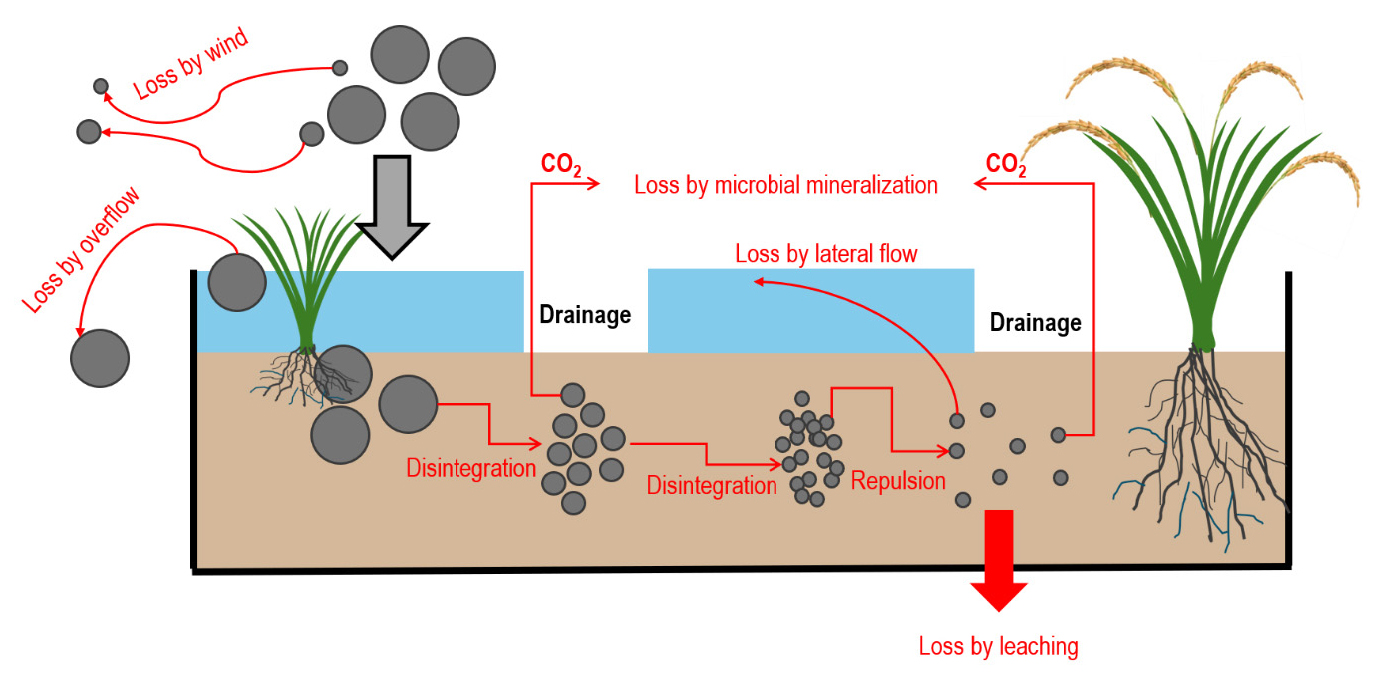
Here, we propose the mechanisms and pathways of BC loss from rice paddies. The skeleton density (solid + closed pores) of BC ranges from 1.36 g cm-3 to 1.96 g cm-3, whereas its envelope density (solid + closed pores + open pores) is lower (0.25 - 0.60 g cm-3) than that of water (Brewer et al., 2014). Therefore, there is a high possibility of BC loss during field application via wind (wind erosion) and immediately after application through overflow (water erosion) (IBI, 2010; Silva et al., 2015). Once incorporated into the soils, BC particles undergo physical disintegration driven by irrigation and drainage cycle under high summer temperature, further facilitated by the activity of roots and soil fauna (Wang et al., 2013; Lyu and Zimmerman, 2025). The fine BC particles resulting from the disintegration of larger BC fragments are more susceptible to microbial mineralization to CO2 due to their increased surface area (Ventura et al., 2019). Furthermore, these fine particles generally exhibit a more negative zeta potential, leading to increased electrostatic repulsion both between BC particles and between BC particles and soil clays (Wang et al., 2013; Tong et al., 2020; Yuan et al., 2023). This increased repulsion should facilitate the dispersion of BC particles, ultimately increasing both vertical and lateral loss (Wang et al., 2013; Lyu and Zimmerman, 2025) (Fig. 1). Although vertically transported BC particles may still remain in the soils, this BC-derived C may not be accounted for SOC storage if the BC particles migrate into soil layers deeper than 30 cm. This is because of the IPCC Tier 1 guideline, which sets a default soil depth of 30 cm for assessing SOC accrual (IPCC, 2006).
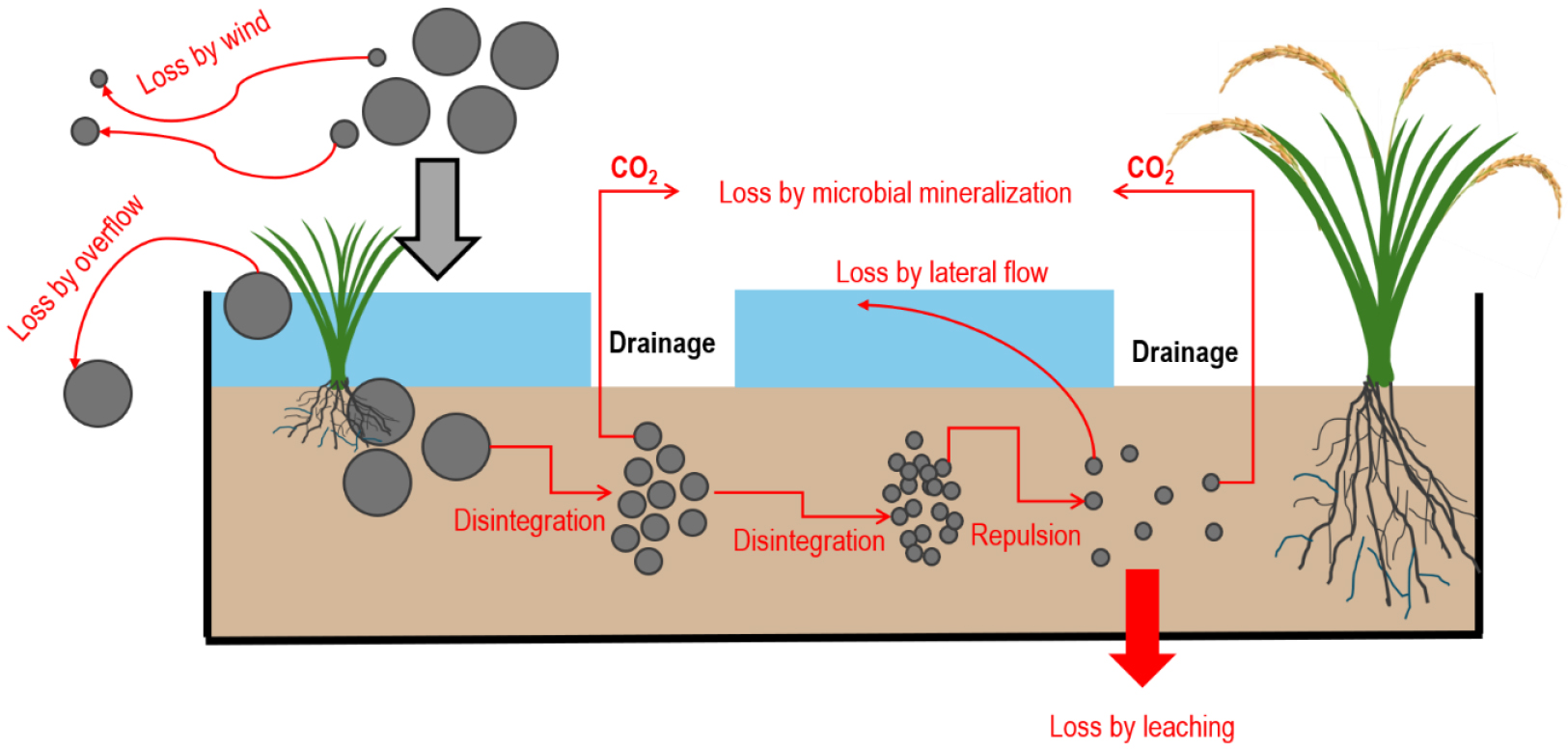
Fig. 1
Possible mechanisms and pathways of loss of biochar applied to rice paddies. BC can be lost via wind, overflow, and physical disintegration followed by microbial mineralization and lateral and vertical migration of fine BC particles.
Future Research Directions
Despite the potential for BC loss, several meta-analyses have reported that SOC increments are enhanced by increasing BC application rates in rice paddies (Lee et al., 2023; Meng et al., 2024; Wen et al., 2025). However, these studies did not specifically investigate the linearity of the SOC response to BC application rates. Given the high potential for BC loss in rice paddies, we hypothesize that SOC may increase nonlinearly with increasing BC rates, which warrants further investigation into the precise patterns of SOC accumulation in responses to BC rates. Regarding BC particle size, since smaller particles are more susceptible to loss via surface runoff and vertical transport (Zhang et al., 2015; Abbruzzini et al., 2017; Song et al., 2024), it is highly required to examine the effect of BC particle sizes on the loss of BC applied to paddy soils. In this context, the particle size distribution of BC used in studies should be reported. Indeed, the IBI (2015) also recognizes particle size of BC as a key quality parameter for biochar characterization.
Biochar applied to rice soils may undergo complex physical, chemical, and microbiological transformations. Therefore, it is necessary to trace the fate of BC in rice paddies, including its redistribution within the soil matrix, microbial mineralization, and migration both into deeper soil layers and out of the soil systems. This can be effectively achieved by employing 13C-labeled BC, produced via 13C labeling of biochar feedstock (e.g., rice plants) followed by pyrolysis (Farrell et al., 2013; Chalk and Smith, 2022; Liang et al., 2023). Finally, increasing the envelope density of BC by filling its open pores may mitigate BC loss by enhancing the sedimentation of BC applied and by preventing the floatation of settled BC particles, thereby reducing susceptibility to wind and water erosion (Brewer et al., 2014).
Conclusions
In this opinion paper, we have outlined several mechanisms of BC loss-namely wind erosion, water erosion, leaching, and microbial mineralization-that may result in nonlinear increases in SOC following BC application. To improve the efficiency of BC for SOC enhancement, mitigating these BC losses from rice paddies is critical for the sustainable utilization of BC for CO2 sequestration. However, current understanding of the fate of BC in rice paddy fields remains very limited. Therefore, future studies need to trace the physical, chemical, and microbiological fates of BC, particularly by employing 13C-labeled BC with varying particle sizes. Furthermore, it is also necessary to develop methodologies for engineering BC with a higher envelope density by modifying its open-pore structure, thereby enhancing its retention and long-term stability in the fields.
Funding
This work was carried out with the support of the “Cooperative Research Program of Agriculture Science and Technology Development (RS-2023-00229969),” Rural Development Administration, Republic of Korea.
Conflict of Interest
The authors declare no conflict of interest.
Author Contribution
Baek N: Investigation, Writing-original draft, Lee SI: Investigation, Writing-original draft, Pia HI: Investigation, Park SW: Investigation, Shin ES: Investigation, Lee TY: Investigation, Kim HY: Supervision, Conceptualization, Writing-review & editing, Choi WJ: Supervision, Conceptualization, Writing-review & editing.
Data Availability
The data that support the findings of this study will be available on reasonable request.
Acknowledgements
The authors thank Chonnam National University, Republic of Korea for the research support.
References
Abbruzzini TF, Moreira MZ, de Camargo PB, Conz RF, Cerri CEP. 2017. Increasing rates of biochar application to soil induce stronger negative priming effect on soil organic carbon decomposition. Agric. Res. 6:389-398. https://doi.org/10.1007/s40003-017-0281-7
10.1007/s40003-017-0281-7Ameloot N, Graber ER, Verheijen FGA, De Neve S. 2013. Interactions between biochar stability and soil organisms: review and research needs. Eur. J. Soil Sci. 64:379-390. https://doi.org/10.1111/ejss.12064
10.1111/ejss.12064Bekchanova M, Campion L, Bruns S, Kuppens T, Lehmann J, Jozefczak M, Cuypers A, Malina R. 2024. Biochar improves the nutrient cycle in sandy-textured soils and increases crop yield: a systematic review. Environ. Evid. 13:3. https://doi.org/10.1186/s13750-024-00326-5
10.1186/s13750-024-00326-539294832PMC11376106Brewer CE, Chuang VJ, Masiello CA, Gonnermann H, Gao X, Dugan B, Driver LE, Panzacchi P, Zygourakis K, Davies CA. 2014. New approaches to measuring biochar density and porosity. Biomass Bioenerg. 66:176-185. https://doi.org/10.1016/j.biombioe.2014.03.059
10.1016/j.biombioe.2014.03.059Chagas JKM, de Figueiredo CC, Ramos MLG. 2022. Biochar increases soil carbon pools: Evidence from a global meta-analysis. J. Environ. Manage. 305:114403. https://doi.org/10.1016/j.jenvman.2021.114403
10.1016/j.jenvman.2021.114403Chalk P, Smith CJ. 2022. 13C methodologies for quantifying biochar stability in soil: A critique. Eur. J. Soil Sci. 73:e13245. https://doi.org/10.1111/ejss.13245
10.1111/ejss.13245Chen J, Sun X, Li L, Liu X, Zhang B, Zheng J, Pan G. 2016. Change in active microbial community structure, abundance and carbon cycling in an acid rice paddy soil with the addition of biochar. Eur. J. Soil Sci. 67:857-867. https://doi.org/10.1111/ejss.12388
10.1111/ejss.12388Chen Z, He L, Ma J, Ma J, Ye J, Yu Q, Zou P, Sun W, Lin H, Wang F, Zhao X, Wang Q. 2024. Long-term successive biochar application increases plant lignin and microbial necromass accumulation but decreases their contributions to soil organic carbon in rice-wheat cropping system. GCB Bioenergy 16:e13137. https://doi.org/10.1111/gcbb.13137
10.1111/gcbb.13137Farrell M, Kuhn TK, Macdonald LM, Maddern TM, Murphy DV, Hall PA, Singh BP, Baumann K, Krull ES, Baldock JA. 2013. Microbial utilisation of biochar-derived carbon. Sci. Total Environ. 465:288-297. https://doi.org/10.1016/j.scitotenv.2013.03.090
10.1016/j.scitotenv.2013.03.090Han KH, Lee SB, Oh YL, Song ES, Yun SI, Kwak JH. 2025. CO2 sequestration potential over 100 years of cattle manure biochar in soil as affected by different feedstocks and pyrolysis temperature. Korean J. Soil Sci. Fert. 58:405-415. https://doi.org/10.7745/KJSSF.2025.58.3.405
10.7745/KJSSF.2025.58.3.405Han KH, Yun SI, Choi DH, Lee SI. 2024. Net CO2 removal of rice husk biochar as soil amendment depending on energy reuse in the production stage. Korean J. Soil Sci. Fert. 57:130-139. https://doi.org/10.7745/KJSSF.2024.57.2.130
10.7745/KJSSF.2024.57.2.130IBI (International Biochar Initiative). 2010. Guidelines on practical aspects of biochar application to field soil in various soil management systems. IBI, Ithaca, New York, USA.
IBI (International Biochar Initiative). 2015. Standardized product definition and product testing guidelines for biochar that is used in soil. IBI, Ithaca, New York, USA.
IPCC (Intergovernmental Panel on Climate Change). 2006. IPCC guidelines for national greenhouse gas inventories. pp. 27-43. In Page Eggleston HS et al. (Eds.) Agriculture, forestry and other land use, Vol. 4. Institute for Global Environmental Strategies (IGES), Hayama, Japan.
Lee JM, Jeong HC, Gwon HS, Lee HS, Park HR, Kim GS, Park DG, Lee SI. 2023. Effects of biochar on methane emissions and crop yields in East Asian paddy fields: A regional scale meta-analysis. Sustainability 15:9200. https://doi.org/10.3390/su15129200
10.3390/su15129200Li L, Long A, Fossum B, Kaiser M. 2023. Effects of pyrolysis temperature and feedstock type on biochar characteristics pertinent to soil carbon and soil health: A meta-analysis. Soil Use Manage. 39:43-52. https://doi.org/10.1111/sum.12848
10.1111/sum.12848Liang Y, Li X, Yang F, Liu S. 2023. Tracing the synergistic migration of biochar and heavy metals based on 13C isotope signature technique: Effect of ionic strength and flow rate. Sci. Total Environ. 859:160229. https://doi.org/10.1016/j.scitotenv.2022.160229
10.1016/j.scitotenv.2022.160229Liu X, Qu J, Li L, Zhang AF, Zheng J, Zheng J, Pan G. 2012. Can biochar amendment be an ecological engineering technology to depress N2O emission in rice paddies?—A cross site field experiment from South China. Ecol. Eng. 42:168-173. https://doi.org/10.1016/j.ecoleng.2012.01.016
10.1016/j.ecoleng.2012.01.016Liu X, Zhou J, Chi Z, Zheng J, Li L, Zhang X, Zheng J, Cheng K, Bian R, Pan G. 2019. Biochar provided limited benefits for rice yield and greenhouse gas mitigation six years following an amendment in a fertile rice paddy. Catena 179:20-28. https://doi.org/10.1016/j.catena.2019.03.033
10.1016/j.catena.2019.03.033Liu Z, Zhang W, Ma R, Li S, Song K, Zheng J, Wang Y, Bian R, Zhang X, Pan G. 2023. Biochar-plant interactions enhance nonbiochar carbon sequestration in a rice paddy soil. Commun. Earth Environ. 4:494. https://doi.org/10.1038/s43247-023-01155-z
10.1038/s43247-023-01155-zLu H, Bian R, Xia X, Cheng K, Liu X, Liu Y, Wang P, Li Z, Zheng J, Zhang X, Li L, Joseph S, Drosos M, Pan G. 2020. Legacy of soil health improvement with carbon increase following one time amendment of biochar in a paddy soil - A rice farm trial. Geoderma 376:114567. https://doi.org/10.1016/j.geoderma.2020.114567
10.1016/j.geoderma.2020.114567Lyu J, Zimmerman AR. 2025. Large losses of pyrogenic carbon (biochar) and native soil carbon during a 15-month field study in North Florida, USA. Agriculture 15:300. https://doi.org/10.3390/agriculture15030300
10.3390/agriculture15030300Meng X, Zheng E, Hou D, Qin M, Meng F, Chen P, Qi Z. 2024. The effect of biochar types on carbon cycles in farmland soils: A meta-analysis. Sci. Total Environ. 930:172623. https://doi.org/10.1016/j.scitotenv.2024.172623
10.1016/j.scitotenv.2024.172623Nan Q, Tang L, Chi W, Waqas M, Wu W. 2023. The implication from six years of field experiment: the aging process induced lower rice production even with a high amount of biochar application. Biochar 5:27. https://doi.org/10.1007/s42773-023-00218-w
10.1007/s42773-023-00218-wPia HI, Baek N, Park SW, Shin ES, Lee SI, Kim HY, Tang S, Cheng W, Kwak JH, Park HJ, Choi WJ. 2024. Luxury application of biochar does not enhance rice yield and methane mitigation: a review and data synthesis. J. Soils Sediments 24:2652-2668. https://doi.org/10.1007/s11368-024-03830-w
10.1007/s11368-024-03830-wRasse DP, Budai A, O’Toole A, Ma X, Rumpel C, Abiven S. 2017. Persistence in soil of Miscanthus biochar in laboratory and field conditions. PLoS One 12:e0184383. https://doi.org/10.1371/journal.pone.0184383
10.1371/journal.pone.018438328873471PMC5584961Silva FC, Borrego C, Keizer JJ, Amorim JH, Verheijen FGA. 2015. Effects of moisture content on wind erosion thresholds of biochar. Atmos. Environ. 123:121-128. https://doi.org/10.1016/j.atmosenv.2015.10.070
10.1016/j.atmosenv.2015.10.070Song K, Jiang S, Liu Z, Cai Y, Liu W, Bian R, Zhang X, Zheng J, Li L. 2024. Biochar improves soil organic carbon sequestration potential in the topsoil and subsoil of a paddy field. Curr. Res. Environmental Sustainability 8:100267. https://doi.org/10.1016/j.crsust.2024.100267
10.1016/j.crsust.2024.100267Sriphirom P, Chidthaisong A, Yagi K, Tripetchkul S, Boonapatcharoen N, Towprayoon S. 2021. Effects of biochar on methane emission, grain yield, and soil in rice cultivation in Thailand. Carbon Manag. 12:109-121. https://doi.org/10.1080/17583004.2021.1885257
10.1080/17583004.2021.1885257Tomczyk A, Sokołowska Z, Boguta P. 2020. Biochar physicochemical properties: pyrolysis temperature and feedstock kind effects. Rev. Environ. Sci. Bio-Technol. 19:191-215. https://doi.org/10.1007/s11157-020-09523-3
10.1007/s11157-020-09523-3Tong M, He L, Rong H, Li M, Kim H. 2020. Transport behaviors of plastic particles in saturated quartz sand without and with biochar/Fe3O4-biochar amendment. Water Res. 169:115284. https://doi.org/10.1016/j.watres.2019.115284
10.1016/j.watres.2019.115284Ventura M, Alberti G, Panzacchi P, Delle Vedove G, Miglietta F, Tonon G. 2019. Biochar mineralization and priming effect in a poplar short rotation coppice from a 3-year field experiment. Biol. Fertil. Soils 55:67-78. https://doi.org/10.1007/s00374-018-1329-y
10.1007/s00374-018-1329-yWang D, Zhang W, Hao X, Zhou D. 2013. Transport of biochar particles in saturated granular media: effects of pyrolysis temperature and particle size. Environ. Sci. Technol. 47:821-828. https://doi.org/10.1021/es303794d
10.1021/es303794dWang J, Xiong Z, Kuzyakov Y. 2016. Biochar stability in soil: meta-analysis of decomposition and priming effects. GCB Bioenergy 8:512-523. https://doi.org/10.1111/gcbb.12266
10.1111/gcbb.12266Wen S, Cui N, Wang Y, Gong D, Wang Z, Xing L, Wu Z, Zhang Y. 2025. Effect of biochar application on yield, soil carbon pools and greenhouse gas emission in rice fields: A global meta-analysis. Agric. For. Meteorol. 369:110571. https://doi.org/10.1016/j.agrformet.2025.110571
10.1016/j.agrformet.2025.110571Yuan R, Salam M, Miao X, Yang Y, Li H, Wei Y. 2023. Potential disintegration and transport of biochar in the soil-water environment: A case study towards purple soil. Environ. Res. 222:115383. https://doi.org/10.1016/j.envres.2023.115383
10.1016/j.envres.2023.115383Zhang Q, Du Z, Lou Y, He X. 2015. A one-year short-term biochar application improved carbon accumulation in large macroaggregate fractions. Catena 127:26-31. https://doi.org/10.1016/j.catena.2014.12.009
10.1016/j.catena.2014.12.009Zhang Q, Song Y, Wu Z, Yan X, Gunina A, Kuzyakov Y, Xiong Z. 2020. Effects of six-year biochar amendment on soil aggregation, crop growth, and nitrogen and phosphorus use efficiencies in a rice-wheat rotation. J. Clean Prod. 242:118435. https://doi.org/10.1016/j.jclepro.2019.118435
10.1016/j.jclepro.2019.118435