

Introduction
About 15% of the DPRK is arable land. This is often cited, falsely, as being comparatively low and even the prime cause of the DPRK’s food deficit, but lots of other countries achieve national food self-sufficiency with less. Compared to all the countries of the world, only 10.6% of land is arable, so the DPRK’s share is well above average. If one accepts this, then the probable main cause of the DPRK’s food deficit is low crop yields. Average yields of paddy rice, the national staple, in 2011 were 3.9 tons ha-1 compared to about 8 t/ha in the 1980s, but had averaged less than 3 t/ha in the late 90s (Andrea, 2010).
Despite the unfavorable natural conditions such as topography, climate, and soil, resource development in agriculture was to increase the quantity of arable land and rural investment projects that may increase the yield of the available land through increased capital and improved technology. North Korea achieved considerable success in agriculture despite allocation of state funds for heavy industry since 1953.
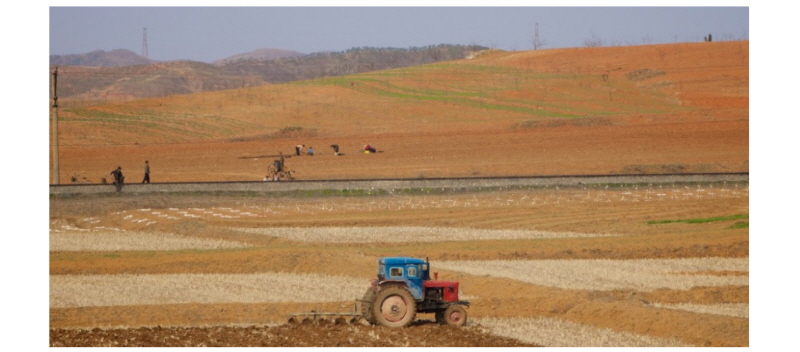
The recent food situation in Democratic People’s Republic of Korea (hereafter as DPRK) has been in a state of difficulty because of a shortage of energy, and of raw materials such as fertilizer and agricultural chemicals. In the 1990s, lack of mechanized operations of pumping water for irrigation contributed to reduced yields and increased harvesting and post-harvest losses (FAO/WFP, 2013; Ireson, 2013). As seen in Fig. 1. the country also faced land degradation after forests stripped for agriculture resulted in soil erosion (Kate, 2011).
IFAD (2000) suggested that the decline of soil fertility would be a major factor preventing the DPRK from achieving self-sufficiency in grain production. Also, the situation has been being even worse by the cold weather, floods, and droughts that have occurred frequently since 1993. In spite of continuing food shortages in the DPRK, there have been few active approaches to revitalize agriculture except only exhorting the masses to increase yields and increase production of farm machinery and farm inputs while they strongly point the way to a sustainable and highly productive agricultural area. Thus, improvement of productivity to improve nutritional status of the population is desperately needed. Therefore, cultivation of leguminous crops especially in crop rotation system was vital in North Korea (WFP, 2013).
International aid programs to the agriculture in DPRK for the past fifteen years have brought a meaningful understanding of the difficulties in the agriculture of DPRK as well as the measures to overcome them. These agricultural aid programs can alleviate some difficulties originating from the agricultural areas, but the policies and measures enforced by the regime of DPRK may not help difficulties in the agriculture of DPRK due to the institutional obstacles enforced by DPRK (Silberstein, 2015)
Since 2011, international members including Korean-speaking member to the assessment teams of the UN Food and Agriculture Organization and World Food Programme have taken crop cuttings from selected fields as a cross check against farm production reports since 2012. However, the official data provided by the North Korean government were adjusted those data based on ground observations and satellite information (Ireson, 2012). When international agencies attempted to understand data on North Korea, they claimed that there were certainly errors in the estimates. Therefore, the information related to the food and agricultural conditions provided by the DPRK government may not be enough to understand and suggest measures to improve or resolve the difficulties that the North Korean government has faced. In this review, we figured out the limits of agricultural situation leading to the food shortage, by reviewing the general agricultural conditions and policies and measures enforced in DPRK based on the institutional and agricultural background in North Korea.
Agriculture in North Korea Farming in North Korea is concentrated in the flat lands of the four west coast provinces, where a longer growing season, level land, adequate rainfall, and good irrigated soil permit the most intensive cultivation of crops. The arable area of DPRK is approximately 20,000 km2 (only about 17% of the total 122,543 km2 landmass), of which 14,000 km2 is well suited for cereal cultivation (FAO/WFP, 2013). The “nature- remaking program” started in 1976 completed the irrigation of non-paddy lands, reclaimed about 100,000 hectares of new land, built approximately 200,000 hectares of terraced fields. The reclamation of 6,200 hectares of tideland at Taedong Bay was a part of the 1987-93 plan to reclaim a total of 300,000 hectares of tidal land (U.S. Library of Congress, 2014). Besides these, they also finished the reclamation of tidal land, afforestation, and water conservation projects as part of improvement of agricultural system and increase in production of agricultural products.
The contribution to the national income by agriculture including forestry and fisheries declined from about 30% in the early 2000s to about 21% in 2011 (FAO/WFP, 2013). Incremental improvements in agricultural production bringing North Korea close to self-sufficiency in staple foods by 2013 had been made since the late 1990s. Particularly, rice yields steadily improved and the use of compost and other organic fertilizer was encouraged instead of consumption of chemical fertilizer.
A relatively short cropping season limit agricultural production and lack of agricultural resources in North Korea might impact agricultural performance with a varying degree of severity with adverse impacts on food production, as well as unfavorable climate such as hailstorms, typhoons, and extremely cold winters, terrain, and soil conditions for farming.
According to FAOSTAT in 2016 (FAO, 2016), North Korea’s top 5 products were: rice, vegetables, potatoes, apples and indigenous pig meat. North Korea's total food production - including cereals, soybeans and potatoes in cereal equivalent - was estimated to have fallen in 2015, the first drop since 2010 (FAO, 2016). Low availability of irrigation water followed by recurrent dry spells since July 2014 negatively impacted the production of maize as well as the dry conditions during the 2015 main season (EU Science Hub, 2016).
According to the investigation of photo-interpretation of points on a digital elevation model superimposed on Google Earth imagery and Bing maps carried out by the EU’s Joint Research Centre (JRC), they estimated that the area of deforested sloping land was between 300,000 and 350,000 hectares in 2012. Also, the JRC concluded that approximately 550,000 hectares of sloping land of gradient greater than 15° was likely to be under cultivation (WFP, 2013). It meant that every possible cultivable land with extremely high slopes in mountainous areas was brought into production in order to increase food production throughout the country. However, cultivation of marginal lands unintended consequences of soil erosion, increased risk of flood damage to more productive lowland, and further reduction in overall land productivity.
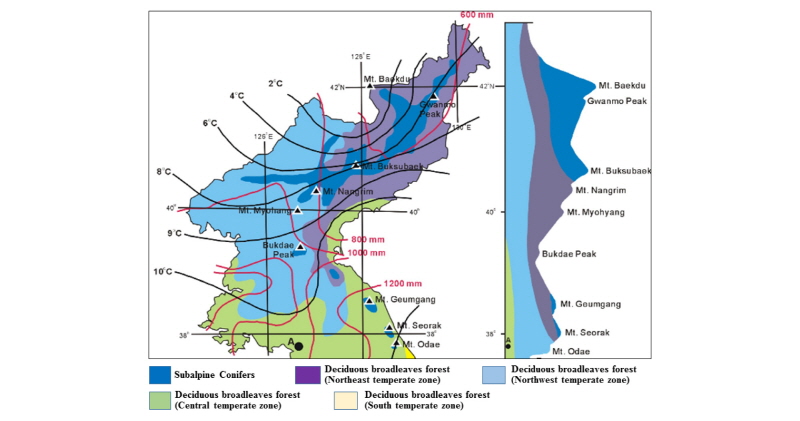
DPRK located in a continental climate zone with a relatively short cropping season can be represented by the particularly harsh and cold in the northern, mountainous regions during the winter while summers tend to be short, hot, humid, and rainy as a result of the southern and southeastern monsoon winds (WFP, 2013). On average, approximately 60% of all precipitation occurs between June and September. The distribution of the remaining 40% of precipitation is less reliable, and droughts are common in spring, autumn, and winter (WFP, 2013). Half the annual rainfall occurring in the three months from June to August favors the cultivation of paddy rice in warmer regions that are outfitted with irrigation and flood control networks (Ireson, 2013). Fig. 2 shows vertical and latitudinal modern vegetation map with an isothermal and an isobaric line. N-S cross-section showing the forests distributed across the peninsula with elevation.
Farm power including machinery and fuel has been the most difficult constraint to increased crop production in DPRK. Mechanization started in 1960 emphasized the development of multi-function machinery for lowlands. In North Korea inadequate farm power can be also a major obstacle to expansion of the area, especially for winter wheat. Due to a shortage of fuel and mechanical parts since 1994, the number of farm machines in operation drastically declined (Kim, 1999). However, the increased portion of tractors in DPRK in 2013 was about 2% compared with 2012 while there was in increase in the number of donated mono-axle tractors for the transport of materials to the field and for the cultivation of small or irregularly shaped fields that are not good for larger tractors (FAO/WFP, 2013; Ireson, 2013).
When North Korean collective farmers do have access to fertilizers, they are obliged to take what fertilizer they can obtain. The production of chemical fertilizers in North Korea were 300,000 and 850,000 MT in 1970 and in 1990, respectively. From this, it was assumed that North Korea had a production capacity of 3.5 million MT including 2 million MT of nitrogenous fertilizer and 1.5 million MT of phosphate fertilizer (Kim, 1999). Fertilizer statistics for 2008-2013 in North Korea showed that the consumption of the N fertilizer as of (NH4)2SO4] was stable at around 450,000 tonnes from 2008 to 2010 and then rapidly increased to 735,000 tons in 2011. At this period, the domestic productions were approximately 257,000 tons in 2008 and 202,000 in 2012 while import and assistance from international societies were rapidly increased from about 181,000 tons to 483,000 tons in 2012. The amounts of P and K as of P2O5 and KCl were relatively smaller than that of N fertilizer for the same period (FAO/WFP, 2013). While the supply of nitrogenous fertilizer including imported ammonium sulphate and locally produced urea was similar in 2012 and 2013, the supply of phosphate was down slightly from 21,000 tons in 2012, the highest since 2008 (Table 1). Overall fertilizer supply (N, P and K) in 2013 was therefore lower than in both of the previous two years. The recent economic difficulties led to a decline in both fertilizer uses.
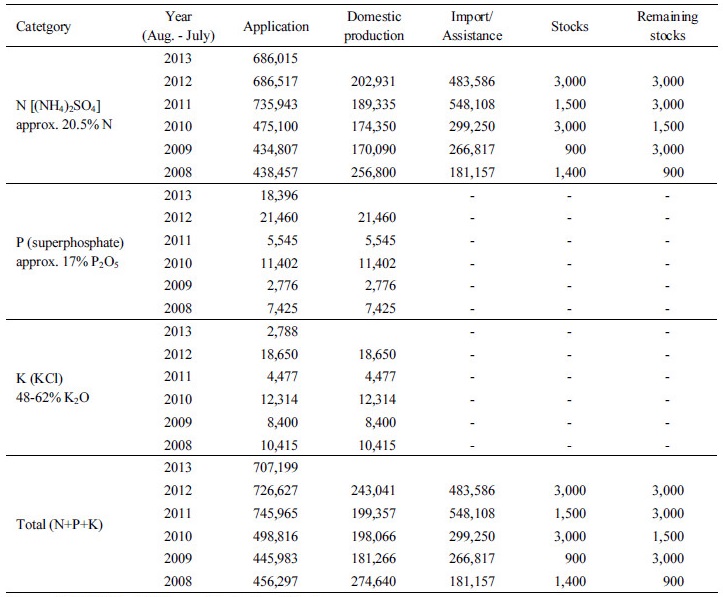
Source: FAOSTAT and Ministry of Agriculture (MoA).
Conservation agriculture and the conditions of soils Conservation agriculture such as minimum mechanical soil disturbance, permanent organic soil cover; and diversified crop rotation helps keep soils fertile and healthy for good crop growth. Farmers relied on intensive ploughing and tilling to grow crops may lead to massive soil degradation and declining yields. FAO recommended and assisted the farmers in North Korea to adopt conservation agriculture techniques to secure food production and to preserve the environment.
The decline of soil fertility in North Korea was a important factor preventing the achievement of self-sufficiency in grain production (IFAD, 1998). For DPRK’s soils, farmers used to use large quantities of chemical fertilizers and pH of soils in DPRK ranged from 4.5 to 5.5, resulting in decrease in availability of several nutrients to crops, most notably phosphate. For rotation crops in intensive single and double cropping systems the legume-based pasture leys might be an inexpensive methods in improvingsoil fertility (Michalk and Mueller, 2002). However, cooperative farm managers were reluctant in adopting this technology in DPRK to devote any of their cropland, irrespective of soil condition, because they feared about failure to meet grain production targets set by the North Korean Government. Programs sponsored by the American Friends Service Committee and the International Fund for Agricultural Development started the projects of improving soil fertility and developing sustainable and replicable cropping systems and environment management in North Korea since 1999 (IFAD, 2000). To achieve their goals, they used their methods such as cover crops and crop rotation systems for sustainability and productivity (AFSC, 2009). Since then, many farms reported further increases in the application of organic fertilizer, some achieving the target of 20 tons per hectare. The use of microbial fertilizers such as a bio-active ingredient containing amino acids derived from the breakdown of animal hair and fur was strongly recommended, to reduce dependence on chemical fertilizers (WFP, 2013). Also, a soil amendment of rich alluvial deposits from rivers was used to replenish the top soil in North Korea.
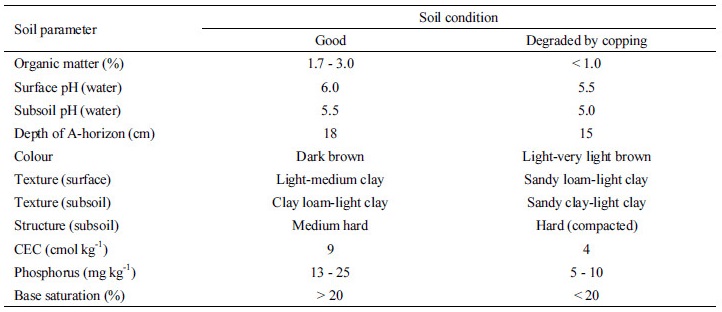
In North Korea, the major cause of degradation of soil physical and chemical properties was characterized by rapid loss of clay particles and organic matter, as seen in Table 2 (Michalk and Mueller, 2002). Especially, a failure to replace nutrients after successive cultivation of crops could cause the changes of soil chemical properties in arable soils, resulting in the evident acidification and reduction of base saturation (Guenat and Mueller, 1999).
The use of conventional and frequent mechanical manipulation along with continuous cultivation of cereals and non-leguminous crops seriously reduced organic matter contents in soil, resulted in a change in soil structure leading to increased erosion. Also this could one of the major causes in further reducing soil fertility, especially on upland soils such as sandy loam derived mainly from granite (Guenat and Mueller, 1999). On the other hand, a series of extreme climatic conditions such as hailstorms, floods and droughts since 1994 have further reduced crop production as well as an inability to import essential fertilizers because of the termination of financial support from Eastern bloc countries (Michalk and Mueller, 2002).
North Korea’s Agricultural Reforms and Policies Agricultural policies in North Korea have been directed towards solving the food shortages through the four strategic methods in agricultural technology. These methods are irrigation, farm mechanization, rural electrification, and intensive use of agricultural chemicals. In addition to these improvements measures, several reclamation projects to increase the area of arable land were also carried out. The examples are construction of new fertilizer plants to achieve self-sufficient in fertilizers, as well as they expansion of agricultural researches to develop farming technology, especially for the application of fertilizers and pesticides (Kim, 1999).
Under the Land Reform Act in North Korea established in 1946, they confiscated about 54% of total farmland in private ownership. They launched the expansion of farming scale immediately after the completion of collectivization in 1958 because the size of collectives was too small to apply farm mechanization. Therefore, the number of collectives fell from more than 50,000 to only 4,000, while the average size of approximately 500 ha accommodated about 300 farm households (Kim, 1999). The recent average farm size cultivated by 80-300 farm families is known to be about 466 ha (Kim, 1999). The collective farming system over the course of 1954-1958 resulted in farmers becoming employees on collective farms. The collective farming system under the socialist system was a way to enforce state control, resulting in that the farmers’ dreams of personal and equitable land ownership were swept away in the name of socialist modernization (Yoo, 2010). Thus, socialist farming in North Korea showed the basic institutional problems even though the management system and size of collective farms have evolved over time. There would, therefore, be limits to how much better it can get, no matter what reforms the state implements as long as North Korea’s agriculture continues to be centrally planned by the state.
In the 1970s and 1980s agricultural development strategies were to balance development between agriculture and industry throughout the first Six-Year Plan (1971-76) and the second Seven-Year Plan (1978-84). It could provide intensive support, both the areas of financial and technical sectors, to the State and collective farms in the designated regions. Researches were focused on the improvement of varieties of corn and soybean and encouragement of double-cropping (Kim, 1997; Kim, 1999).
However, the actual growth rate did not meet their expectation. North Korea, therefore, has made efforts to increase the area of arable land since the 1980s. Unfortunately, the damages by recent natural disasters such as floods of 1995 caused widespread landslides in the terraced fields were increased by the overuse of land (Kim, 1997, 1999).
Agricultural reforms in North Korea became a hot topic when Kim Jong-un took power in 2011. Even in 2013, Kim Jong Un repeatedly stated that the country would focus on improving the people’s lives through increasing food production in the areas of agriculture, livestock, and fisheries. To deal with food production problems in North Korea, they already knew that they strongly needed reforms including extension of new technology, encouraging farmers to work in smaller groups, permitting farmers to sell excess produce, and providing incentives for individual farmers (Kim, 1999; Im, 2016; Ireson, 2014). Since 2013, Kim Jong Un repeatedly stated that the country would focus on improving the people’s lives through increasing food production from agriculture, livestock, and fisheries. But, the 2017 message only mentioned scientific approaches to produce high-yield crops. The New Year’s message in 2017 was as follows; 1) The accomplishments of juche agriculture; 2) Double-crop supply; 3) Seed revolution; 4) Use of organic fertilizer; 5) Land readjustment; 6) Improving repair capabilities; and 7) Enhancing mechanization. However, North Korea’s agricultural infrastructure and equipment has been deteriorating (Im, 2017). North Korea’s agricultural infrastructure and equipment has been deteriorating. At the very least, it seems beyond reasonable doubt that North Korean agriculture has undergone major changes. The most important aspects of these changes are the decreased size of work teams and new rules that let farmers keep 30% of their production plus any surplus above production targets, while the state takes the remaining 70% (Im, 2017).
They strongly suggest an opportunity to make some improvements to guarantee individuals the rights and protections under international and domestic laws although the reforms in agriculture do not meet any interest by North Korean farmers to change its priorities. However, it is too quick to judge whether these prospects will fail and, thus far, the application has been ineffective and inconclusive. However, no one really understands exactly what effect these simplistic reforms have had. Therefore, there will be limits to how much better it can get, no matter what reforms the state implements.
Conclusion
The aggravated chronic food shortages of the 1990’s has been continued by on-going systemic problems including a lack of arable land, collective farming practices, and persistent shortages of tractors and fuel. No matter what management reforms the North Korean regime implements, the country’s economic system remains the intrinsic stumbling block. As long as central planning continues to be the goal of economic and agricultural policies, there will be a limit to the success that agricultural policies can reach in addition to the intrinsic problems including soil and fertilizer. For this reason, agricultural cooperation should be considered.
Despite of North Korea’s trial to reform its agricultural sector since 1995, these efforts have fallen short due to limited funding. North Korea has been unable to draw the foreign investment and capital for their agricultural programs. To improve the situation, North Korea will need to reform and open as the outside world contributes assistance. North Korea understands that opening and reforms present a threat to the status quo and the international community is now aware of the risks in investing in the North.
Accordingly, they should establish collaborative agricultural projects with advanced countries including South Korea that provide them with technology and capital. Otherwise, it will not be possible for the North to overcome food shortage problems sooner or later, and improve the lives of North Koreans. Even if the country effectively implemented reforms across its territory it is doubtful that large-scale results would be visible so quickly. Although farmers in the DPRK have faced numerous challenges, not least of which are soil erosion, scarce inputs and extreme weather like drought, flooding and cold spells, farmers should be encouraged to adopt more environmentally sound cropping practices, to access quality seeds and planting materials and to reduce losses after the harvest. These are just some of the activities to improve food security and to overcome the limits of crop production throughout agricultural practices, leading to secure more yield and better price for their production.