

Introduction
Present Fertilization Practices and Their Limitations
Future Climate-Smart Fertilization Strategy
Conclusions and Future Directions
Introduction
Rising temperatures are accelerating the degradation of soil health, characterized by increased decomposition of organic matter, nutrient depletion, and microbial disruption, which in turn threatens the sustainability of food production (Abebaw and Feleke, 2026). Within the paradigm of climate-smart agriculture (CSA), the functions of soil have expanded beyond stable food production to include the restoration of soil health, the reduction of greenhouse gas (GHG) emissions, and the enhancement of atmospheric carbon dioxide (CO2) sequestration (Kabato et al., 2025). However, current soil fertilization policies are still primarily focused on supplying essential nutrients such as nitrogen (N), phosphorus (P), and potassium (K) for crop growth (Lee et al., 2025), often narrowing the fertilization policies to a binary choice between mineral fertilizers (i.e., chemical fertilizers), which provide nutrients in inorganic forms, and organic fertilizers (including livestock manure compost), which provide nutrients in organic forms (Wang et al., 2024). From the perspective of CSA, it is essential to reframe the relationship between mineral and organic fertilizers not as a binary or competitive one, but as a mutually complementary interaction while incorporating other soil amendments including livestock manure composts and biochar in the view of comprehensive soil health improvement.
Mineral fertilizers can efficiently and immediately supply the nutrients required during the stages of crop growth, while organic fertilizers offer the advantage of promoting soil microbial growth and diversity by providing substrates for microbial activity, alongside a sustained supply of nutrients (Xing et al., 2025). Meanwhile, livestock manure compost is more suited for improving the physical and chemical properties of soil through the supply of soil organic matter rather than focusing solely on nutrient provision (Rayne and Aula, 2020). Furthermore, a new perspective is needed regarding the utilization strategies for biochar, which has recently been promoted in South Korea (Han et al., 2026). While biochar is globally recognized as a soil C sequestration technology, in the context of Korean agriculture, there is a tendency to use it primarily as a nutrient-supplying fertilizer, particularly in the form of livestock manure-based biochar (Jung et al., 2026). There is a concern that this may lead to an overall increase in nutrient loading in agricultural soils due to conventional fertilization practices, which do not account for the nutrients contained in biochar. Meanwhile, given its capacity to mitigate methane (CH4) (Pia et al., 2024) and nitrous oxide (N2O) emissions (Lee et al., 2021), biochar can contribute to reducing GHG emissions in the agricultural sector when applied to farmlands with high emission potential. Therefore, to realize CSA, it is necessary to establish a new fertilization strategy that encompasses not only nutrient supply for food production but also improvement of soil physical-chemical-biological properties, GHG mitigation, and C sequestration. This study provides an overview of the current status of fertilization strategies in South Korea and proposes a comprehensive framework that considers the specific characteristics of key resources—mineral fertilizers, organic fertilizers, livestock manure compost, and biochar—for soil health improvement within a CSA system.
Present Fertilization Practices and Their Limitations
South Korea’s soil nutrient management guidelines remain largely centered on crop production, focusing primarily on individual elemental inputs such as N, P, and K (Lee et al., 2025). Consequently, these guidelines fail to account for the diverse physical, chemical, and biological properties of soil, posing significant limitations for comprehensive soil management within the framework of CSA. In line with the government's policy to expand eco-friendly agriculture by reducing mineral fertilizer usage, the total consumption of mineral fertilizers in Korea decreased from 842,000 tons in 1999 to 388,000 tons in 2023, with application rates per hectare declining from 398 kg ha-1 to 242 kg ha-1 during the same period (RDA, 2025). However, it is estimated that the application of organic fertilizers and livestock manure compost has been continuously increasing. Although official statistical data on their usage are not fully established, a survey of the Rural Development Administration indicates a significant increase in N supply from organic fertilizers for upfield crops (from 55 kg N ha-1 in 2017 to 377 kg N ha-1 in 2021) and greenhouse crops (from 79 kg N ha-1 in 2020 to 145 kg N ha-1 in 2024) (RDA, 2025). Regarding livestock manure compost, the population of beef cattle, swine, and poultry increased substantially between 1999 and 2024 (by 72.6%, 37.9%, and 88.7%, respectively), while total agricultural land area decreased by 20.8% (RDA, 2025). This discrepancy suggests a sharp rise in the amount of livestock manure compost and liquid fertilizer applied per unit area of agricultural land. Consequently, South Korea’s fertilization management has focused on shifting nutrient sources from mineral fertilizers to organic fertilizers without reducing total nutrient inputs, failing to achieve a balanced national nutrient budget. For instance, as of 2020, South Korea’s N and P nutrient budgets reached surpluses as high as 230 kg N ha-1 and 46 kg P ha-1, respectively, which are among the highest levels reported by OECD member countries (OECD, 2025). Therefore, shifting nutrient sources from mineral fertilizer to organic fertilizer is not successful for national nutrient balance.
Meanwhile, direct GHG emissions from the agricultural sector in South Korea are approximately 23 million tons as carbon dioxide equivalent (CO2eq), accounting for 3.5% of the national total (MOE, 2025). The 2030 Nationally Determined Contribution aims for a 22.6% reduction by 2030 compared to 2018 levels (24.7 million tons). GHG mitigation in the cultivation sector is planned to be primarily achieved by expanding paddy water management (CH4 reduction), optimizing N fertilizer application (N2O reduction), and promoting biochar application (C sequestration); however, in practice, the GHG reduction has largely relied on the reduction of agricultural land area (MOE, 2025). The decreases in cropland area hamper long-term food self-sufficiency under climate change. In addition, there is a tendency to avoid the input of organic matter, such as organic fertilizer and livestock manure compost, to mitigate CH4 emissions in paddy field, although they could replace mineral N fertilizers (Baek et al., 2025b). Yet, in the Korean rice production system where rice straw is often diverted to the livestock industry (Jeong et al., 2022), exogenous organic inputs serve as a critical organic resource for maintaining soil microbial health (Baek et al., 2024). Furthermore, fully matured livestock manure compost decomposes slowly in paddy soils, providing a stable food source for soil microorganisms while simultaneously improving the soil's physical and chemical properties (Piccolo and Drosos, 2025). Regarding N2O emissions, while mineral N fertilizers are often perceived as the primary source, 62% of the total N2O directly emitted from agricultural soils (1.677 million tons CO2eq as of 2022) originates from organic fertilizers, including livestock manure compost (MOE, 2025). This implies that the simple reduction of mineral fertilizer application cannot serve as a sufficient strategy for mitigating N2O emissions from agricultural soils. Therefore, fertilization practices primarily targeting GHG reduction are not sustainable strategies for CSA, which aims at enhancing food production, GHG mitigation, and C sequestration together via improved soil health.
Future Climate-Smart Fertilization Strategy
Agricultural inputs currently utilized in Korean agriculture, such as mineral fertilizer, organic fertilizer, livestock manure compost, and biochar, exhibit distinct characteristics regarding nutrient supply, soil health, GHG emissions, and C sequestration (Table 1). While mineral fertilizers provide immediate nutrients for crops, they lack long-term persistence (Hera, 1995). In contrast, organic fertilizers facilitate nutrient supply and are expected to enhance soil microbial and enzyme activity (Baek et al., 2024). Livestock manure compost contains humus-like organic compounds, which replenish humus in soils (Piccolo and Drosos, 2025); meanwhile, biochar can serve as a stable C source with relatively lower nutrient supply capacities (Yang et al., 2024).
Table 1
Comparison of typical fertilizers and soil amendments: Primary function, nutrient supply, greenhouse gas emission, soil health, and side effects.
Regarding GHG emissions, N2O emissions from N-based fertilizer application are well-documented (Lim et al., 2026). Although organic fertilizers also raise concerns regarding N2O emissions, they pose a greater risk of CH4 emissions in paddy fields (Baek et al., 2025b). Conversely, fully matured livestock manure compost contains stabilized N with a slow mineralization rate, resulting in relatively lower risks of N2O and CH4 emissions (Lim and Choi, 2014). Biochar is reported to mitigate GHG emissions by adsorbing NH4+ and organic acids, which are precursors to N2O and CH4, respectively (Lee et al., 2021; Pia et al., 2024; Baek et al., 2025a). While balanced fertilization can increase crop biomass, potentially leading to C sequestration through the incorporation of crop residues, mineral fertilizer has no direct C storage effect. Organic fertilizers are often mistakenly perceived to have C sequestration benefits; however, due to their highly decomposable nature, their residues do not directly convert into soil organic C (Park et al., 2015). Instead, C stabilization can occur when microbial necromass, generated during microbial turnover by decomposing these organic materials, binds with soil minerals (Zhao et al., 2025). Livestock manure compost provides higher C sequestration effects than organic fertilizers due to its recalcitrant components (Lim et al., 2017), while biochar exhibits the highest sequestration potential (Yang et al., 2024).
In terms of soil health, organic fertilizers are expected to increase microbial biomass, while livestock manure compost effectively improves soil physical (e.g., aggregation and water retention) and chemical properties (e.g., cation exchange capacity) by supplying humus-like materials (Piccolo and Drosos, 2025). Biochar, with its porous structure and large specific surface area, offers a wide range of benefits, including water and nutrient retention, provision of microbial habitats, and improvement of soil physical and chemical properties (Pia et al., 2024). However, excessive application of any specific resource may lead to negative impacts, such as soil degradation and increased GHG emissions. The negative effects of over-application of mineral fertilizer, such as soil acidification, nutrient imbalance, and microbial community disruption, are well-established (Geisseler and Scow, 2014). For organic fertilizers, while they may increase CH4 emissions in paddy fields, this can be effectively mitigated through proper application timing and water management such as soil drying (Baek et al., 2025b). Continuous over-application of livestock manure compost can lead to the accumulation of organic matter beyond the soil's C storage capacity and may cause soil alkalization due to a high content of calcium (Rayne and Aula, 2020). Furthermore, excessive biochar application raises concerns regarding the accumulation of heavy metals and salts in the soil (Pia et al., 2024; Jung et al., 2026).
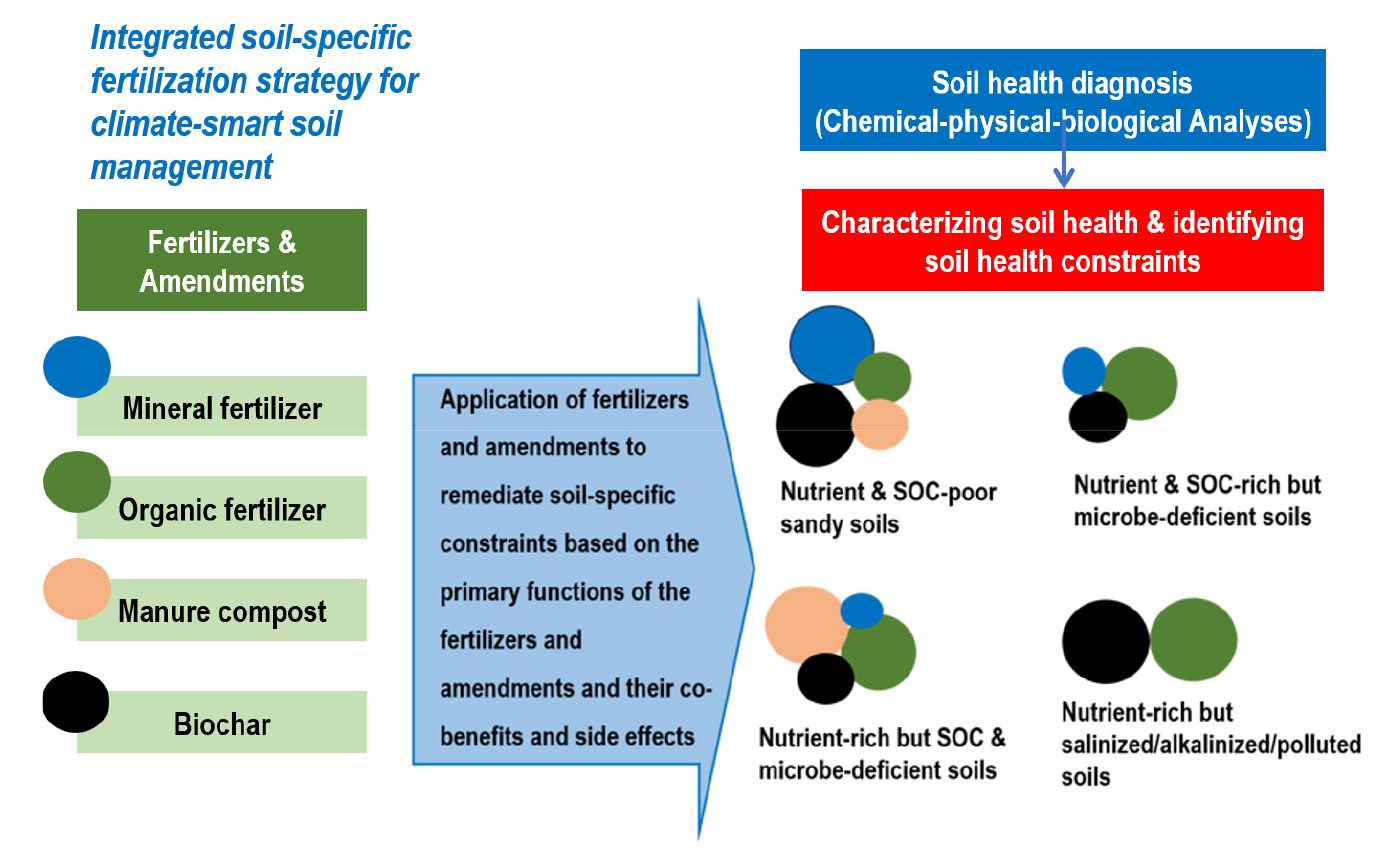
Therefore, based on the strengths and weaknesses of individual inputs, it is necessary to establish a comprehensive, soil-specific fertilization strategy centered on the functionality of the resources rather than the traditional nutrient-based approach (Fig. 1). Since the physical, chemical, and biological properties of soil are fundamentally determined by soil texture, fertilization strategies can be developed accordingly. For example, in sandy soils characterized by low clay content and organic matter, which lead to poor water and nutrient retention, it is advisable to increase the application ratio of livestock manure compost and biochar to enhance nutrient-holding capacity. In such cases, nutrients should preferably be supplied via organic fertilizers rather than mineral fertilizers, which are prone to leaching. This approach can simultaneously achieve stable nutrient supply, increased drought tolerance, mitigation of N2O emissions, and an increase in soil C sequestration. Conversely, for clayey soils with high organic matter content and high nutrient retention capacity, nutrients can be supplied primarily through mineral fertilizers, supplemented by organic fertilizers as an energy source for soil microorganisms. Furthermore, livestock manure compost can be applied as long as SOC content remains below the soil C saturation point. While biochar can also be applied to such soils, caution must be exercised regarding potential side effects, such as the priming effect—which may accelerate the decomposition of existing soil organic matter—and the loss of fine biochar particles (Baek et al., 2026).

Fig. 1
A conceptual diagram for integrated soil-specific fertilization strategy from climate-smart soil health management. Soil health constraints need to be identified by chemical-physical-biological analyses of the target soils, and the ratios of fertilizer and amendment can be formulated and applied to resolve the soil-specific constraints.
Fertilization strategies can also differ with land-use types (Table 2). In paddy fields, where organic fertilizer application poses a significant risk of CH4 emissions, it is preferable to supply nutrients primarily through mineral fertilizers, while utilizing livestock manure compost to replenish soil organic matter. In organic rice farming where mineral fertilizers are avoided, the combined application of organic fertilizer and biochar, along with rigorous soil drying practices such as mid-season drainage, can substantially reduce CH4 emissions (Baek et al., 2025b). Regarding upland soils, which typically contain low clay and SOC contents and where nutrient leaching is a major concern, biochar and livestock manure can be applied with mineral or organic fertilizer to resolve these constraints. For greenhouse cultivation soils where long-term application of livestock manure compost has led to high pH and excessive salt accumulation, it is necessary to supply only the required nutrients using mineral fertilizer based on precise soil testing. Although biochar's nutrient-adsorption capacity may partially mitigate excess nutrients in greenhouse soils, its application could further elevate soil pH (Zhang et al., 2025). Moreover, in greenhouse soils already experiencing high heavy metal concentrations due to prolonged livestock manure compost application, there is a risk that heavy metals contained in biochar, particularly produced from livestock manure, could exacerbate soil contamination (Zhao et al., 2026).
Table 2
Suggestions of fertilizer and amendment application to resolve constraints of rice paddy, upland, and greenhouse soils for climate-smart agriculture.
While this study cannot propose exhaustive fertilization strategies for every type of agricultural soil, it is evident that the current nutrient-based management approach is insufficient to maintain soil functionality within the paradigm of CSA. Therefore, the fertilization paradigm must be shifted from a nutrient-centric strategy based solely on crop requirements to a function-centric fertilization strategy based on the intrinsic properties of the soil and the functionality of the fertilizers and amendments. For the successful paradigm shift, comprehensive studies should be implemented to explore the most feasible and effective combinations of fertilizer and amendment for improvement of soil health under different scenarios.
Conclusions and Future Directions
The findings of this study suggest that the current nutrient-centric fertilization framework in South Korea, which focuses primarily on the supply of N, P, and K, is insufficient to meet the multifaceted demands of CSA. While the transition toward reducing mineral fertilizer is a necessary policy goal, the indiscriminate reliance on organic fertilizer and livestock manure compost has not only failed to balance national nutrient budgets but has also contributed to significant GHG emissions. Furthermore, the interest in biochar as a C-sequestration tool is currently undermined by its primary application as a nutrient supplement, which risks exacerbating nutrient loading and soil contamination. To transition toward a sustainable agricultural paradigm, we propose a shift from nutrient-based management to a "function-centric" fertilization strategy. This approach requires that the application of mineral fertilizer, organic fertilizer, livestock manure compost, and biochar be determined not by crop requirements alone, but by a holistic assessment of soil health, intrinsic physical-chemical-biological properties, and environmental footprints.
In conclusion, achieving the goals of food production, GHG mitigation, and soil carbon sequestration requires a synergistic integration of agricultural inputs for improved soil health. This study highlights the need for a comprehensive framework that leverages the unique functionalities of each resource. Moving forward, it is important to establish site-specific guidelines and conduct further research into the long-term interactions of these fertilizers and amendments under diverse conditions. By reframing fertilization as a comprehensive tool for soil health rather than a mere nutrient supply mechanism for crop growth, South Korean agriculture can effectively align its food production system with global climate-smart sustainability goals.