Introduction
Materials and Methods
Collecting wild-simulated ginseng and soil sample
Soil analysis
Growth characteristics analysis
Statistical analysis
Results and Discussion
Soil properties of Wild-simulated ginseng cultivation sites
Growth characteristics of Wild-simulated ginseng
Correlation between soil properties and growth characteristics
Conclusions
Introduction
최근 국민의 소득이 향상되고, 코로나바이러스 감염증과 같은 질병에 대한 면역증진 및 청정식품에 관한 관심이 높아지면서 대표적인 청정임산물인 산양삼 (wild-simulated ginseng)에 대한 관심 또한 증가하고 있다 (Kim et al., 2019). 삼 (ginseng)은 가장 오래된 약용식물 중 하나이며, 두릅나무과 (Araliaceae) 인삼속 (Panax)에 속한다. 인삼속에는 Panax ginseng, P. notoginseng, P. pseudoginseng, P. trifolius, P. stipuleanatus, P. quinquefolius, P. japonicus, P. japonicus (var. angustifolius, var. bipinnatifidus, var. major), P. zingiberensis 등이 속해 있으며, 주로 동아시아국가와 북미지역에 분포되어 있다 (Santacroce et al., 2020; Zhang et al., 2020). 산양삼은 [임업 및 산촌진흥 촉진에 관한 법률]에 따라 ‘특별관리임산물’로 지정되어 있으며, ‘산지에서 차광막 등 인공시설을 설치하지 아니하고 생산되는 삼’으로 정의하고, 종자, 종묘, 재배, 품질관리 유통까지 모든 과정을 관리하고 있다 (NIFos, 2018). 산양삼은 임야에서 7년 이상 20년까지 자연친화적으로 재배하기 때문에 대부분 고가로 유통되며, 이 중에서도 7년근의 판매량이 가장 높다고 보고되고 있다 (Kim et al., 2021). 산림청은 2019년부터 산양삼 산업 육성 대책을 수립하고, 표준재배법 개발, 유통 투명성, 효능 분석 등과 같은 다양한 연구를 통해 산양삼의 산업 활성화를 위해 노력하고 있다 (KFS, 2019).
산양삼은 임야에서 무농약, 무비료를 원칙으로 자연상태에서 장기적으로 재배하여 산삼과 유사한 약용가치가 있다고 보고되어 있으며 (Choi et al., 2009), 세포 수준에서 항산화, 항염증, 면역증진, 미용 등 효과가 보고되었다 (Gu et al., 2009; Kim et al., 2011; Kang et al., 2016; Kim et al., 2018a; Park et al., 2018; Jeong et al., 2019). 청정한 산림환경에서 재배하는 산양삼의 생육은 기후, 토양특성 등과 같은 재배지 환경의 영향을 받기 때문에 산양삼 재배 시 적지를 찾는 것이 매우 중요하다 (Kim et al., 2015; Larsen et al., 2015).
산양삼과 같은 뿌리작물은 다양한 산림환경 중에서도 토양과 매우 밀접한 관계가 있으며, 국외에서는 이전부터 산림토양 특성에 대한 연구가 수행되고 있고 (Ushio et al., 2010; Kooch et al., 2017), 임야에서 재배하는 삼의 산림토양 특성에 대한 연구도 수행되고 있다 (Liu et al., 2016; Sun et al., 2017). 인삼의 경우, 토양환경, 인삼수확량, 기후 등을 고려하여 재배적지 기준을 설정하고, 경작자에게 제공할 수 있는 인삼 재배적지 기준설정 연구가 수행되었다 (Hyun et al., 2009). Kim et al. (2019b)에 의해 산양삼 재배지의 입지환경과 생육특성 간의 상관관계에 대한 연구가 수행되었으나, 이는 산양삼 연근 중 13년근의 생육과 토양특성에만 집중되어 연구가 수행되었다. 또한 산양삼의 재배방법은 주로 임업인 개인의 경험에만 의존하는 경우가 많기 때문에 보다 체계적이고 과학적인 재배기술 확립을 위해서는 우선적으로 재배적지에 대한 기준 정립이 필요한 실정이다.
따라서 본 연구에서는 산양삼 중 가장 많이 유통되는 7년근과 고가의 13년근 재배지를 대상으로 생육특성과 토양특성을 분석하여 산양삼 재배적지 구명을 위한 기초자료로 활용하고자 한다.
Materials and Methods
Collecting wild-simulated ginseng and soil sample
본 연구에서 사용된 토양 및 산양삼 시료를 채취할 재배지는 전국의 산양삼 재배지 중 [임업 및 산촌진흥 촉진에 관한 법률]에 의거하여 인공시설의 설치 유무, 화학비료와 농약의 사용 등 산양삼의 재배기준에 따라 총 7개 (A - G)의 재배지를 선정한 후 알파벳으로 명명하였다 (Fig. 1). 산양삼 시료는 각 재배지에서 7년근과 13년근 산양삼을 선정하여 각 3본 씩 채취하고, 수태 (sphagnum moss)를 이용하여 산양삼 뿌리를 위아래로 덮은 후 4°C의 저온저장고에 보관하였다 (Jeon et al., 2018). 토양 시료는 표토를 제거하고 7년근과 13년근 산양삼 채취와 동시에 근권토양을 함께 채취하였고, 산양삼 시료를 채취한 장소로부터 10 m 이내에서 산양삼을 재배하지 않은 대조구 토양 시료 또한 채취하였다. 채취한 토양은 실온에서 풍건한 다음 2 mm 체를 이용하여 거른 후 보관하였다.
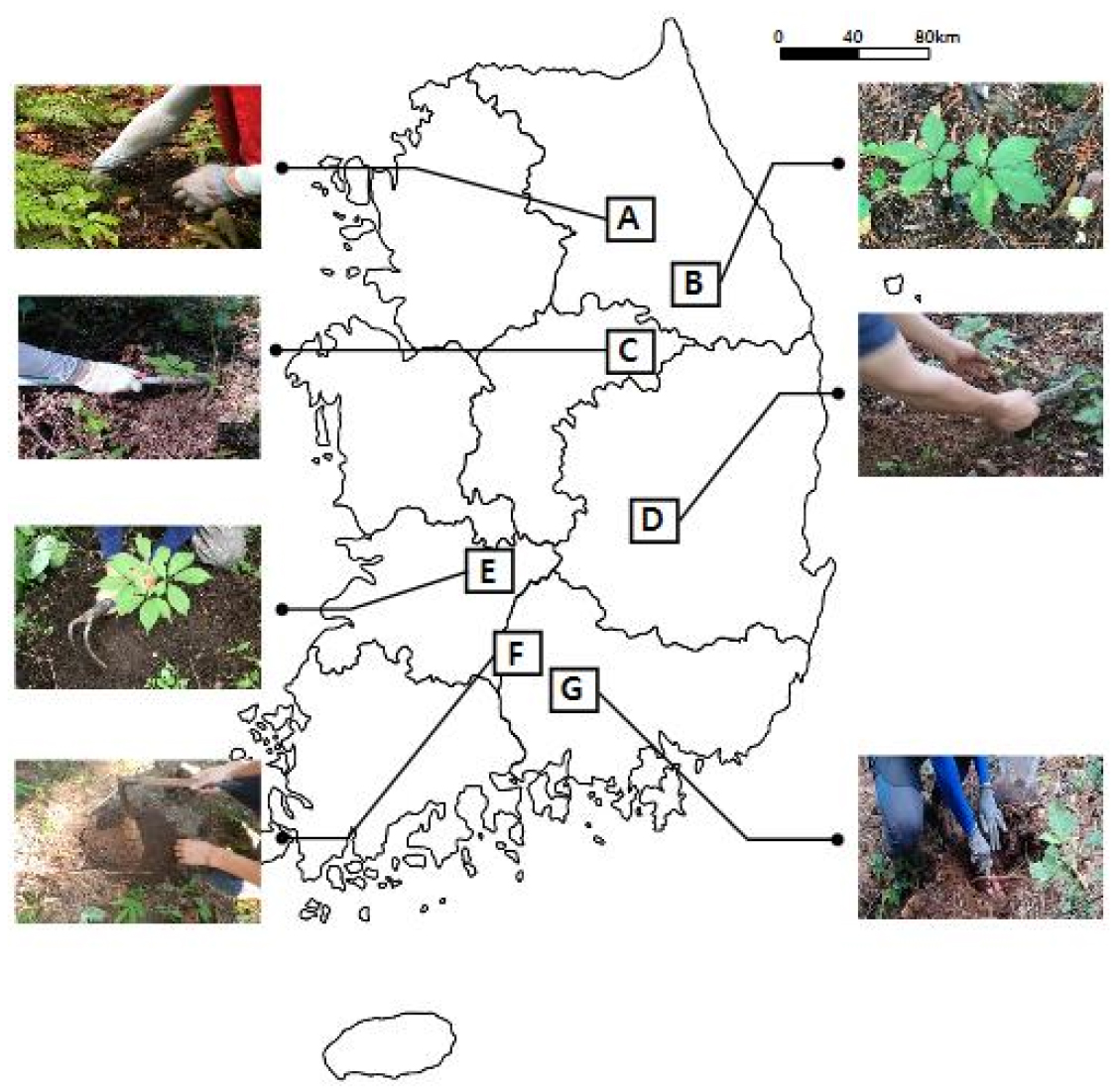
Fig. 1
Study area and sampling of wild-simulated ginseng. A to I are a wild-simulated ginseng cultivation sites of South Korea.
Soil analysis
본 연구에서 사용한 공시토양은 농촌진흥청에서 발간한 [종합분석실 분석 매뉴얼]을 참고하여 분석하였다 (NAAS, 2010). 토양 pH와 전기전도도 (electrical conductivity, EC)는 풍건토와 증류수를 1:5의 비율로 희석하고 30분간 진탕한 후에 각각 pH meter와 EC meter를 이용하여 측정하였다. 유기물 (organic matter, OM) 함량은 Walkley-Black법을 이용하였고, 전질소 (total nitrogen, TN) 함량은 토양 1 g에 진한 황산 5 mL을 넣고 Block digester를 이용하여 분쇄한 후 Kjeldhal 증류법으로 측정하였다. 유효인산 (available phosphate, Avail. P) 함량은 Lancaster 침출법에 따라 1-amino-2-naphtol-sulfanic acid에 의한 흡광도법을 이용하여 측정하였다. 치환성 양이온 (exchangeable cations) 함량은 토양을 1 N-ammonium acetate (NH4OAc)로 침출한 후 Inductively Coupled Plasma Optical Emission Spectrometry (ICP-OES)를 이용하여 측정하였다. 양이온치환용량 (cation exchange capacity, CEC)은 1 N-NH4OAc로 침출한 후 토양에 치환된 NH4+을 Kjeldhal 증류법으로 측정하였다.
Growth characteristics analysis
7년근과 13년근 산양삼의 생육특성 조사는 작물별 특성조사 요령 (인삼)에 준하여 수행하였다. 줄기길이 (shoot length, SL), 줄기직경 (shoot diameter, SD), 소엽길이 (leaflength, LL), 소엽직경 (leaf diameter, LD), 소엽넓이 (leaf width, LW), 뇌두길이 (rhizome length, RhL), 뿌리길이 (root length, RL), 뿌리직경 (root diameter, RD), 줄기 생중량 (shoot fresh weight, SFW), 뿌리 생중량 (root fresh weight, RFW), 뿌리 건중량 (root dry weight, RDW)을 측정하였다 (KSVS, 2014).
Statistical analysis
도출된 정량적 실험데이터는 평균 ± 표준오차 (means ± standard error, S.E.)로 나타내었으며, Statistical Analysis System (SAS, version 9.4, SAS Institute, Cary, NC, USA) 소프트웨어를 이용하여 t-test, Duncan’s multiple range test (DMRT)를 통해 유의성을 검정하였으며, p < 0.05 수준에서 통계처리하였다. 산양삼 재배지의 토양이화학성 및 산양삼 생육특성 간의 상관관계 분석은 IBM SPSS statistics (version 25, IBM Corp., Armonk, NY, USA) software를 사용하여 Pearson 상관계수 (pearson’s correlation coefficient, r)와 유의성 (p < 0.05)을 확인하였다.
Results and Discussion
Soil properties of Wild-simulated ginseng cultivation sites
산양삼 재배지 7지역의 토양특성을 분석한 결과, 모든 재배지의 토성은 사양토 (sandy loam)이고, 토양 pH는 4.70 - 5.69로 산성 토양으로 나타났다 (Table 1). 유기물 함량은 3.81 - 12.0 g kg-1였고, 전기전도도는 0.02 - 0.05 dS m-1, 전질소 함량은 0.15 - 0.48 g kg-1, 유효인산은 23.2 - 169.7 mg kg-1, 교환성 칼륨은 0.08 - 0.69 cmolc kg-1, 교환성 칼슘은 0.10 - 6.99 cmolc kg-1, 교환성 마그네슘은 0.05 - 1.07 cmolc kg-1, 교환성 나트륨은 0.02 - 0.27 cmolc kg-1, 양이온치환용량은 14.3 - 33.5 cmolc kg-1로 나타났다. 산양삼 재배지 모두 염분 함량이 낮은 비염류 토양으로 토양특성 결과에서 전기전도도와 교환성 나트륨의 유의적 차이는 제외하였다. 우리나라 산림토양의 평균 pH는 4.88이고, 산양삼 재배에 적합한 토성은 배수가 좋은 사양토 또는 양토 (loamy soil)가 적당하며, 토양 pH는 4.0 - 6.0으로 보고되고 있다 (Lee, 2000; KOFPI 2013; Kim et al., 2018b). 또한 산림토양의 유기물 적정기준은 4.4% 이상, 전질소는 0.25% 이상이고, 식물 생육에 적절한 양이온 치환용량은 보비력이 우수한 20 - 30 cmolc kg-1으로 보고되었다 (Lim, 2005; Hong et al., 2010; Kim et al., 2013). 이와 같은 선행연구의 자료를 통해 본 연구의 산양삼 재배지는 산양삼 재배에 적합한 것으로 확인되었다.
Table 1
Soil properties according to age of wild-simulated ginseng in 6 different cultivation fields.
Cultivation
fields
|
Age
|
pH
(1:5)
|
EC
(dS m-1)
|
OM
(g kg-1)
|
TN
(g kg-1)
|
Avail. P2O5
(mg kg-1)
|
Exch. cations (cmolc kg-1)
|
CEC
(cmolc kg-1)
|
|
K
|
Ca
|
Mg
|
Na
|
|
A
|
C
|
5.03 ±
0.07 b
|
0.02 ±
0.01 a
|
11.6 ±
0.6 a
|
0.42 ±
0.01 a
|
149.6 ±
9.0 a
|
0.11 ±
0.01 b
|
1.76 ±
0.15 ab
|
0.28 ±
0.04 ab
|
0.04 ±
0.07 b
|
30.9 ±
2.1 a
|
|
7
|
5.53 ±
0.08 a
|
0.03 ±
0.01 a
|
12.0 ±
0.4 a
|
0.43 ±
0.01 a
|
115.7 ±
7.0 b
|
0.23 ±
0.06 a
|
3.65 ±
0.94 a
|
0.63 ±
0.19 a
|
0.23 ±
0.07 a
|
28.7 ±
0.7 a
|
|
13
|
5.17 ±
0.07 b
|
0.02 ±
0.01 a
|
9.2 ±
0.5 b
|
0.35±
.0.1 b
|
131.9 ±
3.8 ab
|
0.13 ±
0.01 ab
|
0.95 ±
0.05 b
|
0.23 ±
0.02 b
|
0.04 ±
0.01 b
|
31.7 ±
1.1 a
|
|
B
|
C
|
5.61 ±
0.35 a
|
0.02 ±
0.01 b
|
9.47 ±
1.00 a
|
0.32 ±
0.05 a
|
131.2 ±
11.5 a
|
0.08 ±
0.01 b
|
0.54 ±
0.27 b
|
0.11 ±
0.06 b
|
0.06 ±
0.01 b
|
27.1 ±
2.7 ab
|
|
7
|
5.34 ±
0.10 a
|
0.03 ±
0.01 ab
|
9.76 ±
0.86 a
|
0.35 ±
0.03 a
|
118.7 ±
4.7 a
|
0.24 ±
0.04 a
|
3.02 ±
0.79 a
|
0.72 ±
0.16 a
|
0.27 ±
0.08 a
|
22.5 ±
1.0 b
|
|
13
|
5.29 ±
0.09 a
|
0.04 ±
0.01 a
|
6.45 ±
0.24 b
|
0.23 ±
0.01 b
|
76.0 ±
7.8 b
|
0.18 ±
0.03 a
|
1.86 ±
0.46 ab
|
0.36 ±
0.04 b
|
0.03 ±
0.01 b
|
29.3 ±
1.5 a
|
|
C
|
C
|
5.61 ±
0.14 ab
|
0.02 ±
0.01 a
|
4.99 ±
0.16 ab
|
0.20 ±
0.01 a
|
86.0 ±
3.1 b
|
0.15 ±
0.04 b
|
4.70 ±
0.39 a
|
1.06 ±
0.02 a
|
0.08 ±
0.02 a
|
14.3 ±
1.8 b
|
|
7
|
5.28 ±
0.06 b
|
0.02±
0.01 a
|
5.58 ±
0.46 a
|
0.21 ±
0.03 a
|
98.6 ±
17.5 b
|
0.31 ±
0.02 a
|
5.10 ±
0.61 a
|
0.80 ±
0.10 b
|
0.06 ±
0.02 b
|
21.2 ±
2.6 a
|
|
13
|
5.69 ±
0.11 a
|
0.02 ±
0.01 a
|
3.81 ±
0.41 b
|
0.15±
0.01 a
|
108.0 ±
24.6 a
|
0.31 ±
0.03 a
|
4.86 ±
0.55 a
|
0.71 ±
0.05 b
|
0.02 ±
0.01 ab
|
17.9 ±
1.0 ab
|
|
D
|
C
|
5.06 ±
0.20 a
|
0.05 ±
0.03 a
|
4.28 ±
0.88 a
|
0.17 ±
0.04 a
|
120.9 ±
7.3 ab
|
0.31 ±
0.16 b
|
0.55 ±
0.16 b
|
0.16±
0.03 b
|
0.03 ±
0.01 b
|
14.7 ±
2.2 a
|
|
7
|
4.70 ±
0.05 a
|
0.03 ±
0.01 a
|
5.26 ±
018 a
|
0.19 ±
0.01 a
|
141.5 ±
20.3 a
|
0.51 ±
0.06 a
|
1.77 ±
0.41 a
|
0.39 ±
0.06 a
|
0.13 ±
0.01 a
|
18.3 ±
0.2 a
|
|
13
|
4.97 ±
0.10 a
|
0.04 ±
0.01 a
|
6.29 ±
0.89 a
|
0.23 ±
0.04 a
|
84.4 ±
1.9 b
|
0.69 ±
0.19 a
|
1.25 ±
0.28 ab
|
0.29 ±
0.05 ab
|
0.04 ±
0.01 b
|
21.1 ±
2.4 a
|
|
E
|
C
|
5.11 ±
0.04 b
|
0.03 ±
0.01 a
|
8.84 ±
0.46 a
|
0.34 ±
0.04 a
|
105.8 ±
23.2 a
|
0.19 ±
0.03 a
|
0.86 ±
0.24 a
|
0.22 ±
0.07 a
|
0.06 ±
0.01 a
|
27.9 ±
0.9 a
|
|
7
|
4.95 ±
0.09 b
|
0.03 ±
0.01 a
|
8.49 ±
0.24 a
|
0.35 ±
0.02 a
|
105.6 ±
6.0 a
|
0.16 ±
0.02 a
|
1.75 ±
0.41 a
|
0.22 ±
0.07 a
|
0.27 ±
0.03 b
|
27.7 ±
1.3 a
|
|
13
|
5.46 ±
0.06 a
|
0.02 ±
0.01 b
|
7.25 ±
0.08 b
|
0.27 ±
0.01 a
|
109.7 ±
1.7 a
|
0.14 ±
0.02 a
|
2.72 ±
0.77 a
|
0.38 ±
0.11 a
|
0.03 ±
0.01 b
|
24.3 ±
0.2 b
|
|
F
|
C
|
4.73 ±
0.04 b
|
0.02 ±
0.01 a
|
8.73 ±
1.06 ab
|
0.34 ±
0.04 a
|
62.7 ±
3.4 a
|
0.11 ±
0.02 a
|
0.10 ±
0.02 b
|
0.05 ±
0.01 b
|
0.06 ±
0.02 a
|
26.0 ±
2.2 a
|
|
7
|
4.91 ±
0.03 a
|
0.03 ±
0.01 a
|
9.32 ±
0.90 a
|
0.35 ±
0.02 a
|
26.7 ±
4.0 b
|
0.14 ±
0.01 a
|
0.33 ±
0.02 ab
|
0.09 ±
0.01 b
|
0.09 ±
0.06 a
|
18.8 ±
2.3 b
|
|
13
|
4.99 ±
0.06 a
|
0.02 ±
0.01 a
|
6.25 ±
0.39 b
|
0.21 ±
0.02 b
|
23.2 ±
9.6 b
|
0.15 ±
0.01 a
|
0.58 ±
0.19 a
|
0.17 ±
0.04 a
|
0.03 ±
0.01 a
|
27.2 ±
1.6 a
|
|
G
|
C
|
5.29 ±
0.05 a
|
0.05 ±
0.01 a
|
12.7 ±
0.21 a
|
0.48 ±
0.01 a
|
74.1 ±
13.4 b
|
0.30 ±
0.04 a
|
6.99 ±
1.53 a
|
1.07 ±
0.37 a
|
0.07 ±
0.02 a
|
33.5 ±
0.4 a
|
|
7
|
5.17 ±
0.02 a
|
0.02 ±
0.01 b
|
9.45 ±
0.49 b
|
0.35 ±
0.02 b
|
129.3 ±
15.2 a
|
0.10 ±
0.01 b
|
0.37 ±
0.03 b
|
0.11 ±
0.01 b
|
0.11 ±
0.08 a
|
27.5 ±
1.1 b
|
|
13
|
4.77 ±
0.04 b
|
0.02 ±
0.01 b
|
8.73 ±
0.08 b
|
0.34 ±
0.02 b
|
169.7 ±
8.9 a
|
0.27 ±
0.03 a
|
3.10 ±
0.15 b
|
0.42 ±
0.03 ab
|
0.04 ±
0.01 a
|
28.1 ±
0.4 b
|
본 연구의 산양삼 재배지에서 산양삼을 재배하지 않은 대조구와 산양삼을 각각 7년, 13년을 재배한 근권토양의 이화학성을 비교 분석한 결과, 유기물과 전질소가 대조구 토양과 7년근 근권토양에 비해 13년근 근권토양에서 유의적으로 낮은 것을 확인하였다. Shi et al. (2024)의 연구에서 인삼 4년근과 6년근 재배지의 근권토양의 특성을 비교 분석한 결과, 재배기간이 증가함에 따라 토양 pH, 유기물, 전질소 등이 감소한다고 보고하였다. Zhang et al. (2024)의 연구에서도 인삼의 재배기간이 증가할수록 토양 유기물과 질소함량이 감소하고, 토양 pH가 변화하여 인삼의 생육에 영향을 준다고 보고하였다. 이 밖에 다양한 연구에서 인삼의 재배기간에 따라 토양특성 변화하고, 주로 토양 유기물과 전질소가 감소한다고 보고되고 있다 (Changming et al., 2017; Matsumoto et al., 2022). 이와 같은 선행연구는 본 연구의 산양삼 재배지의 유기물과 전질소 함량 변화 결과를 뒷받침하며, 산양삼을 장기적으로 재배 시 유기물과 전질소가 산양삼의 생육에 영향을 주는 것으로 판단된다.
Growth characteristics of Wild-simulated ginseng
7개 지역의 재배지로부터 채취한 7년근과 13년근 산양삼의 생육특성을 분석한 결과, 뇌두길이, 주근직경, 줄기 생중량, 뿌리 생중량, 뿌리 건중량이 7년근에 비해 13년근이 유의적으로 높았으며, 소엽길이와 뿌리길이는 13년근에 비해 7년근이 유의적으로 높았다 (Table 2). 산양삼은 다년생 초본으로 매년 새로운 줄기가 생성되기 때문에 뇌두 (rhizome)는 줄기가 그해에 생긴 흔적으로 매년 하나씩 생긴다. 따라서 산양삼의 연근이 증가할수록 뇌두길이는 증가하며, 줄기와 뿌리 생육과 연근이 증가할수록 유의적으로 증가한다고 보고되고 있다 (Kim et al., 2020a; Kim et al., 2021). 본 연구에서는 소엽길이와 뿌리길이가 13년근보다 7년근에서 유의적으로 높게 나타났는데 이는 삼의 연근이 증가함에 따라 세포분열 감소 및 조직의 노화와 같은 생리활성이 감소하고 (Liang et al., 2014; Yuan et al., 2024), 장기간 재배에 따른 토양의 물리화학적 변화는 뿌리 생장에 영향을 준다고 보고되고 있다 (Matsumoto et al., 2022). Li et al. (2024)의 연구에서는 미국삼 (Panax quinquefolius L.)을 장기간 재배할 경우, 토양 pH가 감소하고 그로 인해 뿌리의 생장과 토양 미생물의 다양성이 감소한다고 보고하였다.
Table 2
Growth characteristics according to age of wild-simulated ginseng in 6 different cultivation fields.
Cultivation
fields
|
Age
|
SL
(cm)
|
SD
(cm)
|
RhL
(mm)
|
LL
(cm)
|
LW
(cm)
|
RD
(cm)
|
RL
(cm)
|
SFW
(g)
|
RFW
(g)
|
RDW
(g)
|
|
A
|
7
|
19.3 ±
3.4 a
|
2.73 ±
0.24 b
|
11.1 ±
0.7 b
|
7.68 ±
0.44 a
|
3.17 ±
0.19 b
|
7.50 ±
1.03 b
|
9.53 ±
0.99 b
|
3.05 ±
0 .63 b
|
2.53 ±
0.39 b
|
0.97 ±
0.14 b
|
|
13
|
27.4 ±
0.9 a
|
4.03 ±
0.21 a
|
20.3 ±
1.9 a
|
4.74 ±
0.04 b
|
7.77 ±
0.29 a
|
32.8 ±
0.65 a
|
22.8 ±
1.99 a
|
33.5 ±
3.39 a
|
5.44 ±
0.68 a
|
1.87 ±
0.18 a
|
|
B
|
7
|
20.8 ±
4.3 a
|
2.77 ±
0.33 a
|
8.00 ±
2.12 a
|
7.59 ±
0.97 a
|
3.48 ±
0.29 b
|
8.8 ±
0.5 b
|
23.2 ±
2.2 a
|
2.9 ±
0.9 b
|
2.26 ±
0.24 a
|
0.90 ±
0.10 a
|
|
13
|
22.1 ±
3.1 a
|
3.86 ±
0.29 a
|
7.82 ±
0.41 a
|
3.47 ±
0.07 b
|
4.67 ±
0.59 a
|
23.7 ±
2.2 a
|
12.1 ±
1.8 b
|
23.2 ±
2.7 a
|
3.84 ±
0.91 a
|
1.11 ±
0.22 a
|
|
C
|
7
|
15.8 ±
1.6 b
|
2.26 ±
0.45 a
|
8.1 ±
0.2 b
|
7.72 ±
0.45 a
|
3.00 ±
0.22 b
|
10.9 ±
1.3 b
|
17.2 ±
2.2 a
|
2.5 ±
0.6 b
|
2.97 ±
0.57 a
|
1.13 ±
0.21 a
|
|
13
|
25.8 ±
0.5 a
|
2.89 ±
0.06 a
|
17.8 ±
1.9 a
|
3.34 ±
0.03 b
|
4.21 ±
0.26 a
|
21.3 ±
4.2 a
|
9.4 ±
1.7 b
|
18.9 ±
3.4 a
|
3.02 ±
0.07 a
|
1.02 ±
0.06 a
|
|
D
|
7
|
22.8 ±
5.1 a
|
3.16 ±
0.28 a
|
6.9 ±
0.7 b
|
7.22 ±
0.71 a
|
3.01 ±
0.22 a
|
8.4 ±
0.17 b
|
17.5 ±
1.6 a
|
2.1 ±
0.3 b
|
2.37 ±
0.31 a
|
0.65 ±
0.10 a
|
|
13
|
20.3 ±
2.0 a
|
3.80 ±
0.22 a
|
17.5 ±
1.8 a
|
2.95 ±
0.09 b
|
3.53 ±
0.21 a
|
32.0 ±
5.6 a
|
11.8 ±
0.8 b
|
14.8 ±
1.2 a
|
3.36 ±
0.27 a
|
0.96 ±
0.06 a
|
|
E
|
7
|
26.8 ±
0.3 a
|
4.14 ±
0.22 a
|
8.1 ±
0.1 b
|
8.93 ±
0.23 a
|
3.55 ±
0.12 a
|
12.1 ±
0.8 b
|
24.5 ±
2.7 a
|
5.5 ±
0.1 b
|
4.31 ±
0.34 a
|
1.46 ±
0.24 a
|
|
13
|
24.2 ±
0.9 b
|
3.49 ±
0.37 a
|
16.1 ±
1.5 a
|
3.54 ±
0.10 b
|
4.32 ±
0.41 a
|
54.8 ±
7.8 a
|
12.9 ±
0.9 b
|
33.1 ±
1.9 a
|
4.96 ±
0.19 a
|
1.78 ±
0.04 a
|
|
F
|
7
|
17.6 ±
1.4 a
|
2.78 ±
0.20 a
|
7.8 ±
0.6 b
|
5.93 ±
0.18 a
|
2.62 ±
0.06 a
|
9.3 ±
0.7 b
|
18.9 ±
1.5 a
|
2.7 ±
0.2 b
|
2.65 ±
0.21 b
|
1.04 ±
0.10 b
|
|
13
|
18.5 ±
1.2a
|
3.26 ±
0.14 a
|
17.9 ±
0.9 a
|
3.14 ±
0.22 b
|
3.75 ±
0.60 a
|
25.1 ±
2.8 a
|
11.9 ±
1.3 b
|
25.1 ±
3.1 a
|
4.55 ±
0.60 a
|
1.69 ±
0.13 a
|
|
G
|
7
|
13.8 ±
1.5 a
|
2.36 ±
0.22 a
|
6.84 ±
0.36 b
|
5.13 ±
0.32 a
|
2.28 ±
0.42 a
|
10.4 ±
1.2 b
|
16.7 ±
0.6 a
|
0.9 ±
0.2 b
|
2.31 ±
0.38 b
|
0.79 ±
0.09 b
|
|
13
|
22.8 ±
3.0 a
|
3.08 ±
0.39 a
|
9.73 ±
0.31 a
|
2.89 ±
0.08 b
|
2.79 ±
0.60 a
|
30.5 ±
2.5 a
|
12.3 ±
0.7 b
|
21.6 ±
3.6 a
|
5.66 ±
0.46 a
|
1.87 ±
0.16 a
|
Correlation between soil properties and growth characteristics
토양 내 유기물은 전질소를 공급하고, 토양 수분함량 증가, 토양 물리성 개선 등의 역할을 한다 (Jeong et al., 2002; Son and Cho, 2009; Kim et al., 2010). 산양삼은 무농약, 무비료를 원칙으로 장기간 재배하기 때문에 생육에 필요한 유기물과 질소원은 재배지에 함께 서식하는 수종의 낙엽과 같은 부산물로부터 공급받을 수밖에 없다. 산양삼 7년근과 13년근의 생육특성과 재배지 근권토양 특성의 상관관계를 분석한 결과, 토양 유기물은 산양삼의 뿌리 생중량 (r = 0.350, p = 0.018), 뿌리 건중량 (r = 0.358, p = 0.018)과 유의적인 음의 상관관계로 나타났고, 전질소 또한 뿌리 생중량 (r = 0.414, p = 0.006), 뿌리 건중량 (r = 0.515, p = 0.001)과 유의적인 음의 상관관계를 보였다 (Table 3). 이와 같은 결과는 산양삼의 생육기간이 증가할수록 근권토양의 유기물과 전질소가 감소하고, 산양삼 장기재배 시 질소 및 유기물의 공급이 필수적임을 시사한다.
Table 3
Pearson’s correlation coefficient between soil properties and growth characteristics of wild-simulated ginseng
|
Soil properties
|
Growth characteristics
|
|
SL
|
SD
|
Rhl
|
LL
|
LD
|
RD
|
RL
|
SFW
|
RFW
|
RDW
|
|
pH
|
-0.067
(0.674)
|
0.118
(0.457)
|
0.378*
(0.013)
|
-0.294
(0.059)
|
0.151
(0.340)
|
0.042
(0.791)
|
-0.186
(0.239)
|
0.213
(0.177)
|
-0.066
(0.677)
|
-0.038
(0.810)
|
|
EC
|
-0.029
(0.855)
|
-0.077
(0.629)
|
0.141
(0.374)
|
-0.036
(0.819)
|
-0.126
(0.425)
|
0.251
(0.109)
|
0.063
(0.694)
|
0.246
(0.116)
|
0.147
(0.351)
|
0.162
(0.307)
|
|
OM
|
0.042
(0.793)
|
-0.077
(0.627)
|
-0.134
(0.398)
|
-0.151
(0.340)
|
0.107
(0.498)
|
0.062
(0.697)
|
-0.234
(0.135)
|
0.149
(0.347)
|
-0.350*
(0.018)
|
-0.358*
(0.018)
|
|
TN
|
-0.133
(0.402)
|
-0.235
(0.134)
|
-0.176
(0.264)
|
-0.003
(0.983)
|
0.056
(0.727)
|
-0.14
(0.376)
|
-0.122
(0.443)
|
-0.074
(0.639)
|
-0.414**
(0.006)
|
-0.515**
(0.001)
|
|
Avail. P2O5 |
0.236
(0.133)
|
0.159
(0.314)
|
0.103
(0.516)
|
0.274
(0.079)
|
0.387*
(0.011)
|
-0.172
(0.277)
|
0.071
(0.654)
|
-0.105
(0.508)
|
-0.261
(0.095)
|
-0.248
(0.113)
|
|
K
|
0.309*
(0.047)
|
0.321*
(0.038)
|
0.232
(0.139)
|
0.056
(0.724)
|
0.336*
(0.029)
|
0.298
(0.056)
|
0.196
(0.215)
|
0.285
(0.067)
|
0.332*
(0.032)
|
0.424**
(0.005)
|
|
Ca
|
-0.005
(0.972)
|
0.016
(0.919)
|
0.191
(0.225)
|
0.022
(0.888)
|
0.081
(0.608)
|
-0.166
(0.294)
|
0.136
(0.392)
|
-0.014
(0.932)
|
-0.072
(0.653)
|
0.090
(0.572)
|
|
Mg
|
0.049
(0.758)
|
0.08
(0.614)
|
0.08
(0.614)
|
0.152
(0.336)
|
0.078
(0.622)
|
-0.19
(0.227)
|
0.274
(0.079)
|
-0.077
(0.630)
|
-0.022
(0.892)
|
0.115
(0.468)
|
|
Na
|
0.065
(0.683)
|
-0.044
(0.781)
|
-0.441**
(0.003)
|
0.720**
(0.001)
|
-0.049
(0.758)
|
-0.475**
(0.001)
|
0.466**
(0.002)
|
-0.560**
(0.001)
|
-0.236
(0.132)
|
-0.254
(0.104)
|
|
CEC
|
0.072
(0.649)
|
-0.095
(0.551)
|
-0.041
(0.798)
|
-0.136
(0.390)
|
0.172
(0.276)
|
0.031
(0.844)
|
-0.251
(0.109)
|
0.148
(0.351)
|
-0.039
(0.805)
|
-0.160
(0.311)
|
산양삼은 인공적으로 유기물이나 질소원을 공급할 수 없으므로 보다 장기적으로 재배하기 위해서는 산림환경에서도 지속적으로 양분을 공급받을 수 있는 재배지의 선정이 무엇보다 중요하다. 산양삼 재배지의 환경조건 (임상, 해발고도 등)은 토양 내 유기물과 전질소 함량에 영향을 주는 것으로 알려져 있으며 (Woo et al., 2004; Suh et al., 2011), Kim et al. (2020b)의 연구에서는 침엽수림과 침활혼효림에서 산양삼 2년생 유묘의 생육특성을 비교 분석한 결과, 유기물과 전질소 함량이 침엽수림에 비해 높은 침활혼효림에서 산양삼 유묘의 생육이 유의적으로 높다고 보고하였다. 산림환경에서 활엽수의 낙엽은 토양 유기물 층에 축적되어 유기물과 전질소 함량을 증가시킨다고 보고되었고 (Woo et al., 2002; Kim et al., 2015), Kozlowski and Pallardy (1999)은 토양 유기물층이 토양온도를 유지 및 수분함량을 높여주는 역할을 한다고 보고하였고, Binkley and Fisher (2013)는 낙엽 부산물과 같은 유기 탄소원이 많은 활엽수림이 침엽수림에 비해 유기물 함량이 높다고 보고하였다. Liu et al. (2016)은 삼의 다양한 생육단계에서 유기물과 전질소는 중요한 역할을 하며, 뿌리층의 유기물과 전질소 함량은 유의적인 상관관계를 가진다고 보고하였다. 최근 연구에 따르면, 바이오차 (biochar)와 같은 토양 개량제를 장기 시용할 경우 토양 비옥도, 작물 생산성, 그리고 재배 안전성을 장기간 유지하는 데 효과적인 것으로 보고되고 있다 (Baek et al., 2025; Rathinapriya et al., 2025). 산양삼은 화학비료의 시비가 제한된 만큼 본 연구 결과와 이러한 선행연구를 접목하면, 산양삼 장기 재배에서 발생하는 양분 소모를 효과적으로 보완하고, 보다 자연친화적이며 지속가능한 산양삼 재배 기술을 확립할 수 있을 것으로 판단된다.
Conclusions
본 연구에서는 산양삼 중 판매 비중이 가장 높은 7년근과 13년근을 선정하여 7지역의 재배지 근권토양과 생육특성을 조사하고, 토양특성과 산양삼 생육과의 상관관계를 분석하였다. 분석 결과, 산양삼의 재배기간이 길어질수록 근권토양의 유기물과 전질소 함량이 유의적으로 감소하였으며, 상관관계 분석에서는 산양삼의 뿌리 생육과 유의적인 음의 상관관계를 보이는 것을 확인하였다. 즉 산양삼의 13년 이상 장기적으로 재배할 경우, 다른 토양요인보다 유기물과 전질소의 공급이 더 중요함을 시사한다. 산양삼은 법적으로 산림환경에서 7년 이상 최대 20년 이상까지 인공적인 공급 없이 무농약, 무비료 재배를 원칙으로 한다. 따라서 본 연구의 결과는 재배기간 동안 유기물과 질소원을 지속적으로 공급할 수 있는, 활엽수 비중이 높은 산림을 재배지로 선정하는 것이 무엇보다 중요함을 보여준다. 현재 산양삼의 재배 적지 선정과 관련된 연구는 아직 미비한 실정이다. 본 연구는 산양삼 재배지의 선정 기준을 제안하는데 도움을 줄 있을 것이며, 향후 연구 결과를 활용하여 유기물 분해 및 질소고정 능력이 우수한 토양미생물제제 등을 개발한다면 산양삼 친환경 재배기술 확립에 기여할 수 있을 것으로 사료된다.
Conflict of Interest
This authors declare that they have no known competing financial interests or personal relationships that could have appeared to influence the work reported in this paper.
Author Contribution
Kim K: Conceptualization, Resources, Data curation, Formal analysis, Writing-original draft, Yun YB: Data curation, Investigation, Um Y: Conceptualization, Supervision, Writing - review & editing.
Data Availability
The data are available from the corresponding author upon reasonable request.
Acknowledgements
This research was supported by the National Institute of Forest Science (Grant Number: FP0802-2022-03-2025).
References
Baek N, Lee SI, Pia HI, Park SW, Shin ES, Lee J, Kim HY, Choi WJ. 2025. Biochar effects on methane emission from rice paddy differ with nitrogen fertilization, organic inputs, and water management. Korean J. Soil Sci. Fert. 58:133-143. https://doi.org/10.7745/KJSSF.2025.58.1.133
10.7745/KJSSF.2025.58.1.133Binkley D, Fisher RF. 2013. Ecology and management of forest soils. 4th Eds. Wiley-Blackwell. pp. 39-57.
10.1002/9781118422342Changming CE, Xin W, Yun LU, Hongyan Z, Renzhe P. 2017. Change in soil nutrients of farmland with different cultivation years of Panax ginseng. Asian Agricultural Research. 9:75-78. https://doi.org/10.22004/ag.econ.271237
10.22004/ag.econ.271237Choi YE, Yi MJ, You KH, Bae KH, Han JY, Yi JS. 2009. Depletion of phosphorus in mountain soil and growth stimulation of Panax ginseng by phosphorus enrichment. J. Korean Soc. For. Sci. 98:170-177.
Gu Y, Wang GJ, Sun JG, Jia YW, Wang W, Xu JM, Lv T, Zheng YT, Yang S. 2009. Pharmacokinetic characterization of ginsenoside Rh2, an anticancer nutrient from ginseng, in rats and dogs. Food Chem. Toxicol. 47:1705-1713. https://doi.org/10.1016/j.fct.2009.06.013
10.1016/j.fct.2009.06.013Hong KC, Choi BS, Joo JH, Jung YS, Yang JE, Ok YS. 2010. Soil organic matter and aggregate stability of sloping uplands in Gangwon province. Korea. J. Agric. environ. Sci. 22:19-24.
Hyun DY, Hyeon GS, Yeon BY, Kang SW, Kim YC, Lee KW, Kim SM. 2009. A guideline to land suitability used soil physical characteristics and yeild potential in Panax Ginseng C.A. Mayer. Korean J. Medicinal Crop Sci. 17(6):421-426.
Jeon KS, Um YR, Jung CR, Park HW, Kim MJ. 2018. Standard Cultivation Manual of Wild-Simulated Ginseng. National Institute of Forest Science, Seoul, Korea.
Jeong BG, Jung GR, Kim MS, Moon HG, Park SJ, Chun J. 2019. Ginsenoside contents and antioxidant activities of cultivated mountain ginseng (Panax ginseng C.A. Meyer) with different ages. Korean J. Food Preserv. 26: 90-100. https://doi.org/10.11002/kjfp.2019.26.1.90
10.11002/kjfp.2019.26.1.90Jeong JH, Gu GS, Lee CH, Kim CS. 2002. Physicochemical properties of Korean forest soils by regions. J. Korean Soc. For. Sci. 91:694-700.
Kang KM, Lee JY, Kim MU, Lee SH. 2016. Effect of quality characteristics and antioxidant activity of Korean cultivated wild ginseng extract. J. Korean Soc. Food Sci. Nutr. 45:1740-1746. https://doi.org/10.3746/jkfn.2016.45.12.1740
10.3746/jkfn.2016.45.12.1740KFS (Korea Forest Service). 2019. The Industry Development Countermeasure of Wild-simulated Ginseng. Korea Forest Service. Daejeon, Korea.
Kim C, Choo GC, Cho HS, Lim JT. 2015. Soil properties of cultivation sites for mountain-cultivated ginseng at local level. J. Ginseng Res. 39:76-80. https://doi.org/10.1016/j.jgr.2014.06.004
10.1016/j.jgr.2014.06.00425535480PMC4268564Kim CH, Jeon KS, Song KS, Kang IS. 2013. Site and growth characteristics in Korean mountain cultivated ginseng field. 2013 Koran Society of Forest Science pp. 125-126. (Abstr.)
Kim HG, Yoo SR, Park HJ, Lee NH, Shin JW, Sathyanath R, Cho JH, Son CG. 2011. Antioxidant effects of Panax ginseng C.A. Meyer in healthy subjects: A randomized, placebo-controlled clinical trial. Food Chem. Toxicol. 49:2229-2235. https://doi.org/10.1016/j.fct.2011.06.020
10.1016/j.fct.2011.06.020Kim HS, Lee SM, Song HK. 2010. An analysis of the vegetation on the southern and northern slopes in the Deogyusan National Park. Korean J. Environ. Ecolo. 24:601-610.
Kim K, Eo HJ, Kim HJ, Um Y, Jeong DH, Huh JH, Jeon KS. 2021. The growth characteristics and ginsenoside contents of wild-simulated ginseng (Panax ginseng C.A. Meyer) with different years by rusty root. Korean J. Plant Res. 34:403-410. https://doi.org/10.7732/kjpr.2021.34.5.403
10.7732/kjpr.2021.34.5.403Kim K, Huh JH, Um Y, Jeon KS, Kim HJ. 2020a. The comparative of growth characteristics and ginsenoside contents in wild-simulated ginseng (Panax ginseng C.A. Meyer) on different years by soil properties of cultivation regions. Korean J. Plant Res. 33:651-658. https://doi.org/10.7732/kjpr.2020.33.6.651
10.7732/kjpr.2020.33.6.651Kim K, Jeong D, Kim HJ, Jeon K, Kim M, Um Y. 2019. A study on growth characteristics of wild-simulated ginseng (Panax ginseng C.A. Meyer) by direct seeding and transplanting. Korean J. Plant Res. 32:160-169. https://doi.org/10.7732/kjpr.2019.32.2.160
10.7732/kjpr.2019.32.2.160Kim K, Um Y, Jeong DH, Eo HJ, Jeon KS, Kim HJ. 2020b. Effect of location environments on early growth of wild-simulated ginseng (Panax ginseng C. A. Meyer) seedlings in Larix kaempferi and mixed forest. J. Korean Soc. For. Sci. 109:313-324. https://doi.org/10.14578/jkfs.2020.109.3.313
10.14578/jkfs.2020.109.3.313Kim KY., Um YR, Jeong DH, Kim HJ, Kim MJ, Jeon KS. 2019b. The correlation between growth characteristics and location environment of wild-simulated ginseng (Panax ginseng C.A. Meyer). Korean J. Plant Res. 32:463-470. https://doi.org/10.7732/kjpr.2019.32.5.463
10.7732/kjpr.2019.32.5.463Kim MW, Lee EH, Kim YJ, Park TS, Cho YJ. 2018a. Beauty food activities of wild-simulated ginseng (Panax ginseng C.A. Meyer) ground part. J. Appl. Biol. Chem. 61:33-38. https://doi.org/10.3839/jabc.2018.005
10.3839/jabc.2018.005Kim YS, Koo NI, Kang WS. 2018b. Evaluation of the forest soil using plant response methodology. National Institute of Forest Science, Seoul, Korea. pp. 10-14.
KOFPI (Korea Forestry Promotion Institute). 2013. The cultivation of wild-simulated ginseng: In wild-simulated ginseng and cultural environments. Korea Forestry Promotion Institute. Seoul, Korea. pp. 14-34.
Kooch Y, Samadzadeh B, Hosseini SM. 2017. The effect of broad-leaved tree species on litter quality and soil properties in a plain forest stand. Catena. 150:223-229. https://doi.org/10.1016/j.catena.2016.11.023
10.1016/j.catena.2016.11.023Kozlowski TT, Pallardy SG. 1999. Physiology of woody plants. 2nd Eds. Academic Press, London, pp. 411.
KSVS (Korea Seed and Variety Service). 2014. Know-how of characteristics investigating of the crops: Ginseng (Panax ginseng Meyer), KSVS, Gimcheon, Korea.
Larsen J, Jaramillo-Lopez P, Najera-Rincon M, Gonzalez-Esquivel CE. 2015. Biotic interactions in the rhizosphere in relation to plant and soil nutrient dynamics. J. Soil Sci. Plant Nutr. 15:449-463. http://dx.doi.org/10.4067/S0718-95162015005000039
10.4067/S0718-95162015005000039Lee DS. 2010. Weather characteristics and growth of a forest ginseng cultivation sites. J. Korean For. Soc. 99: 863-870.
Li S, Wei H, Qi D, Li W, Dong Y, Duan FA, Ni SQ. 2024. Continuous planting American ginseng (Panax quinquefolius L.) caused soil acidification and bacterial and fungal communities changes. BMC Microbiol. 24:473. https://doi.org/10.1186/s12866-024-03616-7
10.1186/s12866-024-03616-739538174PMC11559190Liang J, Jiang C, Peng H, Shi Q, Guo X, Yuan Y, Huang L. 2014. Analysis of the age of Panax ginseng based on telomere length and telomerase activity. Sci. Rep. 5:7985. https://doi.org/10.1038/srep07985
10.1038/srep0798525614145PMC5379010Lim SU. 2005. Plant growth and nutrients: In fertilizer. Ilsin. Seoul, Korea. pp. 38-45.
Liu WW, Liu MC. Li WH, Zeng FS, Qu Y. 2016. Influence of ginseng cultivation under larch plantations on plant diversity and soil properties in Liaoning Province, Northeast China. J. Mt. Sci. 13:1598-1608. https://doi.org/10.1007/s11629-015-3753-x
10.1007/s11629-015-3753-xMatsumoto S, Doi H, Kasuga J. 2022. Changes over the years in soil chemical properties associated with the cultivation of ginseng (Panax ginseng Meyer) on Andosol Soil. Agriculture. 12:1223. https://doi.org/10.3390/agriculture12081223
10.3390/agriculture12081223NAAS (National Academy of Agricultural Science). 2010. Methods of soil analysis. RDA, Suwon, Korea.
NIFos (National Institute of Forest Science). 2018. Standard Cultivation Manual of Wild-simulated Ginseng, National Institute of Forest Science, Seoul, Korea.
Park SB, Park GH, Um YR, Kim HN, Song HM, Kim NH, Kim HS, Jeong JB. 2018. Wood-cultivated ginseng exerts anti-inflammatory effect in LPS-simulated RAW264.7 cells. Int. J. Biol. Macromol. 116:327-334. https://doi.org/10.1016/j.ijbiomac.2018.05.039.
10.1016/j.ijbiomac.2018.05.039Rathinapriya P, Lee IB, Yi PH, Jeong ST. 2025. Effect of biochar and organic amendments on improving soil quality and apple orchard productivity: a 2-year field study. Korean J. Soil Sci. Fert. 58:159-176. https://doi.org/10.7745/KJSSF.2025.58.2.159
10.7745/KJSSF.2025.58.2.159Santacroce L, Bottalico L, Haxhirexha K, Topi S and Charitos IA. 2020. Prechemistry concepts and medical therapy among ancient physicians through the pre-socratic philosophers. Endocr. Metab. Immune Disord. Drug Targets. 20:1470-1477. https://doi.org/10.2174/1871530320666200508115041
10.2174/1871530320666200508115041Shi Z, Yang M, Li K, Yang L, Yang L. 2024. Influence of cultivation duration on microbial taxa aggregation in Panax ginseng soils across ecological niches. Front. Microbiol. 14:1284191. https://doi.org/10.3389/fmicb.2023.1284191
10.3389/fmicb.2023.128419138282744PMC10813202Son JG, Cho JY. 2009. Effect of organic material treatments on soil aggregate formation in reclaimed tidelands. Korean J. Soil Sci. Fert. 42:201-206
Suh HM, Seo SM, Woo SY, Lee DS. 2011. Forest cultivated ginseng in Korea: All cure medicinal plants. J. Med. Plants Res. 5:5331-5336
Sun H, Wang Q, Liu N, Zhang C, Liu Z, Zhang Y. 2017. Effect of different leaf litters on the physicochemical properties and bacterial communities in Panax ginseng-growing soil. Appl. Soil Ecol. 111:17-24. https://doi.org/10.1016/j.apsoil.2016.11.008
10.1016/j.apsoil.2016.11.008Ushio M, Kitayama K, Balser TC. 2010. Tree species-mediated spatial patchiness of the composition of microbial community and physicochemical properties in the topsoil of a tropical mountain forest. Soil Biol. Biochem. 42: 1588-15953. https://doi.org/10.1016/j.soilbio.2010.05.035
10.1016/j.soilbio.2010.05.035Woo SY, Lee DS, Kim PG. 2004. Growth and eco-physiological characteristics of Panax ginseng grown under tree different forest types. J. Plant Biol. 47:230-235
10.1007/BF03030513Woo SY, Lee DS, Min JK. 2002. A study on the growth and Panax ginseng in the different forest strands (II). J. Korean Soc. For. Sci. 91:304-312
Yuan W, Wang Q, Pei W, Li S, Wang T, Song H, Teng D, Kang T, Zhang H. 2024. Age-induced changes in ginsenoside accumulation and primary metabolic characteristics of Panax ginseng in transplantation mode. J. Ginseng Res. 48:103-111. https://doi.org/10.1016/j.jgr.2023.09.003
10.1016/j.jgr.2023.09.00338223831PMC10785232Zhang H, Abid S, Ahn JC, Mathiyalagan R, Kim YJ, Yang DC and Wang Y. 2020. Characteristics of Panax ginseng cultivars in Korea and China. Molecules. 25:2635. https://doi.org/10.3390/molecules25112635
10.3390/molecules2511263532517049PMC7321059Zhang T, Xu Z, Wang Y, Gao Q. 2024. Effects of soil properties and microbial community composition on ginsenosides accumulation in farmland ginseng. Front. Bioeng. Biotechnol. 12:1462342. https://doi.org/10.3389/fbioe.2024.1462342
10.3389/fbioe.2024.146234239308698PMC11413589