
Original research article

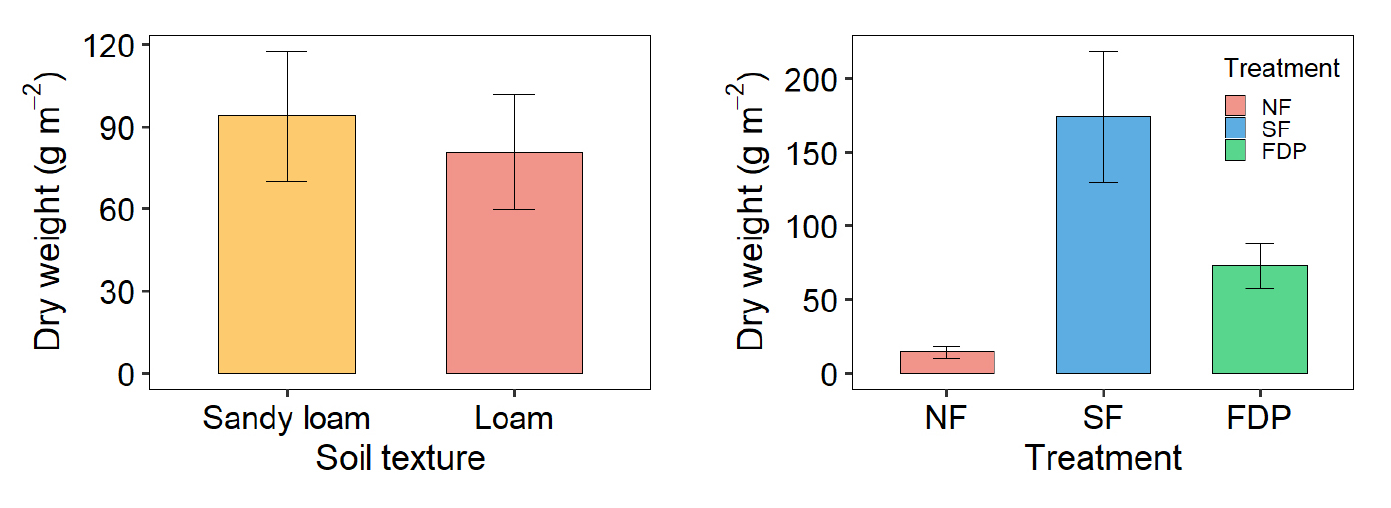
Surface broadcasting of fertilizer in upland maize often causes a temporary accumulation of plant-available nitrogen (N) near the soil surface, leading to weed emergence and potential N losses. This study evaluated the effects of fertilizer deep placement (FDP) on weed growth, soil inorganic N dynamics, and maize yield across soil textures under field conditions. The experiment was arranged in a factorial combination of soil texture (sandy loam and loam) and fertilizer placement (no fertilizer, surface application, and FDP). Surface application increased inorganic N concentration in the upper soil layers and stimulated weed growth, whereas FDP reduced weed density and biomass while maintaining grain yield comparable to surface fertilization. Weed community diversity decreased under FDP, particularly in loam, indicating a shift toward dominance by a few species. These results suggest that FDP simultaneously suppresses weeds and stabilizes maize yield, providing a practical nutrient management strategy to reduce N loss and improve resource use efficiency in upland maize systems.
Agenbag GA, Villiers OT. 2006. The effect of nitrogen fertilizers on the germination and seedling emergence of wild oat (Avena fatua L.) seed in different soil types. Weed Res. 29:239-245. https://doi.org/10.1111/j.1365-3180.1989.tb00908.x
10.1111/j.1365-3180.1989.tb00908.xBenvenuti S. 2003. Soil texture involvement in germination and emergence of buried weed seeds. Agron. J. 95: 191-198. https://doi.org/10.2134/agronj2003.1910
10.2134/agronj2003.1910Bhuiyan MSI, Rahman A, Loladze I, Das S, Kim PJ. 2023. Subsurface fertilization boosts crop yields and lowers greenhouse gas emissions: A global meta-analysis. Sci. Total Environ. 876: 162712. https://doi.org/10.1016/j.scitotenv.2023.162712
10.1016/j.scitotenv.2023.162712Blackshaw RE. 2004. Application method of nitrogen fertilizer affects weed growth and competition with winter wheat. Weed Biol. Manag. 4:103-113. https://doi.org/10.1111/j.1445-6664.2004.00126.x
10.1111/j.1445-6664.2004.00126.xChauhan BS, Abugho SB. 2013. Fertilizer placement affects weed growth and grain yield in dry-seeded rice (Oryza sativa L.) systems. Am. J. Plant Sci. 4:1260-1264. https://doi.org/10.4236/ajps.2013.46155
10.4236/ajps.2013.46155Chen G, Ren L, Wang J, Liu F, Liu G, Li H, Zhang P, Jia Z. 2024. Optimizing fertilization depth can promote sustainable development of dryland agriculture in the Loess Plateau region of China by improving crop production and reducing gas emissions. Plant Soil 499:73-89. https://doi.org/10.1007/s11104-022-05795-6
10.1007/s11104-022-05795-6Cui Y, Meng J, Wang Q, Zhang W, Cheng X, Chen W. 2017. Effects of straw and biochar addition on soil nitrogen, carbon, and super rice yield in cold waterlogged paddy soils of North China. J. Integr. Agric. 16:1064-1074. https://doi.org/10.1016/S2095-3119(16)61578-2
10.1016/S2095-3119(16)61578-2Deng B, Li Y, Wang L, et al. 2021. Feedstock particle size and pyrolysis temperature regulate effects of biochar on soil nitrous oxide and carbon dioxide emissions. Waste Manag. 120:33-40. https://doi.org/10.1016/j.wasman.2020.11.015
10.1016/j.wasman.2020.11.015Denney DA, Patel P, Anderson JT. 2024. Elevated [CO2] and temperature augment gas exchange and shift the fitness landscape in a montane forb. New Phytol. 243:58-71. https://doi.org/10.1111/nph.19765
10.1111/nph.19765Gao Y, Li T, Fu Q, Li H, Liu D, Ji Y, Li Q, Cai Y. 2020. Biochar application for the improvement of water-soil environments and carbon emissions under freeze-thaw conditions: An in-situ field trial. Sci. Total Environ. 723: 138007. https://doi.org/10.1016/j.scitotenv.2020.138007
10.1016/j.scitotenv.2020.138007Hong S, Lee M, Oh B, Lee C. 2025. Effect of fertilizer deep placement on reducing nitrogen fertilizer usage. Korean J. Environ. Agric. 44:29-36. https://doi.org/10.5338/KJEA.2025.44.04
10.5338/KJEA.2025.44.04Hong SC, Kim M, Kim J. 2023. Effect of fertilizer deep placement on rice and soybean yield using newly developed device for deep fertilization. Korean J. Environ. Agric. 42:44-51. https://doi.org/10.5338/KJEA.2023.42.1.07
10.5338/KJEA.2023.42.1.07IPCC. 2021. Summary for Policymakers. In: Climate Change 2021: The Physical Science Basis. Contribution of Working Group I to the Sixth Assessment Report of the Intergovernmental Panel on Climate Change. Cambridge University Press, UK. https://doi.org/10.1017/CBO9781139177245.003
10.1017/CBO9781139177245.003Jeong YJ, Lee JM, Lee M, Lee HS, Lee SI, Park HR. 2024. Changes in N2O emissions from agricultural water samples with storage time at low temperature measured with headspace methods. Korean J. Soil Sci. Fert. 57: 418-425. https://doi.org/10.7745/KJSSF.2024.57.4.418
10.7745/KJSSF.2024.57.4.418Kang YG, Kim JH, Lee JY, Choi J, Kim JH, Oh TK. 2025. Evaluation of the feasibility of fertilizer deep placement for N2O mitigation and soil fertility improvement in rice paddies of Chungnam provinces. Korean J. Soil Sci. Fert. 58:314-323. https://doi.org/10.7745/KJSSF.2025.58.3.314
10.7745/KJSSF.2025.58.3.314Ke J, Zhu B, Liu Y, et al. 2018. Combined controlled-released nitrogen fertilizers and deep placement effects on N leaching, rice yield and N recovery in machine-transplanted rice. Agric. Ecosyst. Environ. 265:402-412. https://doi.org/10.1016/j.agee.2018.06.023
10.1016/j.agee.2018.06.023KNA. 2025. Korea Plant Names Index. Korea National Arboretum. Available at: https://www.nature.go.kr/kpni/index.do (accessed on Sep. 1, 2025).
Kobayashi H, Oyanagi A. 2005. Digitaria ciliaris seed banks in untilled and tilled soybean fields. Weed Biol. Manag. 5:53-61. https://doi.org/10.1111/j.1445-6664.2005.00156.x
10.1111/j.1445-6664.2005.00156.xKwon YS, Chung N, Bae MJ, Li F, Chon TS, Kim MH, Na YE, Park YS. 2013. Evaluation of global warming effects on the geographical distribution of weeds in paddy fields by characterizing germination time and morphological factors. Ecol. Inform. 17:94-103. https://doi.org/10.1016/j.ecoinf.2013.06.007
10.1016/j.ecoinf.2013.06.007Lal R. 2020. Food security impacts of the “4 per Thousand” initiative. Geoderma 374:114427. https://doi.org/10.1016/j.geoderma.2020.114427
10.1016/j.geoderma.2020.114427Lee BM, Park KL, Lee Y, Cho JR, Lee SM, An NH, Choi HS, Jee HJ. 2012. Vertical distribution of weed seed in the soil as affected by tillage and no-till. Weed Turfgrass Sci. 1:1-5. https://doi.org/10.5660/WTS.2012.1.4.001
10.5660/WTS.2012.1.4.001Lee JM, Jun SM, Eo J, Lee B, Jung GB, Choi SK. 2024. Evaluation of nutrient losses of the furrow dike system during the cultivation of soybean (Glycine max L.) in paddy fields. Korean J. Soil Sci. Fert. 57:284-293. https://doi.org/10.7745/KJSSF.2024.57.4.284
10.7745/KJSSF.2024.57.4.284Li N, Ma X, Xu H, Feng Y, Ren G, Yang G, Han X, Wang X, Ren C. 2020. Biochar addition mitigates nitrogen loss induced by straw incorporation and nitrogen fertilizer application. Soil Use Manag. 36:751-765. https://doi.org/10.1111/sum.12642
10.1111/sum.12642Liu L, Shen G, Sun M, Cao X, Shang G, Chen P. 2014. Effect of biochar on nitrous oxide emission and its potential mechanisms. J. Air Waste Manag. Assoc. 64:894-902. https://doi.org/10.1080/10962247.2014.899937
10.1080/10962247.2014.899937Liu X, Tang Z, Zhang Q, Kong W. 2021. The contrasting effects of biochar and straw on N2O emissions in the maize season in intensively farmed soil. Environ. Sci. Pollut. Res. 28:29806-29819. https://doi.org/10.1007/s11356-021-12722-2
10.1007/s11356-021-12722-2Liu Y, Xin Y, Xie Y, Wang W. 2019. Effects of slope and rainfall intensity on runoff and soil erosion from furrow diking under simulated rainfall. Catena 177:92-100. https://doi.org/10.1016/j.catena.2019.02.004
10.1016/j.catena.2019.02.004NAAS (National Academy of Agricultural Science). 2015. Orchard Weed Field Guide (Gwasuwon Japcho Dogam). RDA, Wanju, Korea.
NAS (National Academy of Sciences). 2019. Fertilizer Application Recommendations for Crop Plants. 4th ed. RDA, Wanju, Korea.
Nguyen BT, Phan BT, Nguyen TX, Nguyen VN, Van Tran T, Bach QV. 2020. Contrastive nutrient leaching from two differently textured paddy soils as influenced by biochar addition. J. Soils Sediments 20:297-307. https://doi.org/10.1007/s11368-019-02366-8
10.1007/s11368-019-02366-8Nkebiwe PM, Weinmann M, Bar-Tal A, Müller T. 2016. Fertilizer placement to improve crop nutrient acquisition and yield: A review and meta-analysis. Field Crops Res. 196:389-401. https://doi.org/10.1016/j.fcr.2016.07.018
10.1016/j.fcr.2016.07.018Sánchez-Sabando CF, Sánchez-Urdaneta AB, Sánchez-Mora FD, Loor-Escobar GE, Olivares BO. 2024. Fertilization for growth or feeding the weeds? A deep dive into nitrogen’s role in rice dynamics in Ecuador. Life 14:1601. https://doi.org/10.3390/life14121601
10.3390/life1412160139768309PMC11676183Smith VH. 2003. Eutrophication of freshwater and coastal marine ecosystems: A global problem. Environ. Sci. Pollut. Res. 10:126-139. https://doi.org/10.1065/espr2002.12.142
10.1065/espr2002.12.142Souza RC, Dias AC, Figueiredo MRA, Obara FEB, Christoffoleti P. 2012. Growth of the crabgrass species Digitaria ciliaris and Digitaria nuda. Planta Daninha 30:317-325. https://doi.org/10.1590/S0100-83582012000200010
10.1590/S0100-83582012000200010Venkitaswamy R, Subramanian S, Veerabadran V. 1991. Influence of modified forms of urea and nitrogen levels on weed growth and grain yield of lowland rice. Fertil. Res. 28:315-321. https://doi.org/10.1007/BF01054332
10.1007/BF01054332Wang Y, Guo Q, Xu Y, Zhang P, Cai T, Jia Z. 2022. Optimizing urea deep placement to rainfall can maximize crop water-nitrogen productivity and decrease nitrate leaching in winter wheat. Agric. Water Manag. 274:107971. https://doi.org/10.1016/j.agwat.2022.107971
10.1016/j.agwat.2022.107971Wang Y, Guo Q, Xu Y, Zhang P, Cai T, Jia Z. 2023. Sustainable nitrogen placement depth under different rainfall levels can enhance crop productivity and maintain the nitrogen balance in winter wheat fields. Soil Tillage Res. 233:105817. https://doi.org/10.1016/j.still.2023.105817
10.1016/j.still.2023.105817Wu P, Liu F, Li H, Cai T, Zhang P, Jia Z. 2021. Suitable fertilizer application depth can increase nitrogen use efficiency and maize yield by reducing gaseous nitrogen losses. Sci. Total Environ. 781:146787. https://doi.org/10.1016/j.scitotenv.2021.146787
10.1016/j.scitotenv.2021.146787Zhang X, Gu L, Gui D, Xu B, Li R, Chen X, Sha Z, Pan X. 2024. Suitable biochar application practices simultaneously alleviate N2O and NH3 emissions from arable soils: A meta-analysis study. Environ. Res. 242: 117750. https://doi.org/10.1016/j.envres.2023.117750
10.1016/j.envres.2023.117750Zhang Y, Hu X, Zou J, Zhang D, Chen W, Liu Y, Chen Y, Wang X. 2018. Response of surface albedo and soil carbon dioxide fluxes to biochar amendment in farmland. J. Soils Sediments 18:1590-1601. https://doi.org/10.1007/s11368-017-1889-8
10.1007/s11368-017-1889-8Zhu C, Zeng Q, Ziska LH, Zhu J, Xie Z, Liu G. 2008. Effect of nitrogen supply on carbon dioxide-induced changes in competition between rice and barnyardgrass (Echinochloa crus-galli). Weed Sci. 56:66-71. https://doi.org/10.1614/WS-07-088.1
10.1614/WS-07-088.1Zhu L, Zhang X, Wang Y, et al. 2024. Optimizing crop yields while minimizing environmental impact through deep placement of nitrogen fertilizer. J. Integr. Agric. 24: 36-60. https://doi.org/10.1016/j.jia.2024.05.012
10.1016/j.jia.2024.05.012- Publisher :Korean Society of Soil Science and Fertilizer
- Publisher(Ko) :한국토양비료학회
- Journal Title :Korean Journal of Soil Science and Fertilizer
- Journal Title(Ko) :한국토양비료학회 학회지
- Volume : 58
- No :4
- Pages :536-548
- Received Date : 2025-09-26
- Revised Date : 2025-11-06
- Accepted Date : 2025-11-10
- DOI :https://doi.org/10.7745/KJSSF.2025.58.4.536
 Korean Journal of Soil Science and Fertilizer