
Original research article

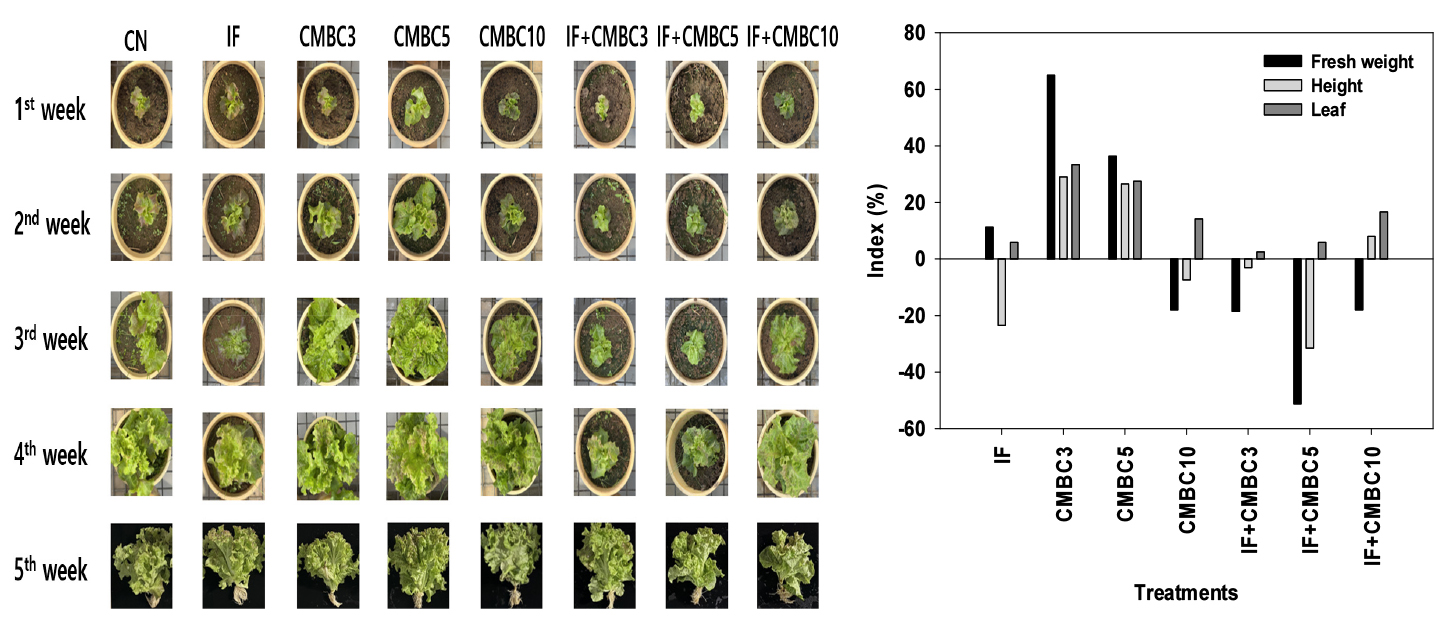
This study aimed to evaluate the effect of mixed biochar derived from chicken manure and woody biomass (CMBC) on lettuce (Lactuca sativa L.) growth and nutrients use efficiency. The CMBC was produced using chicken manure and woody biomass mixed at ratios (80:20). A pot experiment was conducted to investigate the effects of CMBC application on growth Characteristics and nutrient contents of lettuce and soil fertility. Treatments included CMBC at 3, 5, and 10 Mg ha-1 (CMBC3, CMBC5, and CMBC10), control (CN), inorganic fertilizer (IF) of N 200 kg ha-1, P 59 kg ha-1, K 128 kg ha-1, and combinations of CMBC and IF (IF+CMBC3, IF+CMBC5 and IF+CMBC10). The fresh weight, plant height, and leaf number of lettuce in CMBC3 were increased by 29.5 - 82.6%, 53.1 - 83.7%, and 75 - 95.6%, respectively than those other treatments. The total amounts of N, P, and K were also highest in CMBC3, indicating enhanced availability due to biochar application. Nutrients use efficiency including agronomic efficiency and apparent recovery fraction were also highest in CMBC3, while higher rates or combined treatments showed a decreasing trend. Soil chemical charateristics were increased in pH, EC, exchangeable cations, T-N and O.M with CMBC application, indicating improved soil fertility. These results suggest that low-rate application of CMBC (3 Mg ha-1) is effective as an organic fertilizer. Nevertheless, excessive application rates or the co-application of biochar with inorganic fertilizers may negatively affect nutrient use efficiency and crop performance, highlighting the need for further optimization of fertilization strategies.
Agegnehu G, Nelson PN, Bird MI. 2016. The effects of biochar, compost and their mixture and nitrogen fertilizer on yield and nitrogen use efficiency of barley grown on a Nitisol in the highlands of Ethiopia. Sci. Total Environ. 569:869-879. https://doi.org/10.1016/j.scitotenv.2016.05.033
10.1016/j.scitotenv.2016.05.033Andersen M, Gerard B. 2021. Climate mitigation co-benefits from sustainable nutrient management in agriculture: Incentives and opportunities, OECD Environment Working Papers, No. 186, OECD Publishing, Paris. https://doi.org/10.1787/a2960c54-en
10.1787/a2960c54-enAnyebe O, Sadiq FK, Manono BO, Matsika TA. 2025. Biochar Characteristics and Application: Effects on Soil Ecosystem Services and Nutrient Dynamics for Enhanced Crop Yields. Nitrogen. 6:31. https://doi.org/10.3390/nitrogen6020031
10.3390/nitrogen6020031Asai H, Samson BK, Stephan HM, Songyikhangsuthor K, Homma K, Kiyono Y, lnoue Y, Shiraiwa T, Horie T. 2009. Biochar amendment techniques for upland rice production in Northern Laos: 1. Soil physical properties, leaf SPAD and grain yield. Field Crops Res. 111:81-84. https://doi.org/10.1016/j.fcr.2008.10.008
10.1016/j.fcr.2008.10.008Beak UI, Kim DW, Chung EG, Na EH, Kim Y. 2023. Characteristics of Soil Heavy Metal Contamination in the Intensive livestock farming watersheds. Korean Soc. Environ. Eng. 45:257-287. https://doi.org/10.4491/KSEE.2023.45.7.275
10.4491/KSEE.2023.45.7.275Cao Y, Wang X, Bai Z, Chadwick D, Misselbrook T, Sommer SG, Qin W, Ma L. 2019. Mitigation of ammonia, nitrous oxide and methane emissions during solid waste composting with different additives: A meta- analysis. J. Clean. Prod. 235:626-635. https://doi.org/10.1016/j.jclepro.2019.06.288.
10.1016/j.jclepro.2019.06.288Chang KW, Cho SH, Kwak JH. 1999. Changes of Soil Physico-chemical Properties by Repeated Application of Chicken and Pig Manure Compost. J of KOWEREC. 7:23-30.
Cho JY, Yoon YE, Choe H, Godagedara LT, Lee KA, Kim SC, Kim YN, Lee, YB. 2024. Influences of continuous wood-derived biochar application on soil chemical properties and lettuce (Lactuca sativa L.) yield. Korean J. Soil Sci. 57:96-105. https://doi.org/10.7745/KJSSF.2024.57.2.096
10.7745/KJSSF.2024.57.2.096Cho S, Kim J, Lee E, Moon j and Eom H. 2022. Protein consumption market trends in Korea: focusing on meat, fishery, and plant-based protein foods. Korean J Soc. Food Culture. 37:213-238. https://doi.org/10.7318/kjfc/2022.37.3.213
10.7318/kjfc/2022.37.3.213Hong SC, Yu SY, Kim KS, Lee GH, Song SN. 2020. Effects of biochar on early growth and nutrient content of vegetable seedlings. Korean J. Environ. Agric. 39:50-57 https://doi.org/10.5338/KJEA.2020.39.1.7
10.5338/KJEA.2020.39.1.7Ippolito JA, Cui L, Kammann C, MÖnnig NW, Estavillo JM, mendizabal TF, Cayuela LM, Sigua G, Novak J, Spokas K, Bochard N. 2020. Feedstock choice, pyrolysis temperature and type influence biochar characteristics: a comprehensive meta-data analysis review. Biochar 2:421-438 https://doi.org/10.1007/s42773-020-00067-x
10.1007/s42773-020-00067-xJang JE, Lim SH, Shin MW, Moon JY, Nam JH, Lim GJ. 2023 Effects of applied biochar derived from spent oyster mushroom (Pleurotus ostreatus) substrate to soil physico-chemical properties and crop growth responses. J. Korea Org. Resour. Recycl. Assoc. 31:73-82. https://doi.org/10.17137/korrae.2023.31.3.73
10.17137/korrae.2023.31.3.73Jeffery S, Verheijen FG, Van de Velde M, Bastos AC. 2011. A quantitative review of the effects of biochar application to soils on crop productivity using meta- analysis. Agric. Ecosyst. Environ. 144:175-187. https://doi.org/10.1016/j.agee.2011.08.015.
10.1016/j.agee.2011.08.015Jeong SH, Lim JE, Lee ss, Chang YY, Moon DH, Ok YS. 2013. Evaluation on Remediation Efficiency on Acid-Spilled Soil using Oyster Shell and Biochar. J. Agric. Life Environ. Sci. 25:10-16.
Jeong SS, Park BJ, Yoon JH, Lee SP, Yang JE, Kim HS. 2023. Effects of additives on greenhouse gas emission during organic waste composting: a review and data analysis. Korean J. Environ Agric. 42:358-370. https://doi.org/10.5338/KJEA.2023.42.4.41
10.5338/KJEA.2023.42.4.41Jo WY, Lee SB, Park HJ, Kim GW, Kim TY. 2023. An analysis of consumer’s willingness to pay for the improvement of agricultural land’s nutrition balance. Korean J. Org. Agric. 31:167-189. https://doi.org/10.11625/KJOA.2023.31.3.167
10.11625/KJOA.2023.31.3.167Joseph S, Pow D, Dawson K, Rust J, Munroe P, Taherymossavi S, Mitchell D, Robb S, Solaiman Z. 2020. Biochar increases soil organic carbon, avocado yields and economicreturn over 4 years of cultivation. Sci. Total Environ. 724:138-153. https://doi.org/10.1016/j.scitotenv.2020.138153
10.1016/j.scitotenv.2020.138153Kang SW, Cheong YH, Yun JJ, Park JH, Park, JH, Seo DC, Cho JS. 2021. Effect of biochar application on nitrogen use efficiency for sustainable and productive agriculture under different field crops. J. Plant Nutr. 44:2849-2862. https://doi.org/10.1080/01904167.2021.1921200
10.1080/01904167.2021.1921200Kim MS, Kim SC, Park SJ, Lee CH. 2018. Analysis of Commercial Organic Compost Manufactured with Livestock Manure. J. Korea Org. Resour. Recycl. Assoc. 26:21-29. https://doi.org/10.17137/korrae.2018.26.4.21
10.17137/korrae.2018.26.4.21Kim SH, Lee SG, Yun JJ, Park JH, Kang SW, Cho JS. 2022. Effect of Saline Soil and Crop Growth with Bottom Ash from Biomass Power Plant Based Wood Pellet. Korean J. Environ. Agric. 41:310-317. https://doi.org/10.5338/KJEA.2022.41.4.36
10.5338/KJEA.2022.41.4.36Kumar A, Joseph S, Tsechansky L, Privat K, Schreiter IJ, Schüth C, Graber ER. 2018. Biochar aging in contaminated soil promotes Zn immobilization due to changes in biochar surface structural and chemical properties. Sci. Total Environ. 626: 953-961. https://doi.org/10.1016/j.scitotenv.2018.01.157
10.1016/j.scitotenv.2018.01.157Lee I, Cho HN, Park JH, Kang SW. 2024. Effect of bed soil using livestock manure biochar on initial growth of Kimchi cabbage. Korean J. Soil Sci. Fert. 57:403-410. https://doi.org/10.7745/KJSSF.2024.57.4.403
10.7745/KJSSF.2024.57.4.403Lee SI, Kang SS, Choi EJ, Gwon HS, Lee HS, Lee JM and Choi WJ. 2021. Soil carbon storage in upland soils by biochar application in East Asia. Korean J. Environ Agric. 40:219-230. https://doi.org/10.5338/KJEA.2021.40.3.26
10.5338/KJEA.2021.40.3.26Lee SI, Kim GY, Choi EJ, Lee JS, Gwon HS, Shin JD. 2020. Effect of Biochar Application on Nitrous Oxide Emission in the Soil with Different Types of Nitrogen Fertilizer During Corn (Zea may) Cultivation. Korean J. Environ Agric. 39:297-304. https://doi.org/10.5338/KJEA.2020.39.4.35
10.5338/KJEA.2020.39.4.35Lee SI, Lee JS, Kim GY, Choi EJ, Suh SU, Na US. 2016. Effect of Carbonized Biomass Derived from Pruning on Soil Carbon Pools in Pear Orchard. Korean J. Environ. Agric. 35:159-165. http://dx.doi.org/10.5338/KJEA.2016.35.3.26
10.5338/KJEA.2016.35.3.26Lehmann J, Da Silva Jr JP, Rondon M, Steiner C, Nehls T, Zech W, Glaser B. 2002. Nutrient availability and leaching in an archaeological Anthorosol and a Ferralsol of the Central Amazon basin: fertilizer, manure and charcoal amendments. Plant Soil. 249:343-357. https://doi.org/10.1023/A:1022833116184
10.1023/A:1022833116184Mosa A, Mansour MM, Soliman E, El-Ghamry A, El Alfy M, El Kenawy AM. 2023. Biochar as a soil amendment for restraining greenhouse gases emission and improving soil carbon sink: current situation and ways forward. sustainability. 15:1206. https://doi.org/10.3390/su15021206
10.3390/su15021206NAS (National Institute of Agricultural Science). 2019. Fertilizer application recommendations for crops. RDA, Wanju, Korea.
NIAST (National Institute of Agricultural Science and Technology). 2000. Methods of soil and plant analysis. RDA, Suwon, Korea.
Nugrahaeningtyas E, Jeong SH, Novianty E, Ataallahi M, Park GW, Park KH. 2023. Measurement of greenhouse gas emissions from a dairy cattle barn in Korea. J Anim Sci Technol. 65:459-472. https://doi.org/10.5187/jast.2023.e25
10.5187/jast.2023.e2537093900PMC10119453Oh TK, Lee JH, Kim SH, Lee HC. 2017. Effect of biochar application on growth of Chinese cabbage (Brassica chinensis). Korean J. Agric. Sci. 44:359-365. https://doi.org/10.7744/kjoas.20170039
10.7744/kjoas.20170039Oh TK, Shinogi Y, Lee SJ, Choi B. 2014. Utilization of biochar impregnated with anaerobically digested slurry asslow-release fertilizer. J. Plant Nutr. Soil Sci. 117:97-103. https://doi.org/10.1002/jpln.201200487
10.1002/jpln.201200487Park DG, Hong SG, Jung E, Shin JD. 2019. Assessment of an optimum biochar application rate for tomato (Solanum lycopersicum L.) cultivation. J. Korea Org. Resour. Recycl. Assoc. 27:39-48. https://doi.org/10.17137/korrae.2019.27.1.39
10.17137/korrae.2019.27.1.39Park JH, Cho HN, Lee IH, Kang SW. 2024. Effect of cow manure biochar on lettuce growth and nitrogen agronomy efficiency. Plants. 13:3326. https://doi.org/10.3390/plants13233326
10.3390/plants1323332639683119PMC11644183Park JH, Kim DW, Kang SW, Cho JS. 2023. Effect of continuous biochar use on soil chemical properties and greenhouse gas emissions in greenhouse cultivation. Korean J. Environ. Agric. 42:435-443. https://doi.org/10.5338/KJEA.2023.42.4.49
10.5338/KJEA.2023.42.4.49Rathinapriya P, Maharajan T, Jothi R, Prabakaran M, Lee IB, Yi PH, Jeong, S T. 2025. Unlocking biochar impacts on abiotic stress dynamics: a systematic review of soil quality and crop improvement. Front. Plant Sci. 15:1479925. https://doi.org/10.3389/fpls.2024.1479925
10.3389/fpls.2024.147992539872204PMC11770001Saifullah, Dahlawi S, Naeem A, Rengel Z, Naidu R. 2018. Biochar application for the remediation of salt-affected soils: Challenges and opportunities. Sci. Total Environ. 625: 320-335. https://doi.org/10.1016/j.scitotenv.2017.12.257
10.1016/j.scitotenv.2017.12.257Seo D, Jo S, Rahul K, Jang H, Park J. 2025. Advanced strategy for greenhouse gas reduction in the domestic livestock sector. Korean J. Environ. Agric. Eng. 47:110-118. https://doi.org/10.4491/KSEE.2025.47.2.110
10.4491/KSEE.2025.47.2.110Shin JH, Kang YG, Lee JY, Kim JH, Oh TK. 2024. Effect of poultry manure biochar on soil nutrition and carbon improvement in Saemangeum reclaimed soils. Korean J. Agric. Sci. 51:643-654. https://doi.org/10.7744/kjoas.510418
10.7744/kjoas.510418Song IO, Song D. 2019. CBDR and climate technology transfer to cope with climate change. JHLR. 20:419-454. http://dx.doi.org/10.16960/jhlr.20.2.201906.419
10.16960/jhlr.20.2.201906.419Sorensen RB, Lamb MC. 2016. Crop yield response to increasing biochar rates. J. Crop Improv. 30:703-712. https://doi.org/10.1080/15427528.2016.1231728
10.1080/15427528.2016.1231728Wang D, Xu Z, Zhao J, Wang Y, Yu, Z. 2011. Excessive nitrogen application decreases grain yield and increases nitrogen loss in a wheat–soil system. Acta Agriculturae Scandinavica, Section B-Soil & Plant Science. 61: 681-692. https://doi.org/10.1080/09064710.2010.534108
10.1080/09064710.2010.534108Yoon JH. 2013. Use of wood waste biochar from roadside trees. Master’s thesis, University of Seoul, Seoul, Korea.
Zhang B, Liu C, Li Q, Ye J, Lin Y, Wang Y, Burton DL. 2025. Evaluating the effect of biochar rate and combination with fertilizer on the dynamics of soil nitrogen supply in tea plantation. Scientific Reports. 15:3135. https://doi.org/10.1038/s41598-025-87942-4
10.1038/s41598-025-87942-439856316PMC11759679Zhu K, Fu H, Zhang J, Lv X, Tang J, Xu X. 2012. Studies on removal of NH4+-N from aqueous solution by using the activated carbons derived from rice husk. Biomass Bioenergy. 43:18-25. https://doi.org/10.1016/j.biombioe.2012.04.005
10.1016/j.biombioe.2012.04.005- Publisher :Korean Society of Soil Science and Fertilizer
- Publisher(Ko) :한국토양비료학회
- Journal Title :Korean Journal of Soil Science and Fertilizer
- Journal Title(Ko) :한국토양비료학회 학회지
- Volume : 58
- No :4
- Pages :442-454
- Received Date : 2025-07-29
- Revised Date : 2025-08-25
- Accepted Date : 2025-09-26
- DOI :https://doi.org/10.7745/KJSSF.2025.58.4.442
 Korean Journal of Soil Science and Fertilizer